Tuesday, September 14, 2021

SpaceX - Starlink V1.5 Group 2-1 - Sep. 14, 2021

  SpaceX Falcon 9 Block 5 - Starlink V1.5 Group 2-1 - Launching September 14, 2021
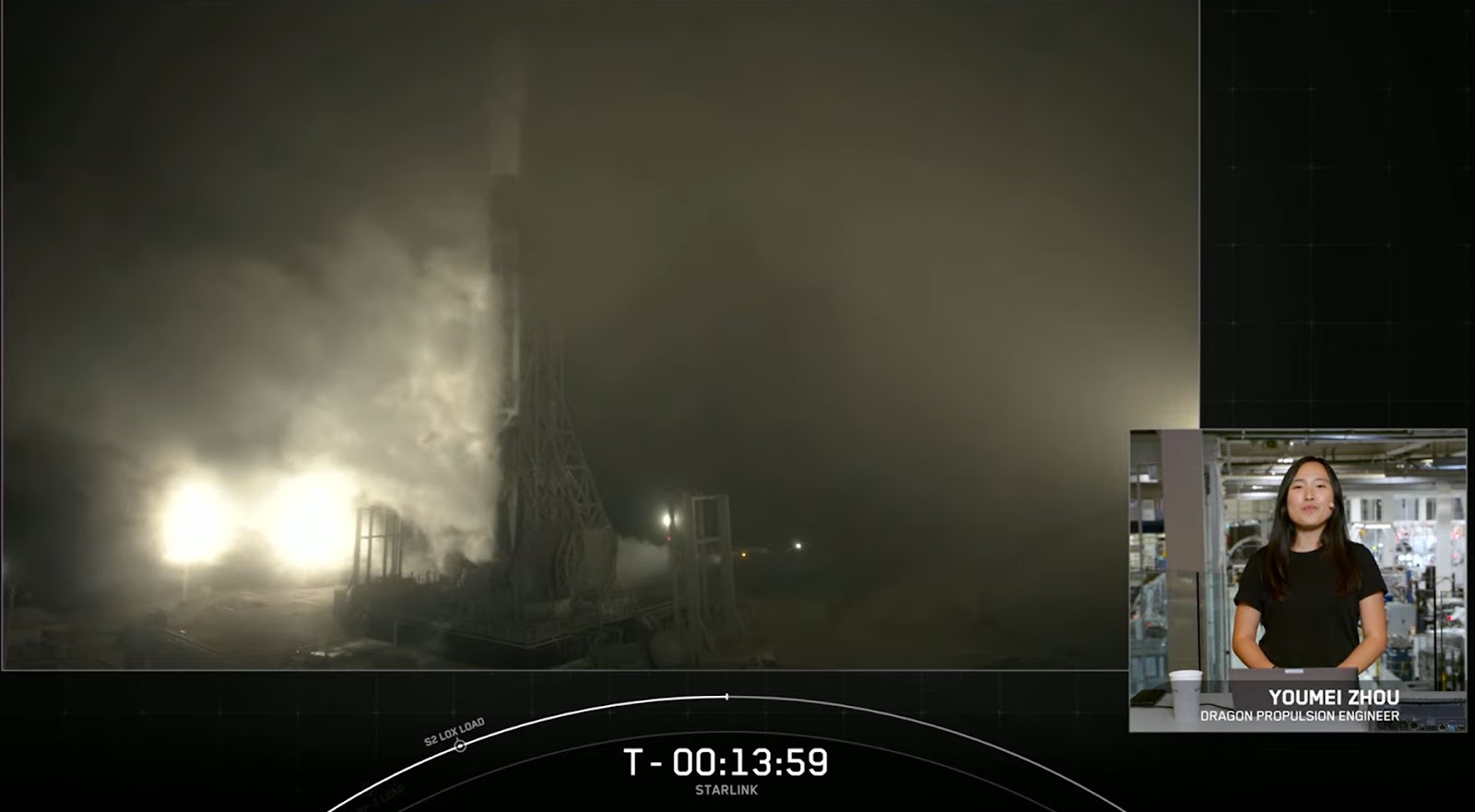
Screenshot from SpaceX Webcast of the launch of Starlink V1.5 Group 2-1

Mission Rundown: SpaceX B5 - Starlink V1.5 Grp. 2-1

Written: July 17, 2022

Lift Off Time

September 14, 2021 - 03:55:50 UTC

September 13, 2021 - 20:55:50 PDT

Mission Name

Starlink V1.5 Group 2-1

Launch Provider

SpaceX

Customer

SpaceX

Rocket

Falcon 9 Block 5 serial number B1049-10

Launch Location

Space Launch Complex 4 East - SLC-4E

Vandenberg Air Force Base, California

Payload

51 Starlink V1.5 Satellites x 306 kg

Payload mass

15 300 kg ~ 33 400 pounds

Where are the satellites going?

Low Earth Orbit - 212 km x 343 km x 70.01° - After testing to Starlink Shell 2’s operational orbit - 570 km

Will they be attempting to recover the first stage?

Yes - OCISLY were towed south from Long Beach

Where will the first stage land?

OCISLY is located 640 km downrange

Will they be attempting to recover the fairings?

Yes - NRC Quest will recover both fairings from the water ~ 665 km downrange

Are these fairings new?

No - The pair both flew on 3 different missions - It’s the second and third fairing launch respectable

This will be the:

– 125th flight of all Falcon 9 rockets

– 68th re-flight of all Falcon 9 boosters

– 69th flight of Falcon 9 Block 5 rocket

– 54th re-flight of Falcon 9 Block 5 booster

– 1st launch to Starlink Shell 2

– 17th SpaceX launch from SLC-4E

– 90th booster landing overall 

– 22nd mission for SpaceX in 2021

Where to watch

Where to read more

SpaceX YouTube link

Want to know more link ask Tim Dodd


Launch debriefing

(This is what happend)

T -00:14:17

Host:

T   00:00:00

T +00:01:14

T +00:02:37

T +00:02:47

T +00:03:08

T +00:04:33

T +00:06:51

T +00:08:30

T +00:08:59

T +00:15:39

T +00:19:49

T +00:26:00

T +00:27:02

T +00:00:00

SpaceX video feed at 04:17

Youmei Zhou filled in the foggy picture

Liftoff at 18:35 - Starlink Shell 2 are being filled

MaxQ at 19:48

MECO 21:11, stage separation 21:14

SES-1 at 21:21

Fairing separation at 21:42

1st stage apogee at 23:17 - 6 815 km/h at 133 km

Entry burn 25:26 by 3 Merlin 1D# for 20 seconds

Landing burn 27:04 by 1 Merlin 1D# for 20 seconds

SECO-1 at 27:34 in an direct orbit - All unseen

Deployment of 2-1 at 34:13 - 04:11:26.880 UTC

SpaceX resumes live feed at 38:23 - Apology

SpaceX resumes live feed at 44:35 - Confirmed

Rap up from SpaceX at 44:37

Both fairings recovered from the ocean


Let’s fill Starlink Shell Two too?

SpaceX’s Starlink Group 2-1 mission successfully launched 51 Starlink satellites atop its Falcon 9 rocket. The Falcon 9 lifted off from Space Launch Complex 4E (SLC-4E), at the Vandenberg Space Force Base, in California, United States. Starlink Group 2-1 marked the 29th operational Starlink mission, boosting the total number of Starlink satellites launched to 1,788. This mission also marked the first launch of the second or is it the third Starlink shell. There is some confusion about the inclination of 70 degrees.

It’s launching Wednesday September 14 , 2021 at 03:55 UTC, from Space Launch Complex 4E (SLC-4E) at Cape Canaveral Space Force Station, Florida. Starlink V1.5 Group 2-1 first stage booster B1049-10 will land on ‘OCISLY’ - Of Course I Still Love You around eight minutes after liftoff.

After boosting the second stage along with its payload towards orbit, the first stage will perform a re-entry burn to slow the vehicle down in preparation for atmospheric reentry. The booster will then perform a 20 second landing burn aboard SpaceX’s autonomous spaceport drone ship.

SpaceX will also recover both fairing halves, with NRC Quest having recently joined fairing recovery operations in the Pacific Ocean.

B1049-10 will have made its tenth flight after launching the following missions:

Telstar 18V

September 10, 2018

Starlink V1.0 L10

August 18, 2020

Iridium NEXT-8

January 11, 2019

Starlink V1.0 L15

November 25, 2020

Starlink V0.9 L0

May 24, 2019

Starlink V1.0 L17

March 4, 2021

Starlink V1.0 L2

January 7, 2020

Starlink V1.0 L25

May 4, 2021

Starlink V1.0 L7

June 4, 2020

Starlink V1.5 2-1

September 13, 2021

B1049-10 did perform a static fire test at 19:29 September 2, 2021 after waiting for a west coast launch out of Vandenberg. SpaceX has since Starlink V1.0 L08 omitted this safety precaution fifteen times so far. It is not required to perform a static fire test inhouse missions like Starlink, that was to save money and time before the launch. 

SpaceX is the first entity ever that recovers and reflyes its fairings. After being jettisoned, the two fairing halves will use cold gas thrusters to orientate themselves as they descend through the atmosphere. Once at a lower altitude, they will deploy drogue chutes and parafoils to help them glide down to a soft landing for recovery.

The fairings are a used pair from three different missions. The active fairing half flew on one mission, NROL-108. The passive half have flown on two missions, GPS III-3 and Turksat-5A. Both fairings survived the landing. Active fairings are equipped with four pushrods to separate the two fairings.

Fairings have evenly spaced venting ports that have been redesigned a number of times by having first ten, then eight and now having their venting ports built as close pairs along the fairing edge. This prevents saltwater from the ocean from flooding and sinking the fairing, and makes refurbishment toward the next flight easier.

The Payload

SpaceX plans to offer “better than nothing” service in North America by the end of 2020 and estimates that once complete, its venture will make $30-50 billion annually. The funds from which will, in turn, be used to finance its ambitious Mars program.

To achieve initial coverage, SpaceX plans to form a net of 12,000 satellites, which will operate in conjunction with ground stations, akin to a mesh network.

Furthermore, the company recently filed for FCC permission on an additional 30,000 spacecraft, which, if granted, could see the constellation amount to a lucrative 42,000. This would octuple the number of operational satellites in earth orbit, further raising concerns about the constellations' effect on the night sky and earth-based astronomy.

For more information on Starlink, watch the Real Engineering video listed below.

Each Starlink V1.0 satellite is a compact design that used to weigh 260 kg. SpaceX developed them to be a flat-panel design to fit as many satellites as possible within the Falcon 9’s 5.2 meter wide payload fairing. 60 satellites were fitted into a dispenser affixed to the second stage.

Each Starlink V1.5 satellite still has a compact design and now has a mass of 306 kg with room for only 51 Starlink V1.5 satellites. The Starlink V1.5 satellites being launched are equipped with an inter-satellite laser communication system. This allows the satellites to communicate directly with each other, eliminating the need for costly ground stations.

The entire Starlink payload weighs around 15,600 kg. That’s near the limit that a Falcon 9 can lift into LEO and still have enough propellant for landing.

Starlink also features a SpaceX built and designed star track navigation system to enable precision placement of broadband throughput.

Four inter-satellite laser links (ISLLs) allow high-speed communication between Starlink satellites. SpaceX placed two ISLLs on the front and rear of the satellite to talk with Starlink satellites in the same orbital plane. They remain fixed in position. Two ISLLs on the satellite’s sides track other Starlink satellites in different orbital planes. This means they have to move to track the other satellites.

Starlink Orbit Plans

The first 29 launches of one testbed Starlink mission and 28 operational Starlink missions V0.9 L0 - V1.0 L01 - L28 brought the number of launched Starlink satellites to 1665. How many that still work’s, or are in orbit, are mentioned in this old article.

All Starlink payload batches in launch order: L1 L2 L3 etc. including launch L28.

5 x 60 = 300 293 300 300 300 52 60 60 = 1665 Starlink V1.0 satellites launched.

On board the Starlink L28 flight were 60 of SpaceX’s Starlink internet satellites, which will now join the 1613 V1.0 satellites already in orbit. Of the v1.0 satellites that have been launched prior to this launch, six have either destructively reentered, as designed, or after encountering issues after launch, leaving 1659 operational Starlink V1.0 satellites.

Spreading the wings of individual Starlink satellites in their orbit tracks - Graphic by Ben Craddock

Of the 60 v0.9 satellites launched in 2019, 46 have reentered by now to date, 6 are still under some control with the remaining 8 either actively deorbiting or naturally decaying. The Tintin and v0.9 satellites will not be in the operational Starlink satellite constellation. These pre-satellites lack the communications payload needed for full operation.

SpaceX will assign 18-20 Satellite Vehicles to each of three adjacent orbital planes. Orbital planes are to satellites as tracks are to trains – they are orbits parallel to each other designed to maximize area coverage while minimizing the number of satellites required.

Since early-December 2020, SpaceX has been altering the spacing of the satellites already on orbit.  It appears the company is arranging many of the planes to have 18 active satellites instead of 20, which would fill some small gaps and free up some satellites to act as spares. There will eventually be 72 planes of 22 satellites each in the initial shell of the Starlink constellation.

Look for an Animation by Ben Craddock for NASASpaceflight showing the movements of Starlink satellites into their orbital planes since August 1, 2020. The satellites from each launch split into three groups that each formed a plane.
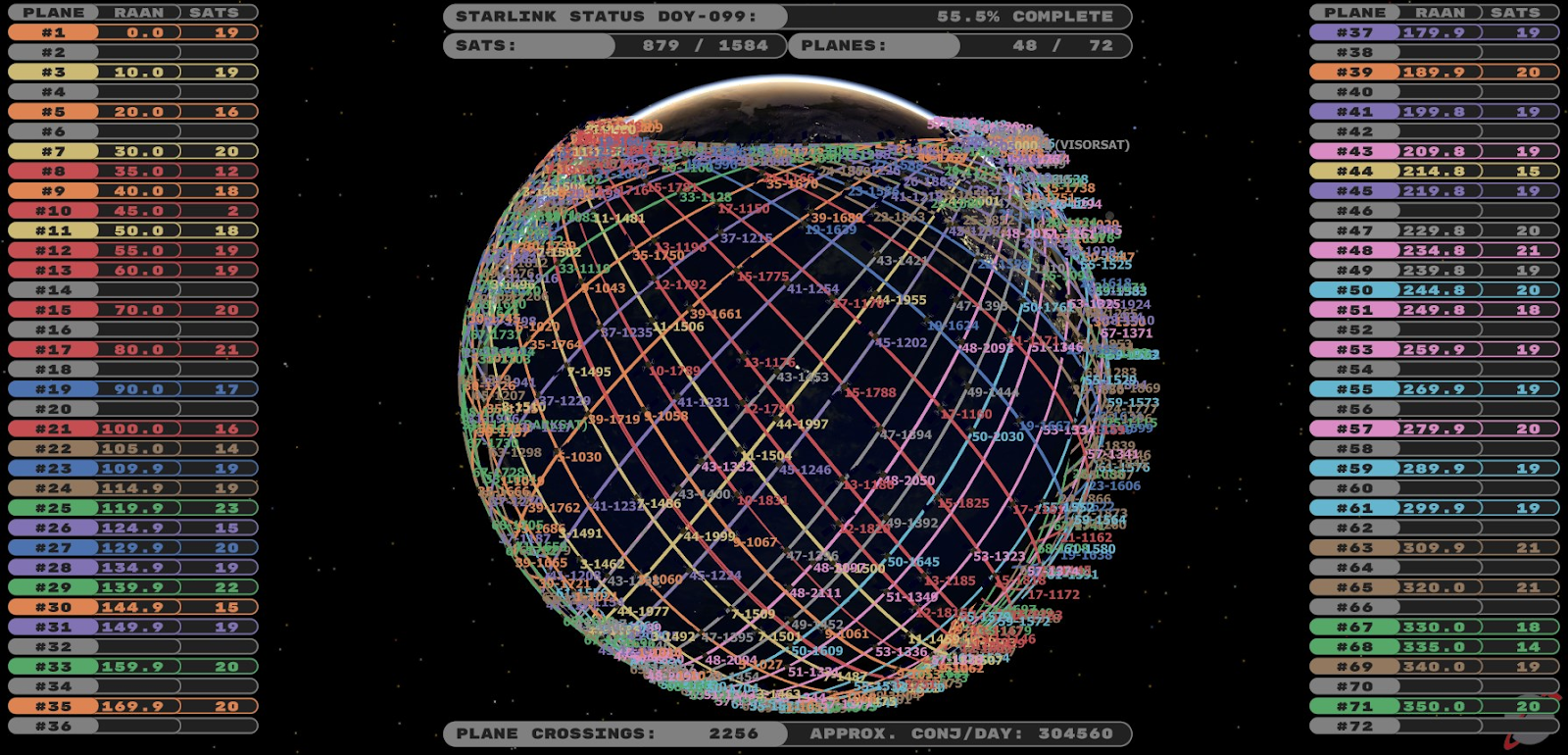
Just a little peak in the current Starlink orbit mesh, it’s still a work in progress - small gabs does it

SpaceX plans to begin offering Starlink service to Canada and the northern United States later this year. Near global coverage is expected to start next year. Pricing has not been made public, but it has been hinted that speeds up to one gigabit may be possible.

Having now filled 18 evenly spaced planes in the constellation, SpaceX should be attaining continuous coverage in the northern U.S. and southern Canada areas where they intend to launch the Starlink service. SpaceX are now working on filling up to 72 evenly spaced planes in the constellation.

Starlink Phase 1 Orbital Shells

The first orbital shell of Starlink satellites will consist of 1,584 satellites in a 53° 550 km low-Earth orbit. This is the shell that SpaceX is currently filling, and it is expected that this shell will be complete by June 2021. Once complete, the first shell will provide coverage between roughly 52° and -52° latitude (~80% of the Earth’s surface), and will not feature laser links until replacement satellites will launch after 2021.

Completed - The surviving operational Starlink V1.0 are now using a few months to reach operational orbits in 72 planes with 22 Satellite Vehicles in each plus spares. This shell is currently near completion, with occasional satellites being replaced.

Starlink's second shell will host 720 satellites in a 70° 570 km orbit. These satellites will significantly increase the coverage area, which will make the Starlink constellation cover around 94% of the globe. SpaceX will put 20 satellites in each of the 36 planes in the second shell. This shell is currently being filled with 51 Starlink V1.5 satellites.

The third shell will consist of 348 satellites in a 97.6° 560 km orbit. SpaceX deployed 10 laser link test satellites into this orbit on their Transporter-1 mission to test satellites in a polar orbit. SpaceX launched an additional three satellites to this shell on the Transporter-2 mission. All satellites that will be deployed into this orbit will have inter-satellite laser link communication. Shell four will have six orbital planes with 58 satellites in each plane.

The fourth shell will consist of 1,584 satellites in a 540 km 53.2° LEO. This updated orbital configuration will slightly increase coverage area and will drastically increase the bandwidth of the constellation. This shell will also consist of 72 orbital planes with 22 satellites in each plane. This shell is currently being filled alongside shell two.

The fifth and final shell of phase 1 of Starlink will host 172 satellites in another 97.6° 560 km low-Earth polar orbit. Shell 5 will also consist purely of satellites with laser communication links; however unlike shell four it will consist of 4 orbital planes with 43 satellites in each plane.

Ion Drive with Krypton gas

Innovative ion propulsion technology keeps these satellites in the correct position while on orbit. They use ion Hall-effect thrusters to achieve their working orbit. Each Starlink satellite incorporates an autonomous collision avoidance system. It uses the Department of Defence’s debris tracking data to avoid colliding with space debris or other satellites.

Starlink’s low altitude also allows SpaceX to easily deorbit malfunctioning satellites, even if their engines fail. Although 100 km is commonly described as the upper limit of Earth’s atmosphere, there is no “hard barrier”. Even at 550 km altitude, there is still a slight amount of atmospheric drag pulling the satellites down. Each satellite’s onboard ion Hall-effect thruster engine is powerful enough to keep it in orbit, but if the engine fails, it will fall back to Earth within about a year. Read about the Hall-effect thruster engine here.

The miniscule atmospheric drag in low Earth orbit will help ensure that dead satellites don’t stay in orbit for long. This will help reduce the amount of space debris in orbit, which is rapidly becoming a major concern.

Starlink Satellite Constellation

Constellations use multiple satellites working in conjunction for a common purpose. SpaceX plans eventually to form a network of about 12,000 satellites. They will operate roughly 4,400 satellites using Ku- and Ka-band radio spectrum, and almost another 7,500 satellites in the V-band.

To achieve initial coverage, Starlink will use 72 orbital planes, angled at 53 degrees from the Earth’s equator at an altitude of 550 km. They will put 22 satellites into each of these orbital planes, totaling 1,584 satellites. They will communicate with other Starlink satellites and with ground stations, akin to a mesh network.

In late 2019, the company asked the American Federal Communications Commission (FCC) for permission to launch an additional 30,000 satellites into orbits ranging from 328 km to 580 km in altitude. If the FCC okays the request, the constellation could grow to 42,000 satellites. This would increase the number of operational satellites in Earth orbit by at least a factor of 20 from pre-2019 levels.

The constellation’s large numbers are raising concerns regarding their effect on the night sky and Earth-based astronomy. However, Elon Musk stated that he is confident that SpaceX can mitigate light pollution issues and is working with industry experts to minimize the potential for any impact. Future Starlink satellites will use a sunshade that is a patio-like umbrella to reduce light reflectivity.

As was the case with a single Starlink satellite on the V1.0 L7 mission (launched on June 4), all Starlink satellites that will launch on subsequent missions “L8 - L28” going forward will feature a sun shade or visor, which will assist in blocking sunlight from reflecting off the majority of the spacecraft body while in orbit and reducing its overall albedo/intrinsic brightness as observed from the ground.

Starlink ground antennas

Prototypes of the Starlink user terminal antenna have been spotted alongside the other antennas at Starlink gateway locations in Boca Chica, Texas and Merrillan, Wisconsin.  These user terminals will be crucial to the success of the Starlink network.

SpaceX board member Steve Jurvetson recently tweeted that the company’s board had an opportunity to try out the user terminals at the company headquarters in Hawthorne.  The devices use a Power over Ethernet (PoE) cable for their power and data connection.  The antenna connects to a SpaceX branded router with Wi-Fi (802.a/b/g/n/ac, transmitting at 2.4 & 5GHz).  SpaceX is producing the antenna assemblies in-house while outsourcing production of the more common router component.

SpaceX continues to make progress setting up its network of gateways for the Starlink system. New gateways are being added in countries all over the world and will connect giant data servers to users through Starlink.

As of now, only higher latitudes are covered (between 44 and 52 degrees according to one source). However, SpaceX only needs 24 launches for global coverage. Given SpaceX’s current Starlink production and launch rate, Starlink will have global coverage by the middle of 2021.

The third shell will, when operational, provide service almost all over the world because Starlink V1.5 satellites will be visible from the north pole just over the horizon with a 70 degree inclination orbit at a 570 km altitude.

SpaceX is currently offering a beta version of the Starlink internet service, jokingly named the “Better Than Nothing Beta”. Users pay $500 for the Starlink terminal and router and then $99 per month for the service.

Invitations to participate in the beta were sent out to people who signed up through the official Starlink website and live in parts of the northern United States, southern Canada, and very recently the United Kingdom.

The results so far have been very promising, with SpaceX reporting speeds of 100mbps with 20-40ms latency, well below geostationary satellite latency. Many users have reported speed tests even higher than 100mbps.

Author Trevor Sesnic link

Coauthor/Text Retriever Johnny Nielsen

link to launch list


Sunday, August 29, 2021

SpaceX - CRS-23

  SpaceX Falcon 9 Block 5 - CRS-23 SpX-23 - Launching August 29, 2021

Screenshot from NASA/SpaceX shared Webcast of the CRS-23

Mission Rundown: SpaceX Falcon 9 Block 5 - CRS-23

Written: August 30, 2021

Lift Off Time

August 29, 2020 - 07:14:49 UTC - 03:14:49 EST

Mission Name

Dragon CRS-2 SpX-23 - CRS-23

Launch Provider

SpaceX

Customer

NASA

Rocket

Falcon 9 Block 5 serial number B1061-4

Launch Location

Historic Launch Complex 39A - LC-39A

Kennedy Space Center, Florida

Payload

Cargo Dragon 2 serial number C208-2

Payload mass

2 200 kg ~ 4 800 pounds

Where did the Dragon go?

Low Earth Orbit to the International Space Station

Will they be attempting to recover the first stage?

ASOG were towed northeast 300 km downrange

Where will the first stage land?

A Shortfall Of Gravitas - On its ‘maiden’ landing zone

Will they be attempting to recover the fairings?

The Cargo/Crew Dragon 2 are not enclosed in fairings

This will be the:

– 124th flight of all Falcon 9 rockets

– 67th re-flight of all Falcon 9 boosters

– 68th flight of Falcon 9 Block 5 rocket

– 53rd re-flight of Falcon 9 Block 5 booster 

– 1st booster landing on Marmac 302 - ASOG

– 37th SpaceX launch from LC-39A

– 89th booster landing overall

– 21st mission for SpaceX in 2021

Where to watch

Where to read more

SpaceX YouTube link

Want to know more link ask Tim Dodd


Launch debriefing

(This is what happens)

Guess:

T-03:55:00

T-01:15:00

T-00:45:00

T-00:35:00

T-00:14:11

Hosts:

-

T 00:00:00

T+00:01:15

T+00:02:31

T+00:02:42

T+00:02:53

T+00:05:58

T+00:07:13

T+00:08:41

T+00:11:54

T+00:12:28

T+31:15:11

my clock

773:57:11

787:02:11

787:42:11

There was no timeline for loading this Cargo Dragon

Cargo loading begins - Stuffin’ suitcases in planes is…

Dragon hatch closure for flight - We need bigger tools

Crew access arm retraction - Are we all present?

Falcon 9 propellant loading begins - Is’t foggy now

NASA/SpaceX live feed at 04:42

Megan Cruz, Andy Tran, Joshua Santora and Shaneequa Vereen from NASA Communications and SpaceX

Liftoff at 18:53 - 07:14:49 UTC - August 29, 2020

MaxQ at 20:09

MECO 21:25, stage separation 21:29

SES-1 at 21:35 - Green TEA-TEB ignition

Boost back burn 3 Merlin 1D# at 21:46 for 29 seconds

Entry burn 24:52 by 3 Merlin 1D# for 20 seconds

Landing burn 26:07 by 1 Merlin 1D# for 34 seconds

SECO at 27:35 and coasting

SpaceX shows Dragon deployment at 30:47

Rap up from NASA 31:21

Docking at ISS Harmony module at 14:30:00 UTC

Other events during the CRS-23 mission were:

Undocking 31 days later at Sep. 30 at 13:12:00 UTC

Reentry Earth's atmosphere at 02:17:00 UTC ish…

Splashdown in Area LZ 5 Cape at 02:57:00 UTC


Summer’s over, School’s in and Dragon’s up

Sunday’s CRS-23 launch from LC-39A occurred on August 29 at 03:14:48 EDT - 07:14:48 UTC. Dragon then completed the docking with the ISS on Monday. 

Dragon CRS-2 SpX-23 is a Commercial Resupply Service mission that will be heading to the International Space Station (ISS). SpaceX was awarded this mission by NASA in 2016 and will launch it on its Falcon 9 Block 5 rocket using a Cargo Dragon 2, C208-2. The rocket will lift off from Launch Complex 39A, at the Kennedy Space Center in Florida. This mission will mark the third flight for SpaceX under NASA’s CRS Phase 2 contract.

The ISS is a lab like no other, so are dozens of new experiments that will be delivered there by SpaceX’s Dragon. Moreover, this mission will bring the GITAI S1 Robotic Arm Tech Demo to the ISS and deploy ELaNa 37’s 3 CubeSats.

B1061 will after this fourth launch with CRS-23 changes its designation to B1061-4.

Crew-1

Nov. 15/16, 2020

SXM-8

June 6, 2021

Crew-2

April 23, 2021

CRS-23

August 29, 2021

B1061-4 did perform a static fire test after refurbishment and waiting for an east coast launch out of the Cape. SpaceX has since Starlink V1.0 L08 omitted this safety precaution many times so far. It is not required to perform a static fire test in house missions like Starlink. Only one mission other than Starlink has omitted the static fire test.

Cargo Dragon Payload

Dragon C208-2 will separate from the second stage of the Falcon 9 Block 5 at ~12 min after launch. After that, it will perform a series of thruster firings to adjust its orbit and reach the ISS. The current schedule suggests that the spacecraft will arrive at the ISS one day later, on August 30, at 11:00 EDT (15:00 UTC). Dragon will autonomously dock to the ISS’ Harmony module. Upon Dragon’s arrival, the crew will proceed with unloading the 2200 kg cargo.

Dragon C208-2 will spend around two months at the ISS. Its mission will end on October 28, 2021. After that, the spacecraft will travel back to Earth and will splash down under parachutes in the Atlantic ocean, returning research and cargo to Earth.

Starting with CRS-2 SpX-23, SpaceX’ cargo missions will have an extended duration – from two months and beyond.

Dragon C208-2 will double as an extra space science laboratory where 4 experiments will share power, downlink data streams and data storage from Dragon C208-2 internal supply. One experiment will be moved from its current home on ISS to its new location on Dragon C208-2, where it will join 3 already installed experiments.

The redesign of Cargo Dragon Capsules will extend ISS ability to conduct experiments, and it seems ISS is due for an extension with an extra laboratory module some time soon.

The Cargo Dragon 2

CRS-23 marks the third launch of SpaceX’s upgraded Dragon 2 spacecraft.

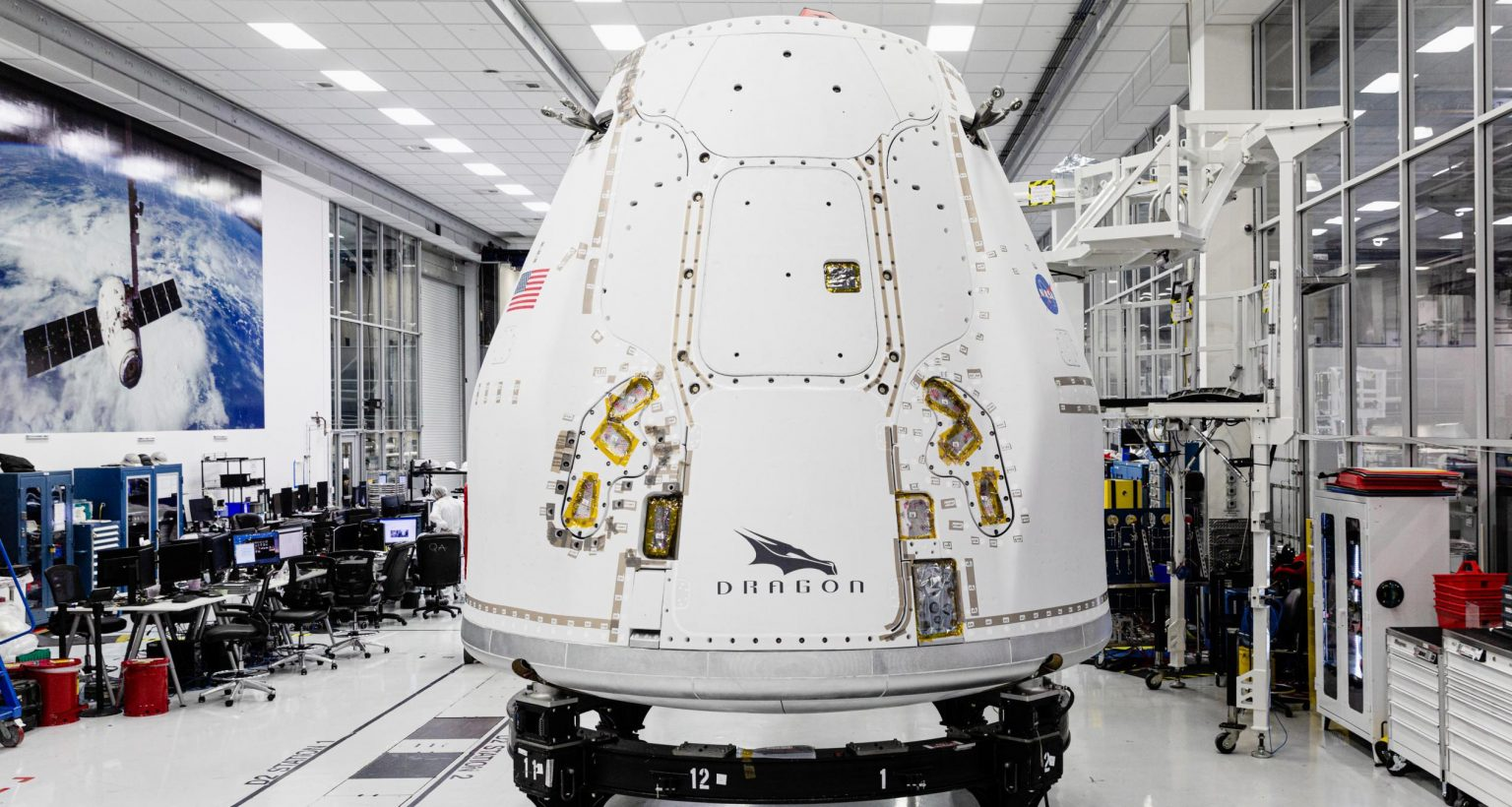
Dragon capsule C208 during processing at SpaceX HQ in Hawthorne prior to CRS-21

Cargo Dragon 2 is essentially a Crew Dragon, without an abort system, so it has all of the upgrades from Crew Dragon. Most importantly, Dragon 2 is designed to be reused up to 5 times, with a turnaround time of under 6 months, which is significantly lower than Dragon One; Dragon One’s fastest turnaround time was 418 days, with most turnaround times being significantly longer.

Dragon 1 was unable to dock with the International Space Station. Meaning that Dragon 1 would hold a position away from the ISS. In this position the Canadarm would capture the spacecraft, and attaching it to the ISS. This is called berthing.

Dragon 2 autonomously attaches itself and docks to the ISS. CRS-23 will mark the seventh fully autonomous docking SpaceX has completed. Since its inaugural flight, Dragon 2 has flown 9 times — 3 crewed and 6 uncrewed.


Unmanned Crew Dragon

Manned Crew Dragon

Unmanned Cargo Dragon

Dragonfly Pad Abort

DM-2

CRS-21

DM-1

Crew-1

CRS-22

Dragon Inflight Abort

Crew-2

CRS-23

Cargo Dragon 2’s trunk is also different from both Dragon 1’s and Crew Dragon’s. Dragon 2 has its solar panels integrated into its trunk, while Dragon 1 had a deployable solar array from its trunk. Crew Dragon is equipped with 4 fins, which are used for aerodynamic control during ascent. Cargo Dragon 2’s trunk only has 2 solar cell fins.

Externally, Cargo Dragon 2 differs from its crewed counterpart, lacking windows and the SuperDragon abort system. The differences between Crew Dragon and Cargo Dragon are derived from the fact that Cargo Dragon is not required to have launch escape capability. Crew Dragon is fitted with eight SpaceX-developed SuperDraco engines, located in four, two engine clusters around the outside of the capsule, which are there to pull the capsule and its crew to safety away from a Falcon 9 in the event of a catastrophic failure during fueling or launch.

Since Cargo Dragon does not carry crew, the spacecraft does not have to carry those systems; therefore the SuperDracos have been removed from the Cargo Dragon capsule giving a mass reduction that allows for additional cargo to be carried to ISS.

Cargo Dragon 2 also lacks all of the life support and onboard control systems present on Crew Dragon that are needed for humans. Instead, it carries minimal support systems to ensure conditions are kept acceptable for hatch opening on the Station and ISS Crew ingress to the vehicle.

Cargo Dragon 2 is also significantly more massive, with a dry mass of ~12,000 kg. With this mass increase Dragon 2 is able to carry ~50% more science to the ISS than Dragon One. Because of this, missions past CRS-21 will stay docked to the ISS for 3 months, rather than the 1 month that CRS-21 stayed docked.

Dragon 2’s nose cone is also significantly different as it opens instead of being jettisoned on ascent. It is protecting the docking mechanism.

At a press conference after Crew-1, Gwynne Shotwell said SpaceX is expecting to have a fleet of 8 dragons: 5 Crew Dragons and 3 Cargo Dragons. This will allow SpaceX to conduct up to 25 crewed missions and 15 resupply missions.

Unlike prior cargo resupply missions, the new Cargo Dragon 2 carried too much mass to permit a Return To Launch Site (RTLS) landing of the Falcon 9 first stage.  Instead, the first stage — like Crew Dragon, from which Cargo Dragon is now derived — made use of a newly built drone ship “A Shortfall Of Gravitas'' in the Atlantic for landing and recovery.

A Shortfall Of Gravitas

‘A Shortfall of Gravitas’ (ASOG) began life as a barge named Marmac 302, making her a relative of SpaceX’s other two drone ships. Just Read the Instructions (JRTI) and Of Course I Still Love You (OCISLY) are designated Marmac 303 and 304, respectively. SpaceX’s original droneship, also named Just Read the Instructions, was Marmac 300 and supported three missions in 2015, never completing a successful recovery.

On July 9, ASOG left Louisiana for Port Canaveral, Florida. After completing a sea trial offshore, the ship and its tug—Finn Falgout—turned on course towards Florida.

Overall, ASOG appears to be more modern than the others, and her deck lacks the thrown together look of OCISLY and JRTI. The sea van containers used to hold navigational, electrical, and other equipment have largely been contained within a purpose-built superstructure.

The “wings,” or structural pieces added to the sides of the deck in order to increase landing area, also appear to be different, with the corners removed from the normal rectangular shape. While this extra landing area may have been useful in early experimental landings, SpaceX’s matured recovery systems have produced very precise landings more recently.

ASOG features four large thrusters on each corner of the ship which appear to be the same type of thrusters installed on JRTI. The diesel electric engines used to power the thrusters are located within the black superstructure.

While the other drone ships require a tug boat to provide propulsion for the entire several day journey to and from a landing zone, usually several hundred kilometers offshore, Musk confirmed on Twitter that ASOG can indeed operate without a tug. Regulations may still require tugs to move ASOG in and out of port before an autonomous system takes over just offshore, and ASOG’s thrusters will still perform station keeping once at the landing zone, just like the propulsion systems on OCISLY and JRTI.

Like its sisters, ASOG will feature an Octagrabber robot used to secure boosters to its deck after landing. The Octagrabber was built at SpaceX’s Cidco Road facility in Florida, just like the one given to Just Read the Instructions after its move to the east coast.

Prior to ASOG’s arrival, SpaceX operated both JRTI and OCISLY on the east coast. With a drone ship coming, however, and the resumption of Falcon 9 launches from Vandenberg, California, on the horizon, the company opted to send the oldest of the three drone ships OCISLY to the Port of Long Beach via the Panama Canal.

OCISLY completed the journey in around 1 month; she rode on top of the massive transport ship Mighty Servant 1—a ship that can submerge itself in order to take on large cargo. This allowed the droneship to complete the journey more quickly than if it had been towed by a tug the entire way.

While SpaceX launch activity has decreased for the short term future, the company is now in a position to resume launching with an even greater cadence—the vast majority of these launches supporting the company’s Starlink satellite internet constellation. SpaceX plans to launch batches of Starlink satellites to polar orbits from both the east and west coast, as well as continuing mid-inclination launches from Florida.

These next Starlink V1.5 will be upgraded and may feature laser inter-satellite links, an important evolution for the Starlink network. The Starlink launch salvo will likely resume in September.

Author Mariia Kisseleva link

Coauthor/Text Retriever Johnny Nielsen

link to launch list


SpaceX - Eutelsat 36D

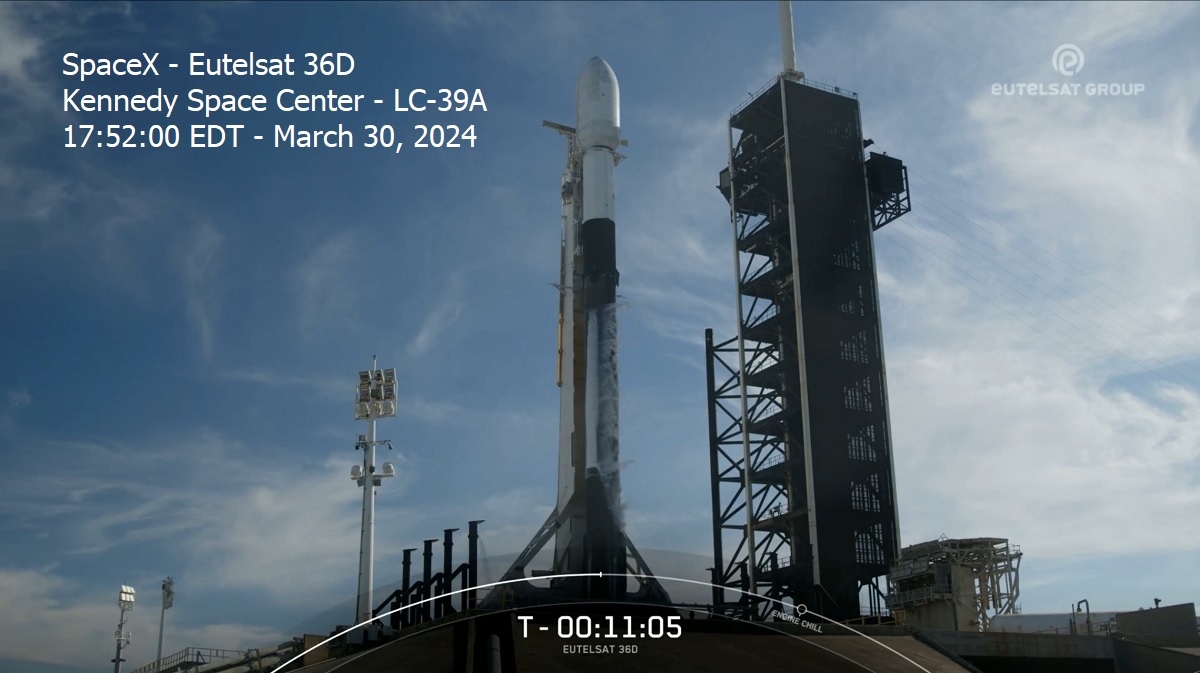
Screenshot from the launch of Eutelsat 36D. At last we get to see a normal GTO mission in daylight Mission Rundown: SpaceX Falcon 9 - Eutels...