Sunday, October 7, 2018

SpaceX Falcon 9 - SAOCOM 1A

  SpaceX Falcon 9 Block 5 - SAOCOM 1A - Launching October 7/8, 2018
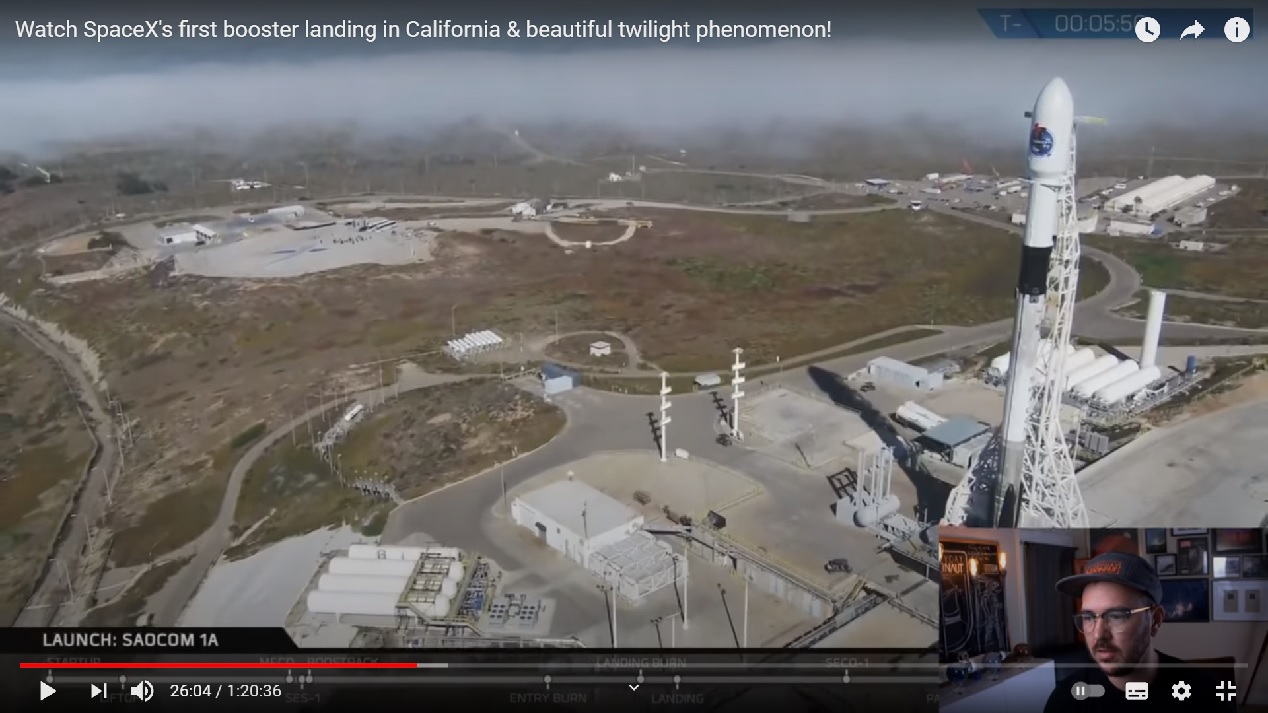
Screenshot of SAOCOM 1A on SLC-4E and LZ-4W with Everyday Astronaut Tim Dodd as host

Mission Rundown: SpaceX Falcon 9 - SAOCOM 1A

Written: January 11, 2021

Lift Off Time

October 8, 2018 02:21 UTC

October 7, 2018 19:21 PDT

Mission Name

SAOCOM 1A

Launch Provider

SpaceX

Customer

CONAE - Comission National de Actividades con Espacios - Argentinas Space Agency 

Rocket

Falcon 9 Block 5 serial number B1048-2

Launch Location

Space Launch Complex 4 East - SLC 4E

Vandenberg Air Force Base in California 

Payload

Satelite Argentina de Observación Con Microondas 

Earth Observation Satellite

Payload mass

3 000 kg ~ 6 614 pounds

Where did the satellite go?

Low Earth Sun Synchronous Polar Orbit - 616 km x 635 km in a 97.895° orbit making it fly slightly backwards

Will they be attempting to recover the first stage?

Yes - There is enough fuel for a return flight

Where will the first stage land?

Space Launch Complex 4 West SLC 4W, now rebuilt as LZ-4 at Vandenberg Air Force Base in California

Will they be attempting to salvage the fairings?

No - Type 1 fairings are usually not equipped with parachutes and Mr Steven did not leave the port

Are these fairings new?

Yes - Type 1 boat hull sized fairings - 34 x 17 feet with 10 evenly spaced ventilation ports in a circle

This will be the:

– 62nd flight of all Falcon 9 rockets

– 16th re-flight of all Falcon 9 boosters

– 6th flight of Falcon 9 Block 5 rocket

– 2nd re-flight of Falcon 9 Block 5 booster

– 12th SpaceX launch from SLC-4E

– 30th booster landing overall

– 1st booster landing at LZ-4 former SLC-4W

– 17th mission for SpaceX in 2018

Where to watch

Where to read more

SpaceX link

Tim Dodd on SAOCOM-1A Oct 7/8, 2018

Twilight phenomena explained link plus Fleet Week

Up close view - little shaky, note RCS thrusters puffs


Launch debriefing

(This is what happend)

-

T-00:11:09

Host:

T 00:00:00

T+00:01:09

T+00:02:24

T+00:02:33

T+00:02:45

T+00:02:51

T+00:06:02

T+00:07:19

T+00:10:15

T+00:12:45

-

-

-

T+00:45:00

Post Launch Run Down from 0:01 then Q&A

SpaceX live feed at 20:45, Tim was on camera two

Tom Pradario on his own today

Liftoff at 31:55

MaxQ at 33:04 (3 sec delay on downlink camera)

MECO 34:19, stage separation 34:21

SES-1 at 34:28

Boost back burn at 34:40 for 35 seconds

Fairing  separation at 34:47

Entry burn 37:57 by 3 Merlin 1D# for 25 seconds

Landing burn 39:14 by 1 Merlin 1D# for 36 seconds

SECO at 42:10 and coasting

Deployment at 44:40

Q&A with info, replays and explanations from 46:12

Launch day offer on merchandise at 1:18:08

Rap up from Tim Dodd at 1:20:08

Both fairings salvaged from the Pacific Ocean


Don’t fly for me Argentina

SpaceX is being commissioned by CONAE, the Argentine space agency, to send the SAOCOM 1A satellite into a low Earth sun synchronous orbit. SpaceX will be launching the satellite on top of one of their Falcon 9 rockets.

Two things are extra exciting about this launch: For the first time on the west coast, SpaceX will be attempting a Return to Launch Site (RTLS) landing for the Falcon 9 booster at the former Space Launch Complex 4 west - SLC-4W now LZ-4.

The booster B1048-2 previously supported the Iridium-7 NEXT launched in July 2018 from the 4 East launchpad placed on Vandenberg Air Force Base (SLC 4E).

This is the second time SpaceX will be reflying a Block 5 booster, making it the second time this rocket flies twice. This marks an important milestone as SpaceX takes another mighty step towards full, rapid reusability.

The Payload

Screenshot: The SAOCOM 1A getting ready for shipment to SpaceX

Satélite Argentino de Observación Con Microondas, or SAOCOM, is a constellation of radar-imaging satellites that is being established by Argentina 's national space agency, Comisión Nacional de Actividades Espaciales (CONAE).

The constellation, whose name means Argentine satellite for microwave observation, will consist of two satellites, which will be interoperated with Italy’s COSMO-SkyMed system. COSMO-SkyMed is a four-satellite constellation that was deployed between 2007 and 2010, with a new generation of satellites slated to begin launching next year.

CONAE was an early customer for the Falcon 9, signing a contract for SpaceX to launch both of the SAOCOM satellites in April 2009: over a year before the rocket made its maiden flight and still three months before the smaller Falcon 1 made SpaceX’s first successful launch with a functional payload. At the time, the two launches were scheduled to take place between 2012 and 2013.

SAOCOM 1A is a 3 000-kilogram satellite. Built by INVAP, it is based around the same platform used for the SAC-C remote sensing satellite which launched aboard a Delta II rocket in November 2000. SAOCOM 1A is designed to operate for five years.

SAOCOM 1A and 1B are both identical Earth observation satellites which have L-Band microwave radar and infrared cameras. Both with the ability to image the Earth in any weather or lighting conditions, see through clouds and at night, and be used to monitor for disasters. SAOCOM 1A will be in orbit next year 2019.

They will join a joint Italia-Argentina SIASGE (Sistema Italo Argentino de Satélites para la Gestión de Emergencias) constellation with 4 Italian COSMO SkyMed Satellites, that carry complentamery S-Band radars.

First Stage Burn Times, Speeds and Propellant Mass

This time SpaceX delivered the telemetry on the first stage giving me a rare opportunity to analyze the performance of the first stage during ascent, boost back burn, reentry burn and finally the landing burn. Rocket thrust time equals burn time but not thrust levels.

9 Merlin 1D# engines produce a maximum thrust of 7 607 kN with an available burntime of 162 seconds, which is used to lift the Falcon 9 rocket weighing 549 metric ton into a parabolic trajectory, from which the second stage continues to orbit after 144 second burntime on the first stage. Gravity on the first stage is 5 391 kN and therefore the thrust to weight ratio is 1,44. Rocket thrust divided by rocket mass in Earth's gravity.

All 9 Merlin 1D# engines from ignition to Main Engines Cut Off - MECO were burning for a period of 147 seconds almost at full throttle except at Mach One, MaxQ and just before stage separation. The Boost Back Burn, the Re-entry Burn and the Landing Burn were all equivalent to 21 seconds of full burn time giving a total of 168 second burn time. This is 6 second too much in burntime according to Falcon 9 engine specifications.

The down throttling of the 9 Merlin 1D# engines increases the burn time durations, so it is logical to assume that the 6 second extra burn time plus whatever propellant reserve in the fuel tanks have been gained by throttling the 9 Merlin 1D# engines during assent, and by throttling the main 3 Merlin 1D# engines during the Boost Back Burn, the Reentry Burn and especially the Landing Burn.

Given that the ratio of LOX to RP-1 is 2,327 part LOX to 1,0 part RP-1 it can be assumed that LOX density of 1.255 g/cm3 in super chilled condition and with RP-1 chilled density of 0.842 g/cm3, that 2,920 kg LOX + 0,842 kg RP-1 is consumed per second per engine.

3,762 kg propellant x 9 Merlin 1D# engines x 162 second burntime = 5 485 kg propellant.

That doesn't fit with the fact that the 9 Merlin 1D# engines have 410,9 ton of propellant in the first stage fuel tanks. We can now estimate the size of the parts of propellant in the LOX/RP-1 ratio by dividing the 410,9 ton with the 5,485 ton which gives 74,91 as the number of portions of propellant that 9 Merlin 1D# engines consume.

The 74,91 could be the nozzle throat area in square centimeters or the ratio 1:74,91 of the nozzle throat compared to the Merlin 1D# rocket engine nozzle rim.

74,91 x 3,762 kg propellant x 9 Merlin 1D# x 162 second = 410 900 kg propellant.

The ratio of LOX to RP-1 is 2,327 part LOX to 1,0 part RP-1 must be multiplied by the part factor 74,91, which is 218,73 kg or 174,29 liter LOX and 63,07 kg or 74,91 liter RP-1 “which is the 1,0 part” consumed per second per Merlin 1D# engine at full thrust.

It is now possible to calculate the minimum tank volume of both types of propellants by multiplying with the number of engines and the total burn time. 174,29 liter x 9 Merlin 1D# engines x 162 seconds burn time = 254 118 liter equivalent to 254,12 m3 of LOX tank space in the first stage. 74,91 liter x 9 Merlin 1D# engines x 162 seconds burn time = 109 219 liter equivalent to 109,22 m3 of RP-1 tank space in the first stage.

Wikipedia states that the first stage has a 287 400 kg LOX tank capacity and a 123 500 kg RP-1 tank capacity which is not quite equivalent to the calculated propellant mass in kilo. 218,73 kg x 9 Merlin 1D# engines x 162 seconds burn time = 318 908,34 kilo LOX. 63,07 kilo x 9 Merlin 1D# engines x 162 seconds burn time = 91 956,06 kg RP-1.

If you add the two numbers you get 410 864,4 kilo calculated propellant capacity and if you also add wikipedia's numbers you get almost the same tank capacity number of 410 900 kg propellant. I have therefore found a flaw in the wikipedia numbers.

With 2 242,8 liters of propellant is consumed by the 9 Merlin 1D# engines every second of full thrust during liftoff. This is equivalent to 592,5 gallons of propellants to those metric impared. At some point during a SpaceX webcast Jessica Anderson stated that Falcon 9 during liftoff consumed 700 gallon of propellant every second. This is proven incorrect by the calculations above this paragraph.

The schedule below is used for calculating burn times and velocity on the first stage.

Launch debriefing

(This is what happend)


Boost back burn = 10 s

Entry burn = 7 seconds

Landing burn = 4 sec


Total burn time 21 sec


Check burn = 3 sec

Launch burn = 144 sec


Seen burn time = 168 s


0.57 x 20 sec = 6 sec


20 seconds of throttle down time is at least 6 seconds of full burn

-

-

T-00:00:03

T 00:00:00

T+00:01:09

T+00:02:24

-

T+00:02:45

-

-

-

T+00:03:53

-

T+00:06:02

-

-

T+00:06:27

-

T+00:07:19

-

-

T+00:07:55

Post Launch Run Down

Data from SpaceX live feed during launch

TEA-TEB ignition - Full thrust check in 3 seconds

Liftoff at 31:55, 9 Merlin 1D+ at full thrust

MaxQ at 33:04, 9 Merlin 1D+ with reduced thrust

MECO 34:19, 9 Merlin 1D+ shutdown - T+02:22-24 ???

0 km/h - 5 896  km/h taking 142-144 seconds

Boost back burn at 34:40 for 35 seconds

1 - 3 - 1 Merlin 1D# lith in 4 - 29 - 2 seconds burns

4 + 3x29 + 2 = 93 equivalent to 10 seconds full burn time

Velocity change from 5 110 km/h to 1 565 km/h

Free Falling in parabolic arc reaching 134 km altitude

Free falling gaining speed from 1 084 km/h to 4 515 km/h

Entry burn 37:57 by 3 Merlin 1D# for 25 seconds

1 - 3 - 1 Merlin 1D# lith in 4 - 19 - 2 seconds burns

4 + 3x19 + 2 = 63 equivalent to 7 seconds burn time

Breaking decent speed from 4 515 km/h to 2 105 km/h

Fall through atmosphere reduced velocity to 1 088 km/h

Landing burn 39:14 by 1 Merlin 1D# lith for 36 seconds

Breaking decent speed from 1 088 km/h to 0 km/h

9 x 4 = 36 equivalent to 4 seconds full burn time

Landing safely at LZ-4, dry weight 25 metric ton + fluids


The given LOX/RP-1 data is found on Wikipedia along with weight data on Falcon 9.

Liquid oxygen has a density of 1.141 g/cm3 (1.141 kg/L or 1141 kg/m3) when subcooled it gets a density of 1.255 g/cm3 (1.255 kg/L or 1255 kg/m3)

The capability of sub-cooling the RP-1 fuel to −7 °C is giving a 2.5–4% density increase from 0.81 g/cm3 (0.81 kg/L or 810 kg/m3) to 0.842 g/cm3 (0.842 kg/L or 842 kg/m3) given a 4% increase in density of 32 kg pr. m3.

The precise amount of propellant and tank volume wasn’t known, so I’m calculating the minimum volume and mass numbers from data I believe to be true.

The excess amount of LOX used to superchill the second stage Merlin vacuum engines, bleed the pipes empty after Second Engine Cut Off and rechill the Merlin vacuum engine were likewise not known. It’s a balancing act with unknown LOX pipe volumes, so I’ll add a little more LOX.

Anyway, I'm just playing around with the given numbers. Don’t mind me.

Author John Rumpf or John Eric ???

link

Coauthor/Text Retriever Johnny Nielsen

link to launch list


Sunday, September 9, 2018

SpaceX Falcon 9 - Telstar 18 Vantage

  SpaceX Falcon 9 Block 5 - Telstar 18 Vantage - Launching September 9, 2018

Screenshot from Tim Dodd hosting SpaceX Falcon 9 launch of Telstar 18 Vantage

Mission Rundown: SpaceX - Telstar 18 Vantage

Written: January 12, 2021

Lift Off Time

September 9, 2019 - 04:45 UTC - 00:45 EDT

Mission Name

Telstar 18 Vantage + Apstar-5C

Launch Provider

SpaceX

Customer

Telesat Canada

Rocket

Falcon 9 Block 5 serial number B1049-1

Launch Location

Space Launch Complex 40 (SLC-40)

Cape Canaveral Air Force Station, Florida

Payload

SSL-1300 bus Shared Communication Satellite

Payload mass

Approximately 7 060 kg ~ 15 565 pounds

Where did the satellite go?

Geostationary Transfer Orbit - 259 x 18 060 km x 26.95°

Targeting a Geostationary slot at 138° East

Will they be attempting to recover the first stage?

Yes - OCISLY were towed downrange due east

Where will the first stage land?

On the Autonomous Spaceport Drone Ship - Of Course I Still Love You - OCISLY located about 655 km downrange

Will they be attempting to recover the fairings?

No - Type 1 fairings are not equipped with parachutes

Are these fairings new?

Fairing types described in last chapter

Yes - Type 1 boat hull sized fairings - 34 x 17 feet with 10 evenly spaced ventilation ports in a circle

This will be the:

– 61th flight of all Falcon 9 rockets

– 5th flight of a Falcon 9 Block 5 rocket

– 4th maiden flight of a Falcon 9 Block 5 rocket

– 37th SpaceX launch from SLC-40

– 29th booster landing overall

– 16th mission for SpaceX in 2018

Where to watch

Where to read more

SpaceX link

Tim Dodd on Telstar 18 Vantage Sep 9, 2018


Launch debriefing

(This is what happend)

-

-

T-00:13:27

Host:

T-00:00:03

T 00:00:00

T+00:01:17

T+00:02:39

T+00:02:48

T+00:03:38

T+00:06:23

T+00:08:10

T+00:08:20

-

-

-

T+00:25:39

T+00:26:20

-

-

T+00:32:07

-

-

-

Pre Launch Run Down from 0:01

Q&A, explanations from 6:18 - watch this Dragon video

SpaceX live feed at 16:31

John Insprucker is working alone tonight

TEA-TAB ignition - Thrust check

Liftoff at 29:59

MaxQ at 31:16 (2-3 seconds delay on downlink)

MECO 32:38, stage separation 32:40

SES-1 at 32:47

Faring separation at 33:37

Entry burn 36:22 by 3 Merlin 1D# for 23 seconds

Landing burn 38:09 by 1 Merlin 1D# for 21 seconds

SECO at 38:19 and coasting toward Equator 

Q&A with explanations from 39:40

Launch day offer on merchandise at 47:00

More Q&A with explanations until 55:35

SpaceX resumes live feed at 55:38

SES-2 - SECO-2 in 45 seconds gave a velocity boost from 26 490 km/h to 33 433 km/h at 56:19

Q&A with explanations from 58:34

SpaceX shows deployment at 1:02:06

Launch day offer on merchandise at 1:04:01

Rap up from Tim Dodd at 1:12:12

Both fairings burned partly up during reentry


Fourth Falcon leaving the nest

SpaceX got commissioned by Telesat to send the Telstar 18 Vantage satellite towards its transfer orbit. SpaceX will be launching the satellite on top of one of their Falcon 9 rockets delivering it to an elliptical Geostationary Transfer Orbit. The rocket is currently at Cape Canaveral Air Force Station at launch pad SLC-40 in Florida.

The booster B1049-1 supporting this mission is on its maiden voyage, and will after launch land 655 km downrange aboard SpaceX’s autonomous spaceport drone ship ‘Of Course I Still Love You‘ which is the blue dot on the hazard map.

The Block 5 booster has retractable legs, but this time they couldn’t relock the release pins, so the legs had to be removed at Port Canaveral before road transportation.

The fairings are not going to be recovered, because there were no parachutes mounted on the fairings. They will crumble and burn up on reentry some 700 km downrange.

The Payload

Telstar 18V - Telstar 18 Vantage / APStar 5C is a communication satellite in the Telstar series of the Canadian satellite communications company Telesat. T18V will be equipped with C and Ku-band transponders and operate from 138° East. At 7 060 kilograms (15 560 lb), it is the second-heaviest communication satellite ever launched, weighing slightly less than its sibling Telstar 19V.

Telesat signed a contract with SSL in December 2015 for the construction of the satellite. It will be based on the SSL-1300 bus with an electrical output of approximately 14 kW.

The new satellite called Telstar 18 VANTAGE will operate from 138° East and significantly expand Telesat’s capacity over the Asia Pacific region through a combination of broad regional beams and high throughput spot-beams. Telesat also announced it has entered into an agreement with APT Satellite Company Limited (APSTAR) under which APSTAR will make use of capacity on Telstar-18-VANTAGE to serve its growing base of customers. This agreement extends the long term relationship between APSTAR and Telesat that has existed for more than a decade.

Equipped with C and Ku-band transponders, Telstar 18 VANTAGE will offer superior performance for broadcasters, telecom service providers and enterprise networks on the ground, in the air and at sea. Its broad C-band coverage will extend across the Asia region to Hawaii enabling direct connectivity between any point in Asia and the Americas. Its Ku-band capacity will expand on Telesat’s coverage of growing satellite service markets in China, Mongolia, Southeast Asia, and the Pacific Ocean.

Chilling LOX, that’s a great question

FC Guy asks this at 53:53 - How do they chill the densified liquid fuel/oxygen?

At a pressure of 1 bar, the temperature of liquid boiling oxygen stabilizes at 90 Kelvin. For sub-cooling of LOX, the temperature should be lower. It is possible to cool LOX by forced evaporation by a pressure lower than 1 bar. But the LOX tank in a rocket should be as light as possible. If the pressure inside the tank is substantially lower than outside, extra strength and weight is necessary. But according to these papers: (1) (2) and (3) there is another method.

Cold helium gas is injected at the bottom of the tank and the bubbles rise in the LOX. At the surface of the bubbles, LOX evaporates into the bubble and cools the remaining LOX. But extra space is needed for the bubbles in the LOX and for the gas mixture of helium and oxygen above the liquid level. For topping off, the injection of helium is stopped and the remaining space is filled with LOX. Figure 8 of the first paper shows the effect of different helium gas temperatures. The cooling works best with helium at 85 Kelvin, but even helium at 150 Kelvin cools the LOX.

A bubble injected into the LOX consists of 100 % helium and 0 % oxygen at first. The LOX around this bubble would boil just like in a vacuum because the partial pressure of oxygen in this bubble is zero. Even a bubble consisting of 50 % helium and 50 % oxygen is able to cool LOX at 90 K. Without sub cooling in a tank with boiling LOX at 90 K, the gas above the liquid is 100 % oxygen and the partial pressure of oxygen is 1 bar. If the partial pressure of oxygen is lower than 1 bar in the gas above the liquid or inside the bubbles, the LOX is cooled by evaporation.

At the launch pad the LOX may be precooled using a heat exchanger with ground supplied Liquid Nitrogen boiling at 77.355 Kelvin. To save weight of the rocket, this heat exchanger should be outside the rocket but close to it. On photos/videos taken on the pad or launch complex a large liquid Nitrogen tank is seen with a block of long thin Helium tanks which indicates the super chilling heat exchanger.

Liquid Oxygen is pumped to that heat exchanger, where it is super chilled. Liquid Nitrogen and Oxygen should not be mixed to avoid dissolving Nitrogen within the LOX. Cooling with Helium bubbles may be used within the rocket LOX tanks, and the rocket's propellant tanks are being backfilled, pressurized with heated Helium gas for stability during launch.

During LOX loading there is seen venting from the LOX pipes during prefilling, they are not cold enough, the same goes for the rocket LOX tanks, more venting follows and now a running venting of the rocket LOX tanks through the top valves and all of the Merlin rocket engines. Two of which are seen on the black interstage.

The humid ambient air outside the rocket LOX tank gets chilled to form clouds that drift away in the wind depending on the current wind speed. There is an ice build up on the outside of the rocket LOX tanks on the leeward side, and no ice build up where the air gets freeze dried by the freezing cold rocket LOX tanks.

When the rocket LOX tanks get pressurized before launch, ice is seen popping off and you can get an idea about the ice thickness during the LOX loading. Saturn V and the Shuttle main propellant tank both got to accumulate large amounts of frozen ice that would fall off in huge chunks during launching. A fascinating site on the Apollo launches, but a deadly flaw on the Shuttles main propellant tank when frozen chunks of insulation fell off.

Answer given by Uwe on StackExchange, other comments below.

This helium bubbling trick was also used in the shuttle system prelaunch to make sure that the LOX in the long downcomer line stayed nice and cool. Also the Apollo LOX lines in all the stages used Helium bubbles to prevent clogging of LOX pipes preventing them from freezing shut.

@Hobbes Quite late to the party but Helium bubbling was confirmed by Musk in 2016: "Launch aborted on low thrust alarm. Rising oxygen temps due to hold for boat (in the exclusion zone) and helium bubbles triggered alarm."  (via twitter) – Christoph Nov 15 '19 at 10:42

Author: Tim Dodd link

Coauthor/Text Retriever: Johnny Nielsen

link to launch list


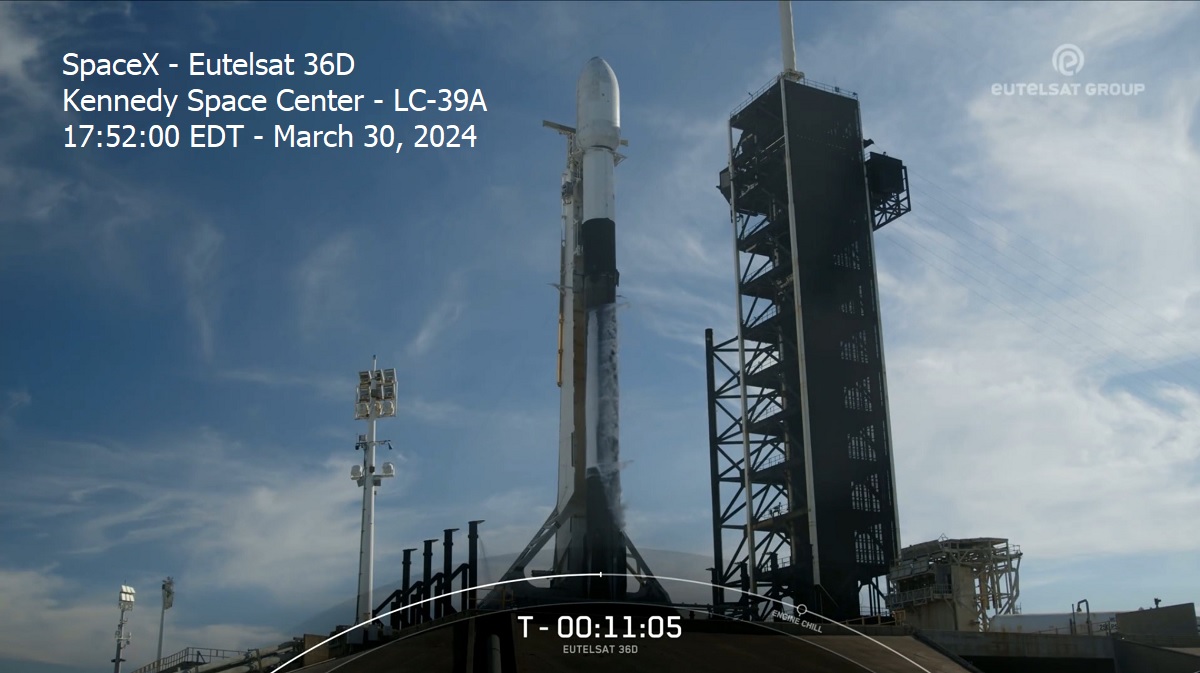
SpaceX - Eutelsat 36D

Screenshot from the launch of Eutelsat 36D. At last we get to see a normal GTO mission in daylight Mission Rundown: SpaceX Falcon 9 - Eutels...