Saturday, January 14, 2017

SpaceX Falcon 9 - Iridium-1 NEXT

 SpaceX Falcon 9 Full Thrust - Iridium-1 NEXT - Launching January 14, 2017

Screenshot from SpaceX - Iridium-1 NEXT with a clear ocean view and ready to go

Mission Rundown: SpaceX FT - Iridium-1 NEXT

Written: January 29, 2021

Lift Off Time

January 14, 2017 - 17:54:34 UTC - 09:54:34 PST

Mission Name

Iridium-1 NEXT

Launch Provider

SpaceX

Customer

Iridium Communications

Rocket

Falcon 9 Full Thrust serial number B1029-1

Launch Location

Space Launch Complex 4 East (SLC-4E) at Vandenberg Air Force Base, California

Payload

10 Telecommunication Satellites in a constellation of 66 active Iridium NEXT with 9 spare Satellites

Payload mass

9 600 kg ~ 21 164 pounds

Where are the satellites going?

Polar Low Earth Orbit - 667 km parking orbit at 86.66° below the 778 x 778 km operational orbit at 86.4°

Will they be attempting to recover the first stage?

Yes - A rebuilt renamed droneship towed downrange

Where will the first stage land?

Marmac 303 - Just Read The Instructions - 2nd JRTI

Will they be attempting to recover the fairings?

No - Engineers are looking for ways to do this

Are these fairings new?

Yes - Two Type 1 boat hull sized fairings - 34 x 17 feet with 10 evenly spaced ventilation ports in a circle

This will be the:

– 29th flight of a Falcon 9 - Amos 6 didn’t launch

– 9th flight of Falcon 9 Full Trust “V1.2” booster 

– 3rd SpaceX launch from SLC-4E

– 7th booster landing overall

– 1st mission for SpaceX in 2017

– 1st of eight Iridium NEXT missions

Where to watch

Where to read more

SpaceX link

Flight Club link got a treat for you


Launch debriefing

(This is what happend)

T-00:19:07

Hosts:

-

T-00:00:02

T 00:00:00

T+00:01:09

T+00:02:30

T+00:02:34

T+00:03:21

T+00:04:16

T+00:06:30

T+00:07:40

T+00:09:05

T+00:52:30

-

T+00:59:17

-

-

-

T+01:18:30

SpaceX live feed at 00:31

Tom Praderio, Michael Hammersley, Lauren Lyons and John Insprucker are presenting this launch

TEA-TEB Ignition - Full thrust check

Liftoff at 19:39 - Technical issues with Webcast

MaxQ at 20:48

MECO 22:08, stage separation 22:10

SES-1 at 22:13

Fairing separation at 23:00 not shown

Boost brake burn at 23:55 - 3 Merlin 1D+ 31 seconds

Entry burn 26:08 by 3 Merlin 1D+ for 16 seconds

Landing burn 27:18 by 1 Merlin 1D+ for 33 seconds

SECO-1 at 28:43 and coasting - no flight data

SES-2 - SECO-2 taking 4-5 sec gave a velocity boost from 26 643 km/h to 27 096 km/h at 1:12:09

Iridium deployment at 1:18:55 - 1:00:57 - 1:02:37 - 1:04:17 - 1:05:57 - 1:07:37 - 1:09:17 - 1:10:57 - 1:12:37 - 1:14:17 - 100 seconds apart - Not shown

Loss Of Signal to and from ground stations

Rap up from 1:38:09


This time we got a big job to do

SpaceX is targeting the launch of Iridium-1 from Space Launch Complex 4E (SLC-4E) at Vandenberg Air Force Base in California. The instantaneous launch window is at 08:54:34 p.m. PST, or 17:54:34 UTC, on January 14.

SpaceX’s Falcon 9 rocket will deliver 10 satellites to low-Earth orbit for Iridium, a global leader in mobile voice and data satellite communications. This is the first set of 10 satellites in a series of 75 total satellites that SpaceX will launch for Iridium’s next generation global satellite constellation, Iridium® NEXT. The satellites will begin deployment about an hour after launch.

Iridium NEXT Constellation

The second-generation Iridium-NEXT satellites began to be deployed into the existing constellation in January 2017. Iridium Communications, the successor company to Iridium SSC, has ordered a total of 81 new satellites being built by Thales Alenia Space and Orbital ATK: 66 operational units, nine on-orbit spares, and six spares yet to be launched.

In August 2008, Iridium selected two companies — Lockheed Martin and Thales Alenia Space — to participate in the final phase of the procurement of the next-generation satellite constellation. The constellation provides L band data speeds of up to 128 kbit/s to mobile terminals, up to 1.5 Mbit/s to Iridium Pilot marine terminals, and high-speed Ka-band service of up to 8 Mbit/s to fixed/transportable terminals. The NEXT satellites incorporate a secondary payload for Aireon, a space-qualified ADS-B data receiver for use by air traffic control and, via FlightAware, by airlines. A tertiary payload on 58 satellites is a marine AIS ship-tracker receiver for Canadian company ExactEarth

As of 2009, the original plan had been to begin launching new satellites in 2014.

The design was completed by 2010, and Iridium stated that the existing constellation of satellites would remain operational until Iridium NEXT is fully operational, with many satellites expected to remain in service until the 2020s, while the NEXT satellites would have improved bandwidth. The new system was to be backward-compatible with the current system. In June 2010, the winner of the contract was announced as Thales Alenia Space, in a $2.1 billion deal underwritten by Compagnie Française d'Assurance pour le Commerce Extérieur. Iridium additionally stated that it expected to spend about $800 million to launch the satellites and upgrade some ground facilities.


The first ten Iridium NEXT satellites are stacked and encapsulated in the Falcon 9 fairing for launch from Vandenberg Air Force Base, CA, in early 2017 (image credit: Iridium)

Plane 6

Plane 3

Plane 4

Plane 2

Plane 1

Plane 6

Plane 5

Plane 3

14-01-17

25-06-17

09-10-17

23-12-17

30-03-18

22-05-18

25-07-18

11-01-18

17:54:34

20:25:18

12:37:01

01:27:34

14:13:51

19:47:58

11:39:30

15:31:33

8 fixed

5 fixed

10 fixed

8 fixed

10 fixed

3 fixed

10 fixed

6 fixed

P5 <- 2

P2 <- 4

1 -> P4

0

1 spare

P1 <- 2

1 spare

0

1 spare

P5 <- 1

2 spares

0

1 spare

1 -> P4

3 spares

Sunday   Jan.   8, 2017 - 10:28:07 PST - 18:28:07 UTC - 1st launch attempt - 1 second window

Saturday Jan. 14, 2017 - 09:54:39 PST - 17:54:39 UTC - 2nd launch attempt - 33:28 early window

The eight Iridium NEXT launches go to following planes 1-6 on these dates and some of them either stay fixed in orbit or move to other neighboring orbit planes. These 6 plane orbits precede eastward and pass over VAFB about 330 seconds earlier every day.

SpaceX was contracted to launch all the Iridium NEXT satellites. All the Iridium NEXT launches have taken place using a Falcon 9 rocket launch from Vandenberg Air Force Base in California. Deployment of the constellation began in January 2017, with the launch of the first ten Iridium NEXT satellites to orbit plane 6, where 8 stayed and 2 shifted to orbit plane 5 in order to relive the oldest satellites.

Below is a picture of the assembly process of stacking two ESPA pipe sections, each of them mounted with 5 Iridium NEXT satellite vehicles. They will be deployed in the order: 

One - Three - Five - Two - Four in the top ring and then Six - Eight - Ten - Seven - Nine in the bottom ring gets deployed.

IridiumIR ‏@IridiumIR - Satellites have been fueled, pressurized & dispenser tiers are being stacked as we move closer to first launch - Iridium Twitter message

Changing of the Guards

The new bunch of Iridium NEXT satellites will immediately replace the old, almost spent satellites already in service orbits. Being deployed in a lower and thereby faster orbit that slowly intersects the higher orbits of the Iridium Constellation have the advantage that after testing and making sure they can communicate with each other, the ground stations and the old satellites. Then it’s time to change the guards.

The new bunch of Iridium NEXT satellites will change their orbit altitudes, or their shift orbital planes either to the right or left by 30 degree and replace the old satellites one by one all by starting the onboard rocket engine twice first in a transfer orbit and then in a circulation orbit just above the old Iridium satellite, who in turn after handing over its data streams will begin its deorbit burns with whatever little propellant, there must be left in the satellites propellant tanks.

The logical thought you will have is that all 10 Iridium NEXT satellites will raise to their operational altitude as one brand new string of “pearls” in the Iridium Constellation, but that is wrong because there are old dying satellites already in place, and they are all on their last legs some more than others, and they need replacement before they lose their ability to deorbit themselves. A series of Tweets about Iridium makes that clear.

https://twitter.com/iridiumboss/status/824028851353350147

Which reads as follows: - My Ops team is really rocking on shaking out our new Iridium NEXT birds. Just hit 1000 testing activities since launch. Going well! - Follow the Source.

Only three launches deliver all their 10 Iridium NEXT satellites directly into their orbit plane. The five remaining launches all have Iridium NEXT satellites shifting orbit planes.

All of the 75 Iridium NEXT satellites will from their lower test orbit planes overtake the old satellites from below in a tight 10 satellite cluster formation, and when ordered to fire their thrusters one by one thus raising their orbits and their positions.

It’s a complicated relay race in 4 dimensions. Space and Time. Go Einstein.

All operational satellites are flying north in 6 planes 30 degree apart in rows of 11 and then south on the other side of the earth

All satellites are in touch with 4 other satellites and the ground stations whenever one of them fly over one. Then whatever data is available in the network will be sent from satellite to satellite to the ground station and redirected to the individual clients that are using the Iridium NEXT network. For example imagine this scenario.

A cold storage container sends data on position, temperature and current weather to the Iridium satellite passing above it, the data gets relayed through the network to the ground station who informs the client about this and shall we guess a few thousand other cold storage containers on a number of ships worldwide.

Companies need this kind of data if they want to do business with demanding clients.

Author William Graham link

link

Coauthor/Text Retriever Johnny Nielsen

link to launch list


Thursday, September 1, 2016

SpaceX Falcon 9 - Amos 6

  SpaceX Falcon 9 Full Thrust - Amos 6 - Destroyed September 1, 2016

No screenshot from SpaceX Webcast of the destruction of Amos 6

Mission Rundown: SpaceX Falcon 9 FT - Amos 6

Written: January 30, 2021

Lift Off Time

September 1, 2016 - 13:07 UCT - Destroyed

September 3, 2016 - 07:00 UTC - 03:00 EDT

Mission Name

Amos 6

Launch Provider

SpaceX

Customer

SpaceCom

Israel Aerospace Industries

Rocket

Falcon 9 Full Thrust serial number B1028

Launch Location

Space Launch Complex 40 (SLC-40) at Cape Canaveral Air Force Station, Florida

Payload

AMOS 4000 platform communication satellite 

Payload mass

5 500 kg ~ 12 100 pounds

Where was the satellite going?

GEO Transfer Orbit - 250 km x 35 800 km at 4o west

Will they be attempting to recover the first stage?

They were

Where will the first stage land?

OCISLY was waiting downrange

Will they be attempting to recover the fairings?

No - Engineers are looking for ways to do this

Are these fairings new?

Yes - Two Type 1 boat hull sized fairings - 34 x 17 feet with 10 evenly spaced ventilation ports in a circle

This would have been the:


But it was the:

– 29th flight of all Falcon 9 rockets

– 9th flight of Falcon 9 Full Trust “V1.2” booster 

– 27th SpaceX launch from SLC-40

– 7th booster landing overall

– 9th mission for SpaceX in 2016


– 1st destruction of a Falcon 9 rocket on the ground

Where to watch

Where to read more

SpaceX link none exist

Scott Manley have this to say about it

Want to know or learn more link go see Tim Dodd


Anomaly debriefing

(This is what happend)


The timeline is fixed to the planned launch time for Amos-6. The launch could have been moved down for various reasons.

T-41:54:04

T-41:53:00

T-41:52:44

T-41:52:36

T-41:52:35

T-41:49:26

T-41:49:26

T-41:49:18

T-41:49:06

T-41:49:05

T-41:48:53

T-41:48:45

T-41:47:30

USLaunchReport You Tube feed at 00:07

Static fire explosion at 01:11 - Sharp flash

Max fireball at 01:16

Fairing falls with Amos-6, explodes at 01:24

First soundwave reach camera at 01:25

Growing fire with small explosions until 03:34

Video cut by 03:34 unknown length T- affected 

Third major explosion at 03:42

Soundwave reach camera at 03:54

Fourth minor explosion at 03:55

Fourth soundwave reach camera at 04:07

Helikopter sound at 04:15

Diminishing fire until end of clip at 05:30


Shouldn’t we test without the satellite?

In January 2013, SpaceCom announced that they had signed a contract with SpaceX for the 2015 launch of the Amos-6 satellite on a Falcon 9 launch vehicle. The Amos-6 satellite was intended to replace the Amos-2 satellite, which was planned to be retired in 2016. During 2015 SpaceCom announced the launch date had slipped to mid-2016. A final launch date was set for 3 September 2016.

Under the deal with SpaceCom, state-owned IAI was contracted to build Amos-6 and its ground control systems, as well as provide operating services. SpaceCom estimated that the cost of launching, insuring and one year's operation of Amos 6 would be $85 million.

On 1 September 2016, during propellant loading for a routine test, the Falcon 9 launch vehicle suffered an anomaly that destroyed the vehicle and its AMOS-6 payload. The explosion started near the upper stage LOX (Liquid oxygen) tank.

Because the satellite was destroyed prior to the launch, the cost of the satellite was not covered by SpaceCom's insurance policy, but rather by the manufacturer, IAI - that had its own insurance and filed a claim in order to compensate SpaceCom.

The contract with SpaceX specified that SpaceCom could choose to receive $50 million, or a future flight at no cost. SpaceCom chose the future flight to launch Amos 17.

News reports in early November indicated that SpaceX had determined the root cause for the anomaly, that it was straightforwardly fixable, and that SpaceX would return to flight in December 2016. On 2 January 2017, SpaceX released an official statement indicating that the cause of the failure was a buckled liner in several of the COPV tanks, being the root cause of perforations that allowed liquid and/or solid oxygen to accumulate underneath the lining, which was ignited by friction caused by pressurizing the COPV.

Somebody in SpaceX should have asked a simple question, but since nobody did. It went wrong. SpaceX has since this incident not done static fires testing with commercial or public payloads onboard. They are more lax about inhouse payloads from SpaceX.

The Payload

The primary payload for what was to be the 29th flight of the Falcon 9 rocket was AMOS-6, an earth communications satellite weighing 5.5-tonne (12,100 lbs). AMOS-6 had a total power generating capability of 10 kW, and was meant to replace the aging AMOS-2 satellite.

It was a Israeli Earth communications satellite, one of the SpaceCom AMOS series, that was built by Israel Aerospace Industries (IAI), a defense and aerospace company.The Amos-6 included payload components from various subcontractors including Canada's MacDonald, Dettwiler and Associates, which built the communications payload, and Thales Alenia Space ETCA for the electric propulsion.

AMOS-6 is an geostationary earth communications satellite – primarily built by Israel Aerospace Industries (IAI) and operated by Space Communication Ltd (SpaceCom) – that is part of the SpaceCom AMOS (Affordable Modular Optimized Satellite) series of satellites.

It had a planned mission duration of 15 years.

AMOS-6 was destined for a geostationary orbit, placed at 4° West with a perigee of 35,785 km (22,235 mi) and an apogee of 35,800 km (22,245 mi).

Overall, AMOS-6 was to be the second satellite in the AMOS 4000 platform – the second generation of AMOS satellites – after AMOS-4.

Moreover, AMOS-6 was to be the first in the AMOS series to make use of electric propulsion for station keeping operations in its geostationary orbit; however, its orbit raising maneuvers following its release from the second stage of the Falcon 9 would still have been conducted via traditional, chemical-based propulsion.

AMOS-6 was equipped with 36, 43 Ku band coverage and 36, 43 Ka band coverage – as well as two S-band transponders. What 36, 43 Ku and 36, 43 Ka band means, I don’t know.

The satellite was originally contracted to launch in 2015; however, SpaceCom later announced that launch would not take place until mid-2016.

Subsequently, in October 2015, Facebook and Eutelsat entered into an agreement with SpaceCom to lease 18 of AMOS-6’s 36 Ka-band spot-beams for broadband capability beginning 1 January 2017 through September 2021 for a fixed price of $95 million (USD) over the life of the contract.

The contracts was to serve for spot-beam coverage of sizeable portions of Sub Saharan Africa, significant portions of Europe, and portions of the Middle East (including Israel, Jordan, portions of western Iraq, and a majority of Syria) for Facebook’s internet.org initiative – which aims to provide affordable access to internet services.

Composite Overwrapped Pressure Vessel

COPV are placed in Falcon 9 propellant tanks and deliver the inert gaseous Helium and Nitrogen to backfill the propellant tanks with helium and steer the booster in vacuum so it’s oriented the right way just before ignition. The helium gas is also used to stir the liquid oxygen tank with bubbles which helps with the oxygen evaporation and thereby chills the LOX by removing “the warmer gaseous oxygen”.

The Reaction Control System - RCS thrusters use fast cold gas nitrogen bursts to orient the spacecraft, apply a major burst as a gravity push to press the propellant towards the intake valves, and from where the Merlin 1D+ vacuum engine can start the next burn in outer space. COPV are used to store the necessary Nitrogen gas needed for these maneuvers under extremely high pressure if not in a liquid state.

The forces applied to a COPV are extreme, they are wrapped in carbon fiber composite and reinforced with Kevlar fibers, and they must perform in cryogenic conditions on an ascending rocket. The weakest point on a COPV is the top valve, the pipes and the bolts, that attach them to struts in the propellant tanks. The latter caused the CRS-7 inflight failure where a COPV ripped itself loose, broke a helium pipe and over pressurized the LOX tank to its breaking point. So it was Bye Bye to CRS-7 and Cargo Dragon C109.

The Amos-6 Pad failure found a new never seen before weakness in minor cracks/bubbles in the composite carbon fiber layers. Liquid oxygen penetrates the space between the metal aluminum vessel and the composite carbon fiber layers, freezes and expands the fibers to breaking point. It then snaps and sparks, igniting the oxygen and carbon fiber dust that’s created in an instant. Oxygen expands a 1000 times and breaks more fibers with a cascade of sparks, ignitions and a huge explosion followed within milliseconds.

Carbon dust is the fuel, oxygen is the oxidizer and whether either the friction of or the snap of bursting fibers is the ignition? The BOOOM surely follows. In naval warfare U-boats found that some ships exploded faster and sank faster after being torpedoed. The German Navy took that as evidence that they sank an ammunition ship. But the allies knew who was carrying and wasn’t carrying ammunition.

Passenger Ships like Lusitania, Carpathia and Britannica didn’t carry ammunition, but they sank fast and quickly as if they did carry ammunition. The cause was coal dust blown loose from floors and walls by the torpedo blast and ignited by the flames. The empty coal bunkers, long service tunnels to the boilers and an uninhibited blast wave passing through the bottom of the Passenger Ships sealed their fate. They sank fast.

Fine dust in the air will combust just as fast as a gas/oxygen mixture, so be aware of ignition sources in your surroundings. It might get you killed or burned severely.

Author Chris Gebhardt link

link

Coauthor/Text Retriever Johnny Nielsen

link to launch list


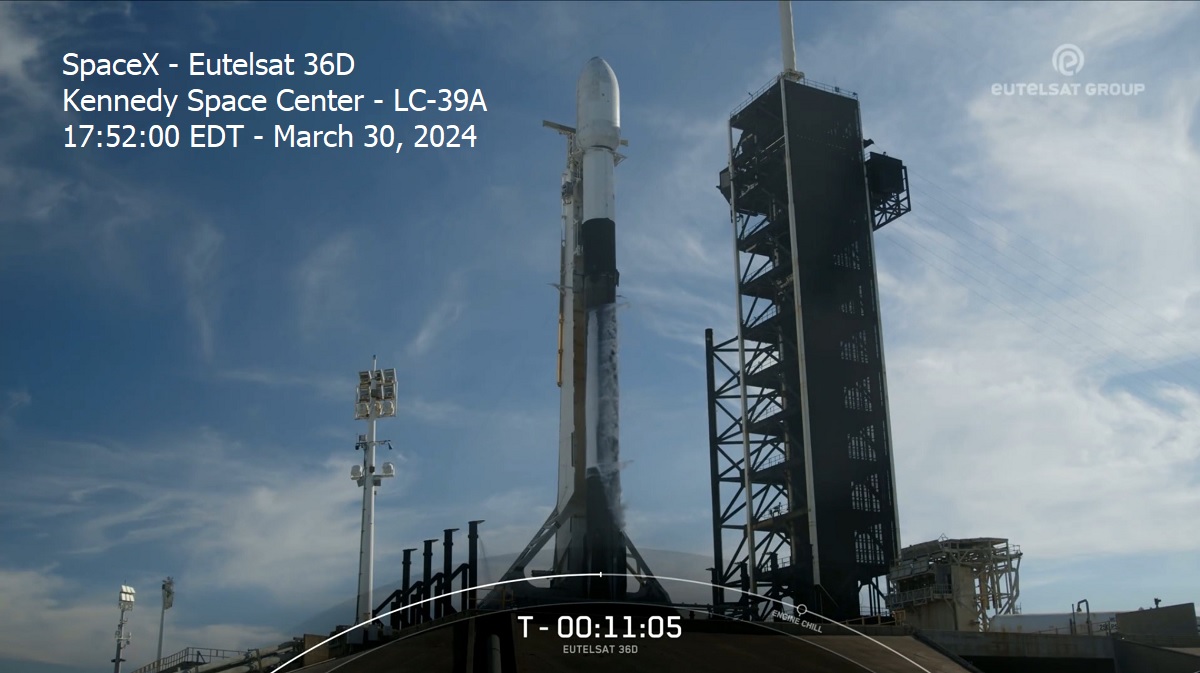
SpaceX - Eutelsat 36D

Screenshot from the launch of Eutelsat 36D. At last we get to see a normal GTO mission in daylight Mission Rundown: SpaceX Falcon 9 - Eutels...