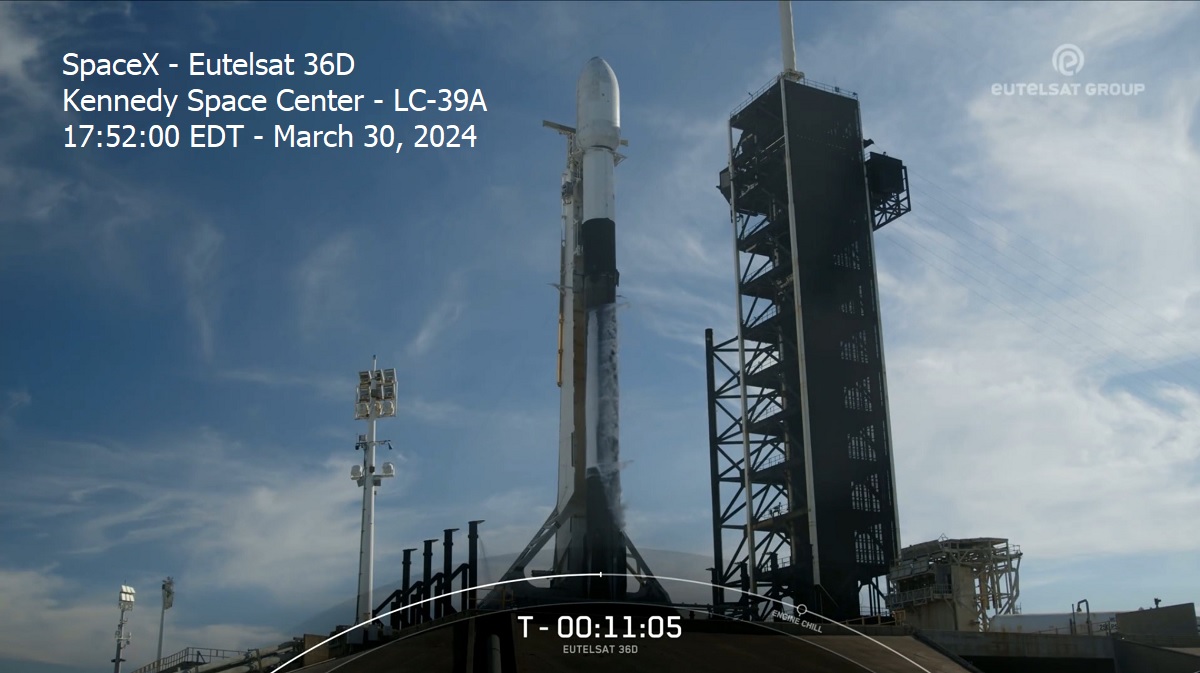
Screenshot from SpaceX Webcast of CRS-9
Mission Rundown: SpaceX Falcon 9 FT - CRS-9
Written: January 30, 2021
Lift Off Time | July 18, 2016 - 04:45:29 UTC - 00:45:29 EST |
Mission Name | CRS-9 |
Launch Provider | SpaceX |
Customer | NASA |
Rocket | Falcon 9 Full Thrust serial number B1025-1 |
Launch Location | Kennedy Launch Complex 39A - LC-39A Kennedy Space Center, Florida |
Payload | Cargo Dragon serial number C111-1 |
Payload mass | 2 257 kg ~ 4 976 pounds |
Where are the Dragon going? | Low Earth Orbit (LEO) to the International Space Station |
Will they be attempting to recover the first stage? | Yes - The booster have fuel enough to return |
Where will the first stage land? | LZ-1 at Cape Canaveral Air Force Station, Florida |
Will they be attempting to recover the fairings? | No. The Dragon capsule have a jettisonable nose cone and solar panel covers on the Trunk |
This will be the: | – 27th flight of all Falcon 9 rockets – 7th flight of Falcon 9 Full Thrust “V1.2” rocket – 25th SpaceX launch from SLC-40 – 5th booster landing overall – 2nd booster landing at LZ-1 – 7th mission for SpaceX in 2016 |
Where to watch Where to read more | SpaceX link Want to know or learn more link visit Tim Dodd |
Launch debriefing (This is what happend) Lift off - 04:45:29 UTC | T-00:16:27 Hosts: - T-00:00:02 T 00:00:00 T+00:01:11 T+00:02:21 T+00:02:35 T+00:02:41 T+00:03:12 T+00:06:29 T+00:07:46 T+00:09:06 T+00:09:42 T+00:12:10 - - T+00:13:28 - T+57:17:31 941:25:31 947:01:31 | SpaceX live feed at 00:31 Tom Praderio, Lauren Lyons, Brian Mahlstedt and John Federspiel burning the midnight oil TEA-TEB Ignition - Full Thrust check Liftoff at 16:59 - Flight telemetry in m/s MaxQ at 18:11 - 4 seconds downlink delay MECO 19:20, stage separation 19:26 SES-1 at 19:34 Boost back burn at 19:40 - 3 Merlin 1D+ 42 seconds Nose cone spotted after separation at 20:11 Entry burn 23:28 by 3 Merlin 1D+ for 19 seconds Landing burn 24:45 by 1 Merlin 1D+ for 31 seconds SECO at 26:05 and coasting = 6:31 of burn time Dragon C111-1 separation at 26:41 Deployment of solar array at 29:09 SES - SECO taking 391 seconds gave a velocity boost from 1 516 m/s to 7 500 m/s - Technical telemetry lost Rap up from SpaceX at 30:28 Other events during this CRS-9 mission was: Berthing with ISS Harmony Nadir airlock at 14:03 UTC Released from ISS after 36-37 days at 10:11 UTC Landed in Pacific Ocean near NCR Quest at 15:47 UTC |
In 7th inning, a second “Home Run” to LZ-1
SpaceX is targeting a July 18 (EDT) launch of its ninth Commercial Resupply Services mission (CRS-9) from Space Launch Complex 40 at Cape Canaveral Air Force Station, Florida. The instantaneous launch window opens at 12:45 am EDT (04:45 am UTC) on July 18, and a backup launch window opens at 12:00 am EDT on July 20. The Dragon will be deployed about 10 minutes after liftoff and attach to the ISS about two days later.
Following stage separation, the first stage of the Falcon 9 will attempt an experimental landing on LZ-1 at Cape Canaveral Air Force Station, Florida.
The Mission step by step
CRS-9 is part of the original order of twelve missions awarded to SpaceX under the Commercial Resupply Services contract. It was pushed back seven times.
In July 2014 the NASA Flight Planning Integration Panel (FPIP) presentation had this mission scheduled no earlier than (NET) 7 December 2015. By December 2014, the launch had been pushed back to NET 9 December 2015. Following the failure of SpaceX CRS-7 on 28 June 2015, the launch date was left open and, in September 2015, was moved to NET 21 March 2016. The flight was later pushed to 24 June, 27 June, 16 July, and finally 18 July 2016, as the crewed mission Soyuz MS-01 took the 24 June slot.
CRS-9 finally launched on 18 July 2016 at 04:44 UTC from Cape Canaveral SLC-40 aboard a Falcon 9 launch vehicle. After 9 minutes and 37 seconds the Dragon spacecraft successfully separated from the rocket, and deployed its solar arrays about two minutes later. The opening of its GNC door came two hours later, enabling orbital operations.
After a series of orbital maneuvers and stationkeeping at different hold points, the CRS-9 Dragon was captured by the ISS's Canadarm2 on 20 July 2016 at 10:56 UTC. After robotic operations, it was berthed some three hours later at 14:03 UTC.
In preparation for recovery, the Dragon capsule was loaded with 1,550 kg (3,410 lb) of experiments and no-longer-needed equipment and, on 25 August 2016 at 21:00 UTC, it was unberthed and stowed in an overnight parking position away from the station. Dragon was released from Canadarm2 the following day at 10:11 UTC.
After maneuvering away from the station, Dragon conducted a re-entry burn at 14:56 UTC and successfully landed in the Pacific Ocean at 15:47 UTC, approximately 525 km (326 mi) southwest of Baja California.
The Dragon Payload
CRS-9 carried 2,257 kilograms (4,975.8 lb) of cargo to the International Space Station. Amongst its pressurized cargo was 930 kg (2,050.3 lb) of material supporting about 250 science and research experiments, 370 kg (815.7 lb) of crew supplies, 280 kg (617.3 lb) of spacecraft hardware, 127 kg (279.9 lb) of extravehicular activity equipment, 1 kg (2.2 lb) of computer equipment, and 54 kg (119.1 lb) of Russian hardware. Its unpressurized cargo, the International Docking Adapter-2 located in Dragon's trunk, massed 467 kg (1,029.5 lb).
Some of the key experiments transported by CRS-9 to the ISS were the Biomolecule Sequencer, which performed DNA sequencing in orbit; the Phase Change Heat Exchanger, which tested temperature regulation systems for future spacecraft applications; the OsteoOmics experiment, which tested if Earth-based magnetic levitation can properly simulate microgravity conditions; and the Heart Cells experiment from Stanford University, which examined the effects of microgravity on the human heart at the cellular and molecular level using human induced pluripotent stem cell-derived cardiomyocytes.
NASA’s SpaceX blog
The real CRS-9: Mission Timeline (all times approximate)
T- 38 minutes: Launch Conductor takes launch readiness poll
T- 35: RP-1 (rocket grade kerosene) and liquid oxygen (LOX) loading underway
T- 7: Falcon 9 begins engine chill prior to launch/Dragon to internal power
T- 2: Range Control Officer (USAF) verifies range is go for launch
T- 01:30: SpaceX Launch Director verifies go for launch
T- 01: Command flight computer to begin prelaunch checks/pressurized propellant tanks
T- 3 seconds: Engine controller commands engine ignition sequence to start TEA-TEB
T0: Falcon 9 liftoff
T+01:08: Max Q (moment of peak mechanical stress on the rocket)
T+02:21: 1st stage main engine cutoff (MECO)
T+02:24: 1st and 2nd stages separate
T+02:32: 2nd stage engine starts
T+02:42: 1st stage boostback burn begins
T+06:31: 1st stage entry burn begins
T+07:38: 1st stage landing burn begins
T+09:02: 2nd stage engine cutoff (SECO)
T+09:37: Dragon separates from 2nd stage
T+11 minutes: Dragon’s solar arrays deploy
T+2 hours, 19 minutes: Dragon’s Guidance, Navigation and Control bay door opens
The launch debriefing timeline above is obtained by watching the Webcast from SpaceX video length and the T+ timeline counter, the only thing wrong with it is the 3-4 second delay in the downlink from the Falcon 9 many cameras and the ground based NASA cameras, who only have a second delay at most.
Max. Q for instance is a 10-12 second time period where Falcon 9 passes through a humid atmospheric layer in the same height where passenger jet planes leave their contrails. That is what it seems like from the ground compared with audio callouts.
SpaceX downlink camera positions
The downlink cameras are numerous. I have caught glimpses from technical cameras placed in the oddest places compared to the most viewed cameras.
1st Stage downlooking camera outside on the interstage - It gets sotty during descent
1st Stage up looking inside interstage camera - You see the oxygen bleed pipes/tubes
2nd Stage right and left vacuum engine bell cameras - Left seems upside down
2nd Stage upper payload adaptor fitting camera - You only see half of deployments
Dragon right and left solar panel bottom cameras - Locked inside the trunks side fairings
1st Stage RP-1 tank inside top down view - Only seen once - Lots of side baffles
2nd Stage LOX tank inside top down view - Seen numerous times - Enough LOX left?
2nd Stage top vacuum engine inside view - Picture below - Lot of pipes + gray actuator
2nd Stage vacuum engine outside top rear view - Seen in the first early launches
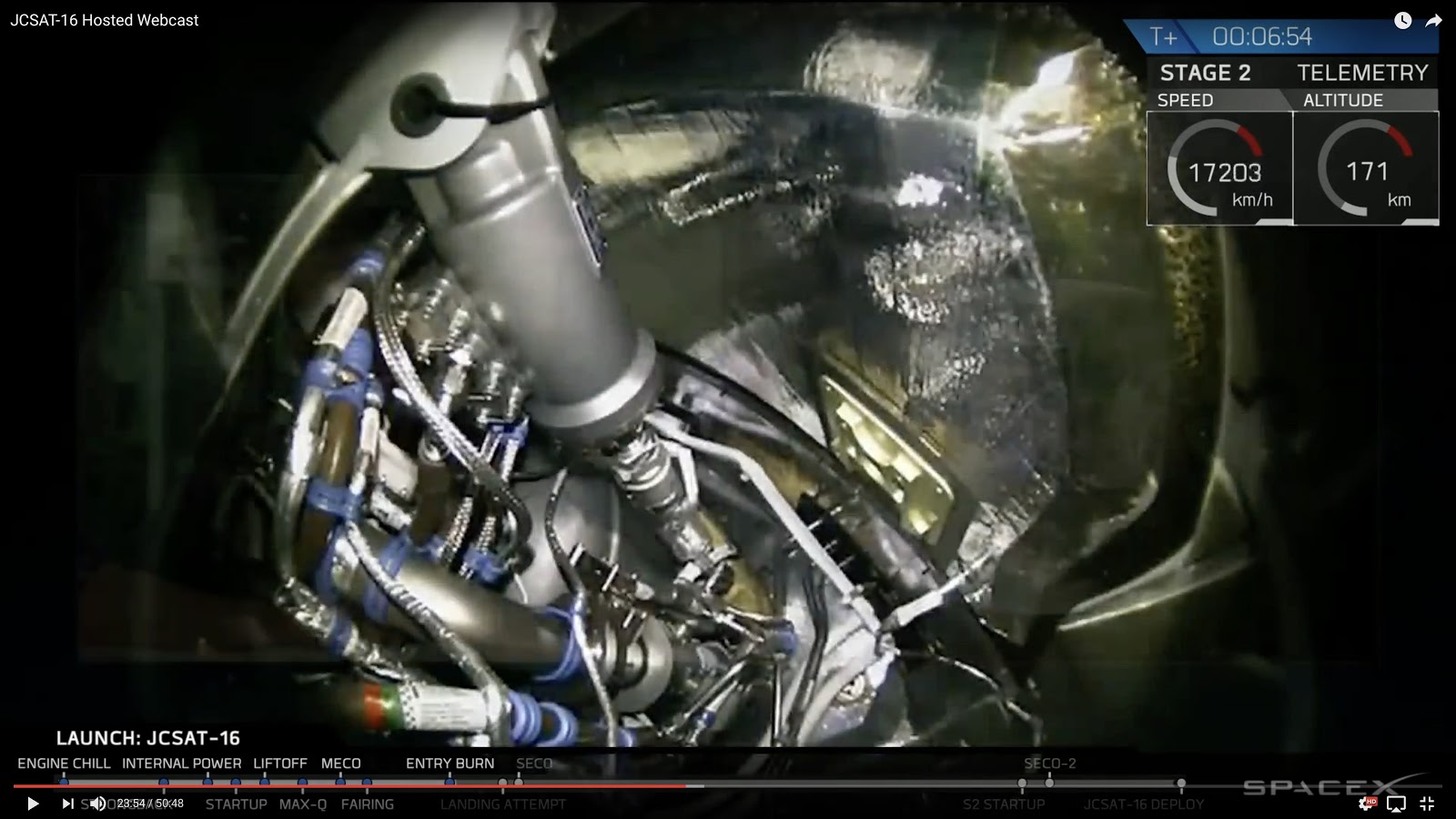
Here’s a rare fisheye view of Stage two Merlin vacuum engine seen from the top
There’s probably more camera placements I don’t remember anymore. One looking up at the RP-1 fuel distributor in 1st stage keeps coming to mind, but I don’t remember which SpaceX clip I saw this. Well it will come to me one day. I’ll keep looking.
Author William Graham link link | Coauthor/Text Retriever Johnny Nielsen link to launch list |