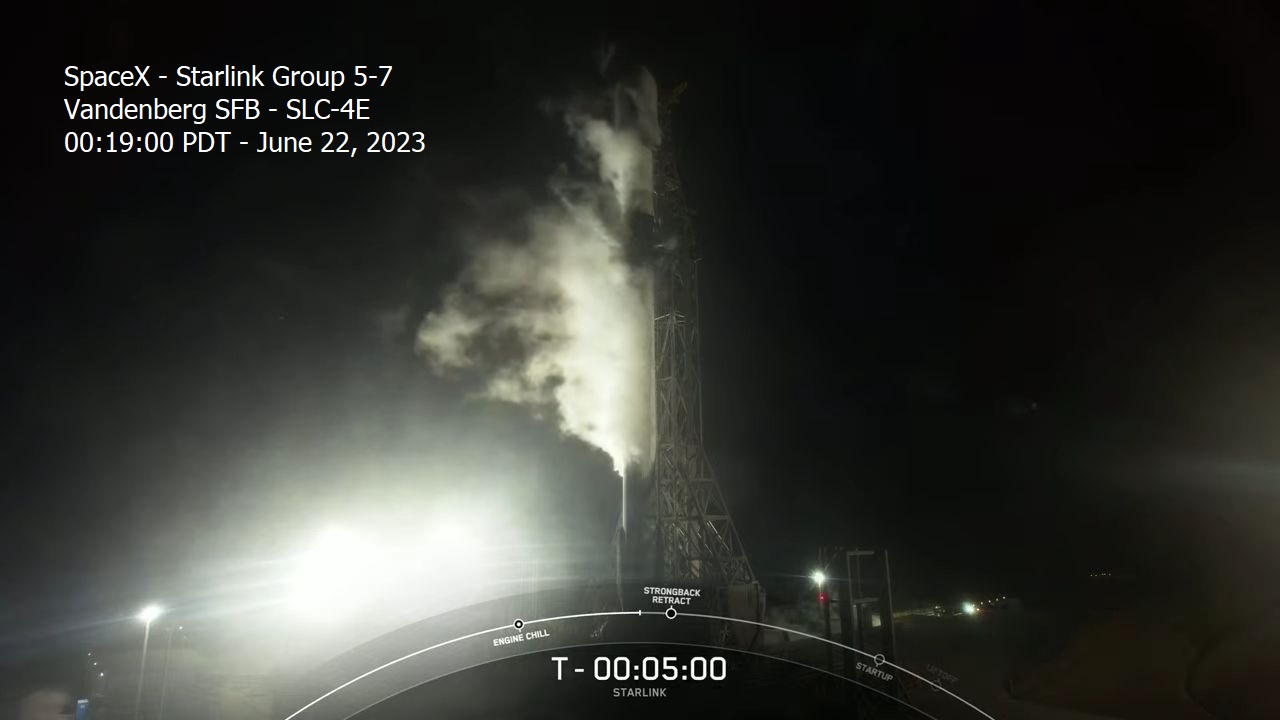
Thursday, June 22, 2023

SpaceX - Starlink Group 5-7

From SpaceX Webcast of the Starlink Grp 5-7 launch. No sleeping in Vandenberg and Hawthorne

Mission: SpaceX Falcon 9 - Starlink Group 5-7

Written: June 22, 2023

Lift Off Time

June 22, 2023 – 00:19:00 PDT | 07:19:00 UTC

Mission Name

Starlink Group 5-7

Launch Provider

SpaceX

Customer

SpaceX

Rocket

Falcon 9 Block 5 sn: B1075-4

Launch Location

Space Launch Complex 4 East - SLC-4E

Vandenberg Space Force Base, California

Payload

47 Starlink v1.5 enhanced Data Relay Satellites

Payload mass

14 500 kg ~ 32 000 pounds

Where did the satellites go?

Low Earth Orbit - 530 km x 531 km x 43,0°

Initial orbit: 229 km x 339 km x 43,0°

Recovery of the first stage?

OCISLY was towed southeast by tug Scorpius

Where will the first stage land?

Of Course I Still Love You was waiting 668 km downrange

Recovery of the fairings?

Recovery ship GO Beyond was waiting 663 km downrange

Are these fairings new?

No - Old pair Type 3.1 with 4x2 venting ports, thermal steel tip, lowered protrusion and no acoustic tiles

This will be the:

– 234th flight of all Falcon 9 rockets

– 168th re-flight of all Falcon 9 boosters

– 178th flight of a Falcon 9 Block 5 rockets

– 154th re-flight of a Falcon 9 Block 5 boosters

– 45th SpaceX launch from SLC-4E 

– 201st booster landing overall

– 42nd mission for SpaceX in 2023

Where to watch

Where to read more in depth

SpaceX YouTube link

Want to know or learn more go visit or see Tim Dodd


Launch debriefing

(This did happen)

Horizontal velocity by 1st stage is usually 7000 km/t at MECO

With a compass course of 143o from Vandenberg the 2nd stage will change course to 133o to reach its 43o orbit

Telemetry jumps  is acquisition/loss of signal from rocket

T-00:05:09

Host:

T 00:00:00

T+00:01:14

T+00:02:34

T+00:02:37

T+00:02:43

T+00:02:53

T+00:04:36

T+00:06:46

T+00:08:21

T+00:08:49

T+00:09:07

T+00:18:52

T+00:50:00

T+01:10:00

SpaceX live feed at 03:12

Zachary Lupin in voice only

Liftoff at 08:20 - 07:19:00 UTC

MaxQ at 09:35 - Maximum aerodynamic pressure

MECO 10:54 - B1075-4 stops after 154 seconds

Stage separation 10:57 - Just losing 95% weight

SES-1 at 11:03 - Green TEA-TAB ignition visible

Fairing separation at 11:13 - No acoustic tiles visible

1st stage apogee at 12:56 - 6 940 km/h at 131 km

Reentry burn 15:06 by 3 Merlin 1D# for 19 seconds

Landing burn 16:41 by 1 Merlin 1D# - for 23 seconds

SECO at 17:09 and coasting in its elliptical orbit

Wrap up from Hawthorne Mezzanine Studio at 17:27

SpaceX doesn’t show deployment at 07:37:52.340 UTC

2nd stage does a xx second deorbit burn at XX UTC

2nd stage does a 44g ocean dive in the north Pacific Ocean


Just keep turning southeast

SpaceX’s Starlink Group 5-7 mission successfully launched 47 Starlink satellites atop a Falcon 9 rocket. B1075-4 lifted off from Space Launch Complex 4E (SLC-4E) on Thursday, June 22, 2023 at 00:19:00 PDT from the Vandenberg Space Force Base, California.

Starlink Group 5-7 marked the 85th operational Starlink mission and is thought to be a test mission for the evolution of this constellation’s spacecraft: Starlink gen 2.

Because of this, and despite the name, the satellites were not put into the previously filled Starlink Shell 5 — a polar low-Earth circular orbit at 560 km. Instead, the satellites were inserted into a 43-degree orbit at 530 km.

As mentioned, Starlink Group 5-7 is testing new hardware, involving technologies from SpaceX’s recently acquired internet of things (IoT) company SWARM. It is unknown how these technologies are being tested. In addition to this, the Starlink v1.5 satellites are thought to have been altered with equipment from v2 satellites, no details are known.

These test satellites will pave the way for SpaceX to begin proper Starlink V2 launches, which are scheduled to start in early 2023 on Starlink Group 6-1. Until SpaceX’s Starship launch vehicle is operational, these missions will utilize the Starlink v2 mini satellites.

Starlink Group 5-7 boosted the total number of Starlink satellites launched to 4,642, of which ~4,312 were still in orbit around Earth once launched. Starlink Group 5-7 marked the tenth launch of Group 5 satellites.

The fifth shell of phase 1 of Starlink was supposed to host 172 satellites in another 97.6° inclination in a 560 km low-Earth polar orbit. Shell 5 will consist of four orbital planes with 43 satellites in each plane. This shell doesn't host any regular Starlink V1.5 satellites.

This fifth shell of the now identified phase 2 has now received 542 enhanced Starlink v1.5 satellites in a 43.0° inclination in a 530 km low-Earth orbit.
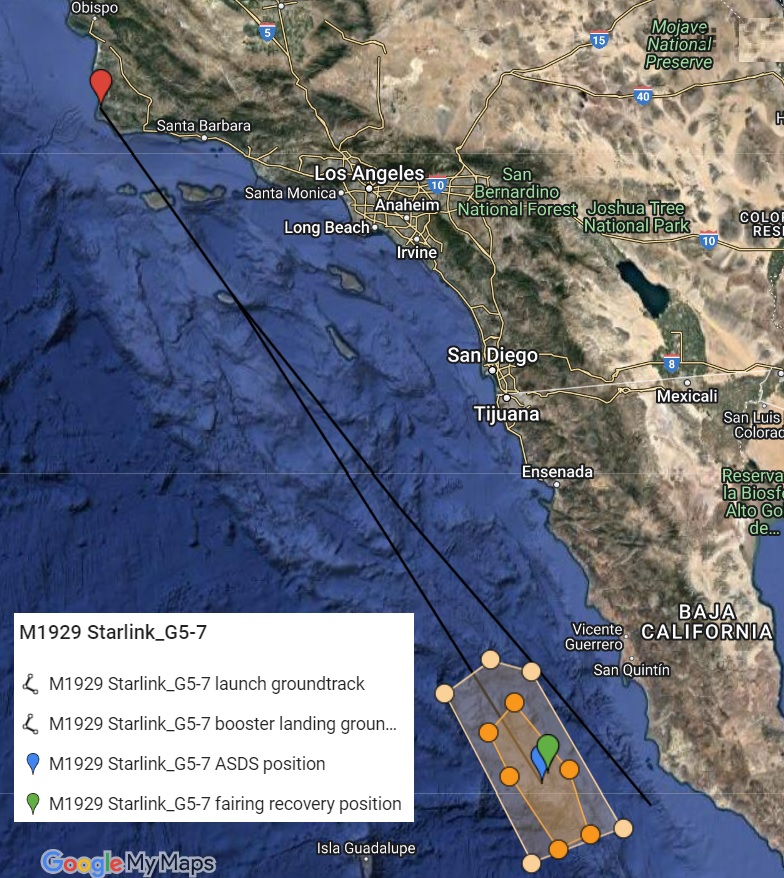
NGA Falcon 9 flies southeast and performs a 10o dogleg maneuver bending across Baja California 

The booster launched is B1075-4. It landed on the drone ship Of Course I Still Love You, some 660 km southeast of SLC-4E, roughly eight and half minutes after liftoff.

After boosting the second stage along with its payload towards orbit, the first stage will freefall in a parabolic curve before it performs a 26 second re-entry burn meant to slow the vehicle down before the atmospheric reentry. The booster will then perform a 21 second landing burn and softly land aboard SpaceX’s autonomous spaceport drone ship.

B1075-4 will have made its fourth flight after launching its next mission:

Starlink Grp 2-4

January 19, 2023

Starlink Grp 2-9

May 10, 2023

SDA Tranche O-1

March 31, 2023

Starlink Grp 5-7

June 22, 2023

B1075-4 didn’t perform a static fire test the day before after refurbishment while waiting for its east coast launch out of Cape Canaveral. SpaceX has since Starlink L08 omitted this safety precaution many times so far. It isn’t required to perform a static fire test on inhouse missions like Starlink as to save time.

SpaceX will also recover both fairing halves in the Pacific Ocean with the newest recovery vessel GO Beyond stationed in Long Beach harbor.

The Starlink Grp. 5-7 Payload

In August 2021, SpaceX presented plans to the Federal Communications Commission (FCC) to either use Falcon 9 or Starship to deploy satellites into Starlink Gen 2. But then, in January 2022, the company announced they would use only Starship as they thought it was going to be ready for launches as soon as March of this year.

However, technical delays in readying Starship for its first orbital flight meant that the company had to revisit its plans and in August 2022 it announced to the FCC that they would now launch into Starlink Gen 2 using both Starship and Falcon 9. 

The document detailed that “while SpaceX will use technically identical satellites on both rockets, the physical structures will be tailored to meet the physical dimensions of the rockets on which they will be launched.” 

This indicated that SpaceX intended to use downsized satellites that would be able to fit inside Falcon 9’s payload fairing. It was then confirmed by Elon Musk during an event with T-Mobile later that month.

The CEO of the company referred to these as Starlink v2 “Mini” but unlike the document, where it doesn’t specify any conditions to launching Starlink v2 satellites on Falcon 9, he said this would only be in the event Starship were to be delayed even further. 

Indications that this launch in particular was related to Starlink Gen 2 came in late October 2022 when SpaceX filed a permit with the FCC requesting authorization to communicate with the Falcon 9 rocket during launch and landing for this mission.

These permits normally include the landing location of the Falcon 9 booster, whether it is a drone ship or otherwise. 

The landing coordinates on the permits for this and subsequent Group 5 missions indicated not only that they intended to use a southeast launch trajectory again just like they did earlier this year, but also that the Group 5 launches wouldn’t be to polar orbit as previously thought.

Starlink’s Gen 1 constellation consists of five orbital shells at four different inclinations. The initial Gen 1 launch campaign to fill the 53.2-degree shell used mission numbers of the form LNN, up to the L28 launch in May of 2021. 

In September 2021, SpaceX started using the Group X-Y designation for their Starlink missions. It was understood at that time that the first number, X, would be the shell to which the satellites are being deployed while the second one, Y, indicated the mission number (but not necessarily the order of launch). So far SpaceX has launched missions to three of those shells using “Group X-Y” mission designations.

It was easy then to think that Group 5 launches would be going into the remaining orbital shell which is one with Sun-synchronous orbits – a type of polar orbit.

However, based on the landing coordinates on the FCC permits, it was clear that the Group 5 missions wouldn’t be going into that orbital shell and therefore it had to be related to something new. In particular, these landing coordinates indicated that Group 5 launches were going into a mid-inclination orbit.

The number of satellites flying on Starlink Group 5-7 suggests this mission is flying the F9 satellite configuration which would allow them to use hardware and processes similar to launching Starlink v1.5 satellites under the Gen 1 constellation. 

SpaceX has already applied for more Group 5 launches in the next couple of months and sources indicate they’ll start launching Group 6 missions as early as February, also headed to Starlink’s Gen 2 constellation.

The Falcon 9 Launch

The Falcon 9 countdown for Sunday’s launch followed the 35-minute-long automated propellant load sequence. At T-3 seconds the engine controller sent the ignition command to all nine Merlin 1D engines on the first stage ramped up to full power in 2.8 seconds.

The rocket was then released at T0 by the launch clamps and began its climb into orbit. The first stage for this mission, B1075, flew for the 4th time.

The booster fired its engines for the two-and-a-half minute ascent into near space, after which B1075-4 shut down its engines and separated from the second stage. After separation, it made a landing on SpaceX’s Autonomous Spaceport Drone OCISLY which was located 624 km downrange a little west of Baja California.

For this mission, the Falcon 9 launch trajectory went southeast and performed a dogleg maneuver around Baja California. SpaceX used this launch trajectory to avoid flying over populated areas in Mexico before reaching orbital velocity.

After stage separation, the second stage ignited its single Merlin 1D Vacuum (MVacD) engine for approximately six minutes to inject the satellites into LEO.

The fairing halves separated shortly after MVacD ignition and performed a parachute assisted splashdown in the Pacific Ocean. They will be retrieved from the water by SpaceX’s multi-purpose recovery vessel Go Beyond.

The target insertion orbit for this mission was 229 by 339 km at 43 degrees inclination. The second stage used a single burn of its MVacD engine to put the satellites into the target orbit. Deployment occurred at around the T+19 minute mark.

Less than one hour after deployment the second stage performs another burn to deorbit itself in order to safely burn up in the north Pacific Ocean.

This mission launched 47 Starlink satellites for the 530 km altitude, 43-degree inclination shell of Starlink’s Gen 2 constellation. This is the tenth time SpaceX launched a payload to this new constellation using the Falcon 9 rocket.

The Falcon 9 rocket

The Falcon 9 Block 5 is SpaceX’s partially reusable two-stage medium-lift launch vehicle. The vehicle consists of a reusable first stage, an expendable second stage, and, when in payload configuration, a pair of 17x34 feet reusable fairing halves.

The Falcon 9 first stage contains 9 Merlin 1D# sea level engines. Each engine uses an open gas generator cycle and runs on RP-1 and liquid oxygen (LOx). Each engine produces 845 kN of thrust at sea level, with a specific impulse (ISP) of 285 seconds, and 934 kN in a vacuum with an ISP of 313 seconds.

Due to the powerful nature of the engine, and the large amount of them, the Falcon 9 first stage is able to lose an engine right off the pad, or up to two later in flight, and be able to successfully place the payload into orbit.

The Merlin engines are ignited by triethylaluminum and triethylborane (TEA-TEB), which instantaneously burst into flames when mixed in the presence of oxygen. During static fire tests and the actual launch the TEA-TEB is provided by the ground service equipment.

The Falcon 9 first stage is able to propulsively land, three of the Merlin engines (E1, E5, and E9) contain TEA-TEB canisters to relight for the boost back, reentry, and landing burns.

The Falcon 9 second stage is the only expendable part of the Falcon 9. It contains a singular MVacD engine that produces 992 kN of thrust and an ISP of 348 seconds. The second stage is capable of doing several ignitions - burns, allowing the Falcon 9 to put payloads in several different orbits.

A second type of the MVacD engine with a shorter engine nozzle has been introduced; this MVacD engine only produces 893 kN of thrust and an ISP of 348 seconds. The shorter bell reduces the expensive alloy used to make the engine nozzle by 75%. The fifth launch of this type is expected to be performed with the Starlink Group 5-7 mission.

For missions with many burns and/or long coasts between burns, the second stage is able to be equipped with a mission extension package. This package consists of a gray paint strip, which helps keep the RP-1 tank warm, and extra composite overwrapped pressure vessels (COPVs) for pressurization control, and additional TEA-TEB.

Comparison of Type 1 and 2 with measurements based on pixels - Type 2 are 5-6 inches thicker

SpaceX is the first entity ever that recovers and reflies its fairings. After being jettisoned, the two fairing halves will use cold gas thrusters to orientate themselves as they descend through the atmosphere. Once at a lower altitude, they will deploy drogue chutes and parafoils to help them glide down to a soft landing for recovery.

There are three known types of 34 x 17 foot fairings used by SpaceX to protect payload during ascent through the atmosphere. The first type had 10 evenly spaced ventilation ports in a circle on the bottom part of the fairings. This type was not aerodynamic enough to carry a parachute and ACS - Attitude Control System.

The aerodynamic balance during descent must have made them prone to stalling, or they burned up too easily. ACS gas tanks, flight orientation computers and ACS thrusters must have helped with these problems during development of type 2 fairings.

The second type is a slightly thicker fairing with only 8 evenly spaced ventilation ports in a circle on the bottom part of the fairings. The ventilation ports release the pressurized Nitrox gas during ascent, but let seawater in which makes it harder to refurbish the fairings after recovery from the ocean.

The new third type has 8 ventilation ports in pair’s near the edge of the fairings. Some old type 2 fairings have been rebuilt and reused in Starlink launches. That have been a test program to develop the type 3 fairings to prevent saltwater from the ocean from flooding and sinking the fairing, and makes refurbishment toward the next flight easier.

Falcon fairings halfs have been recovered and reused more than 100 times since 2019. Improved design changes and overall refurbishment procedures have decreased the effects of water landings and led to an increased recovery rate of fairings.

Lately it’s apparent that the fairings are actively being aiming for the droneship in order to speed up the recovery process and cut corners of the time table. The fairing is actively breaking its speed and turning back before deploying its parachute at the last moment.

Another solution is a ‘vertical’ boost lifting the fairings apogee so the ballistic trajectory is changed aiming for a landing nearer the droneship. It’s equivalent to raising the angle on a water hose giving the water stream an higher arc but giving it a shorter reach.

It’s not clear whether or not the cold gas nitrogen thrusters alone are capable of doing a ‘boost back’ or a ‘push up’ so the fairings can alter their forward momentum mid-flight.

The fairings are a used pair both on its - third - flight with no known joint mission. Both fairings are expected to survive the landing. Active fairings are equipped with four pushrods to separate the two fairing halfs.

NasaSpaceFlight: Trevor Sesnic link

Everyday Astronaut: Trevor Sesnic link

Coauthor/Text Retriever Johnny Nielsen

link to launch list - ElonX stats link


Sunday, June 18, 2023

SpaceX - Satria-1

Screenshot from SpaceX Webcast of the Satria-1 launch. Almost time to go east right of the pad

Mission Rundown: SpaceX Falcon 9 - Satria-1

Written: June 19, 2023

Lift Off Time

June 29, 2023 – 18:21:00 EDT | 22:21:00 UTC

Mission Name

Satria-1

Launch Provider

SpaceX

Customer

Pasifik Satelit Nusantara

Rocket

Falcon 9 Block 5 serial number B1067-12

Launch Location

Space Launch Complex 40 - SLC-40

Cape Canaveral Space Force Station, Florida

Payload

Spacebus NEO communication satellite by Thales Alenia

Payload mass

4 700 kg ~ 10 320 pounds loaded with 1050 kg Xenon Gas

Where did the satellite go?

Geostationary Orbit in the 146° east slot

Initial transfer orbit 250 km - 36 000 km x 28,59°

Recovery of the first stage?

ASOG was towed downrange by Doug

Where will the first stage land?

A Shortfall Of Gravitas was waiting 683 km downrange

Recovery of the fairings?

Recovery ship Doug is 793 km downrange

Are these fairings new?

No - Type 3.2 with 4x2 venting ports, thermal steel tip, lowered protrusion and acoustic tiles

This will be the:

It’s the 201st landing but one Falcon Heavy core booster fell overboard, so it didn’t reach shore for refurbishment

It’s the 240th second stage vehicle to be built with 233 F9 flights + loss of Amos 6 and including six FH flights

– 233rd flight of all Falcon 9 rocket types

– 167th re-flight of all Falcon 9 boosters

– 177th flight of a Falcon 9 Block 5 rocket

– 153rd re-flight of a Falcon 9 Block 5 booster

– 128th SpaceX launch from SLC-40 

– 200th booster landing overall including FH missions

– 41st mission for SpaceX in 2023

Where to watch

Where to read more in depth

SpaceX YouTube link

Want to know or learn more go visit or see Tim Dodd


Launch debriefing

(This did happen)

Horizontal velocity by 1st stage is 7000 km/t after MECO

This was a shallow launch of Falcon 9

Jumps in telemetry is acquisition/loss of signal from rocket

T-00:11:08

Hosts:

T 00:00:00

T+00:01:15

T+00:02:36

T+00:02:40

T+00:02:46

T+00:03:28

T+00:04:38

T+00:06:35

T+00:08:13

T+00:08:25

T+00:27:02

T+00:27:43

-

T+00:36:01

T+00:36:53

T+00:37:05

SpaceX live feed at 03:12

Ronnie Foreman and Somya Srivastava

Liftoff at 14:20 - 22:21:02 UTC - Audio delay

MaxQ at 15:35 - Maximum aerodynamic pressure

MECO 16:56 - B1067-12 is 95% empty after 156 seconds

Stage separation 17:00 - Just losing some weight

SES-1 at 17:07 - Greenish TEA-TAB ignition visible

Fairing separation at 17:49 - Acoustic tiles visible

1st stage apogee at 18:58 - 7 500 km/h at 127 km

Reentry burn 20:55 by 3 Merlin 1D# for 20 seconds

SECO at 22:34 and coasting in a elliptical orbit

Landing burn 22:45 by 1 Merlin 1D# - for 20 seconds

SpaceX resumes live feed at 41:22

SES-2 and SECO-2 in 59 seconds at 42:03 gave a velocity boost from 26 072 km/h to 34 963 km/h

SpaceX resumes live feed at 50:21

SpaceX shows deployment of Satria-1 at 51:13

Wrap up from Hawthorne at 51:25


SAtelliT Republic IndonesiA

SpaceX is launching a Falcon 9 with the PSN SATRIA-1 mission to a geosynchronous transfer orbit. The 178-minute launch window opens at 6:04 p.m. ET (22:04 UTC). If needed, a backup opportunity is available Monday, June 19 with a 198-minute launch window opening at 5:54 p.m. ET (21:54 UTC).

Lift Off took place on Sunday, June 18, 2023 at 18:21:00 EDT - 22:21:00 UTC from Space Launch Complex 40 at Cape Canaveral Space Force Station.

The Falcon 9 with booster B1067-12 on its twelfth launch attempt, its newly built 240th second stage and reused type three fairings containing the satellite Satria-1.

The Falcon 9 didn’t perform a static fire test of the engines. This has been omitted many times due to Falcon 9’s increasing reliability. Only after engine swabs and issues with the importance of the payload does a static fire test become necessary.

B1067-12 will have made its twelfth flight after launching its next mission:

CRS-22

June 3, 2021

Hotbird 13G

November 3, 2022

CREW-3

November 11, 2021

O3b mPOWER

December 16, 2022

Türksat 5B

December 19, 2021

Starlink Grp 5-2

January 26, 2023

Crew-4

April 27, 2022

Starlink Grp 5-5

March 24, 2023

CRS-25

July 21, 2022

Starlink Grp 5-9

May 14, 2023

Starlink Grp 4-34

Sept. 18/19, 2022

Satria-1

June 18, 2023

After stage separation the booster B1067-12 will land on the Autonomous Spaceport Drone Ship - A Shortfall Of Gravitas. After complete refurbishment of the booster, it will be designated as B1067-13.

The 240th second stage will after payload deployment be deorbited in the South Indian Ocean south of Australia several hours after launch.

The fairings are both reused, flying for the seventh and ninth time with no known previous missions flown together. Doug will recover them 793 km downrange.

The Satria-1 payload

Satria is a very high throughput communication satellite built by Thales Alenia Space for the Satelit Nusantara Tiga consortium.

This payload will provide 90,000 schools, 40,000 hospitals, and many other residential and governmental sites with 150 gigabit per second coverage.

Graphic of a satellite split in main components with the BUS, main Antennas + Repeater payload 

The satellite is built on the Spacebus-Neo-200 fully electric spacebus, which was fitted with a fifth-generation - 5G - digital processor. Satria has two deployable 5-panel solar arrays with a range of 8 kWh payload power supply up to 20 kWh during orbit transfers and battery packs to store power for the satellite.

Satria-1 has an on-orbit lifespan of 15 years.

The rocket launch

A typical Starlink mission begins with the countdown that has a traditional 35-minute long propellant load sequence which begins with RP-1 (a refined form of kerosene) loading on both stages and liquid oxygen (LOX) loading on the first stage only.

Loading of RP-1 on the second stage wraps up first at the T-20 minute mark followed by the usual “T-20 minute vent” as the oxygen purging begins on the pipelines of the Falcon 9 Transporter/Erector (T/E) that supplies fluids and power to the vehicle. LOX load on the second stage begins about four minutes after that at T-16 minutes.

Engine chill commences at the T-7 minute mark with a small flow of LOX going into the turbopumps on all nine Merlin engines on the first stage. RP-1 loading on the booster then wraps up about a minute later at the T-6 minute mark.

LOX load on the first and second stages ends at around the T-3 minute and T-2 minute mark respectively, and the rocket takes control of the countdown at the T-1 minute mark.

Engine ignition is commanded at T-3 seconds allowing them to achieve maximum thrust and pass final checks before committing to launch and if engine checks look correct, the ground clamps release the rocket for liftoff at the expected T0 time.

After liftoff, Falcon 9 climbs away from the launch site, pitching downrange as it maneuvers along its pre-programmed trajectory. Approximately 72 seconds into the flight, the vehicle passes through Max-Q — the point of maximum dynamic pressure, where mechanical stresses on the rocket are the greatest.

The nine first-stage engines continue to power Falcon 9 for the first two minutes and 30 seconds of the mission, until the time of main engine cutoff (MECO), at which point all nine engines shut down nearly simultaneously.

Stage separation normally occurs 3-4 seconds later, with the ignition of the second stage’s Merlin Vacuum engine coming about seven seconds after staging.

While the second stage continues onward to orbit with its payload, the first stage coasts upward to apogee — the highest point of its trajectory — before beginning its trip back to Earth. The booster refines its course toward the landing zone before attempting to softly touch down on the deck of one of SpaceX’s three drone ships.

Two or three burns are required to secure the safe return and landing of a Falcon 9 booster depending on the chosen landing site. A boost back burn nullifies the horizontal speed from about 7000 km/h plus to a 1000 km/h negative if a return to launch site is chosen.

Normally a free fall trajectory is chosen which requires a re-entry burn designed to break the speed into the denser atmosphere. The Merlin 1D# engines start in a 1-3-1 sequence with the center engine 9 starting 4 seconds before lighting up engine 1 and 5 in a burn lasting 14-16 seconds ending with a 2 second center engine solo burn.

The re-entry burn last 20-22 seconds and the booster is now falling and steering through the denser atmosphere with the 6x8 feet grid fins. A last landing burn performed by the Merlin 1D# center engine is timed to the last millisecond securing the aiming and breaking of the boosters speed. The booster landing has now been performed 200 times.

Using a drone ship for booster recovery allows SpaceX to launch more mass in a payload on Falcon 9 than it would be able to launch on a return-to-launch-site mission.

In the meantime, the second stage carries on with the primary mission. After stage separation and Merlin Vacuum engine ignition, the payload fairing halves are jettisoned, thereby exposing the satellites to space.

Much akin to the Falcon 9 first stage, the fairing halves can be recovered and reused, using a system of thrusters and parachutes to make a controlled descent into the ocean where they will be picked up by a recovery vessel.

Second-stage engine cutoff (SECO-1) takes place just over eight and a half minutes into the flight. Other engine burns to modify or increase the deployment orbit will follow if the mission requires it, such as on this commercial mission which used a second burn before deploying the Satria-1 satellite.

The Satria-1 satellite are deployed into a geostationary transfer orbit. The satellite will use five months to raise itself into a more stable orbit, where it will undergo checkouts before heading into its final operational orbit.

After spacecraft separation, the second stage will perform a deorbit burn for proper disposal, ensuring that reentry takes place in the south Pacific-Indian Ocean.

The Falcon 9 vehicle

The Falcon 9 Block 5 is SpaceX’s partially reusable two-stage medium-lift launch vehicle. The vehicle consists of a reusable first stage, an expendable second stage, and, when in payload configuration, a pair of reusable fairing halves.

The Falcon 9 first stage contains 9 Merlin 1D# sea level engines. Each engine uses an open gas generator cycle and runs on RP-1 and liquid oxygen (LOx). Each engine produces 845 kN of thrust at sea level, with a specific impulse (ISP) of 285 seconds, and 934 kN in a vacuum with an ISP of 313 seconds.

Due to the powerful nature of the engine, and the large amount of them, the Falcon 9 first stage is able to lose an engine right off the pad, or up to two later in flight, and be able to successfully place the payload into orbit.

The Merlin engines are ignited by triethylaluminum and triethylborane (TEA-TEB), which instantaneously burst into flames when mixed in the presence of oxygen. During static fire and launch the TEA-TEB is provided by the ground service equipment. However, as the Falcon 9 first stage is able to propulsively land, three of the Merlin engines (E1, E5, and E9) contain TEA-TEB canisters to relight for the boost back, reentry, and landing burns.

The Falcon 9 second stage is the only expendable part of the Falcon 9. It contains a singular MVacD engine that produces 992 kN of thrust and an ISP of 348 seconds. The Falcon 9 can put some or many payloads in different orbits on missions with many burns and/or long coasts between burns, the second stage is able to be equipped with a mission extension package.

When the second stage has this mission extension package it has a gray strip, which helps keep the RP-1 warm in sunlight, an increased number of composite-overwrapped pressure vessels (COPVs) for pressurization control, and additional TEA-TEB.

SpaceX is the first entity ever that recovers and reflies its fairings. After being jettisoned, the two fairing halves will use cold gas thrusters to orientate themselves as they descend through the atmosphere. Once at a lower altitude, they will deploy drogue chutes and parafoils to help them glide down to a soft landing for recovery.

The Falcon 9’s fairing consists of two dissimilar reusable halves. The first half (the half that faces away from the transport erector) is called the active half, and houses the pneumatics for the separation system. The other fairing half is called the passive half.

Comparison of Type 1 and 2 with measurements based on pixels - Type 2 are 5-6 inches thicker

As the name implies, this half plays a purely passive role in the fairing separation process, as it relies on the pneumatics from the active half.

SpaceX used boats with giant suspended nets to attempt to catch the fairing halves, however, at the end of 2020 this program was canceled due to safety risks and a low success rate. On this Satria-1 mission SpaceX will attempt to recover the fairing halves from the water with the recovery vessel Doug.

There are three known types of 34 x 17 foot fairings used by SpaceX to protect payload during ascent through the atmosphere. The first type had 10 evenly spaced ventilation ports in a circle on the bottom part of the fairings. This type was not aerodynamic enough to carry a parachute and ACS - Attitude Control System.

The aerodynamic balance during descent must have made them prone to stalling, or they burned up too easily. ACS gas tanks, flight orientation computers and ACS thrusters must have helped with these problems during development of type 2 fairings.

The second type is a slightly thicker fairing with only 8 evenly spaced ventilation ports in a circle on the bottom part of the fairings. The ventilation ports release the pressurized Nitrox gas during ascent, but let seawater in which makes it harder to refurbish the fairings after recovery from the ocean.

In 2021, SpaceX started flying a new “upgraded” version of the Falcon 9 fairing. The third type has 8 ventilation ports in pair’s near the edge of the fairings.

Some old type 2 fairings have been rebuilt and reused in Starlink launches. That have been a test program to develop the type 3 fairings to prevent saltwater from the ocean from flooding and sinking the fairing, and makes refurbishment toward the next flight easier.

Lately it’s apparent that the fairings are actively being aiming for the droneship in order to speed up the recovery process and cut corners of the time table. The fairing is actively breaking its speed and turning back before deploying its parachute at the last moment.

Another solution is a ‘vertical’ boost lifting the fairings apogee so the ballistic trajectory is changed aiming for a landing nearer the droneship. It’s equivalent to raising the angle on a water hose giving the water stream an higher arc but giving it a shorter reach.

It’s not clear whether or not the cold gas nitrogen thrusters alone are capable of doing a ‘boost back’ or a ‘push up’ so the fairings can alter their forward momentum mid-flight.

The Satria-1 mission won’t be utilizing this ‘push up’ fairing recovery program.

Everyday Astronaut: Trevor Sesnic link

NasaSpaceFlight: Trevor Sesnic link

Coauthor/Text Retriever: Johnny Nielsen

SpaceX Launch List - ElonX stats link


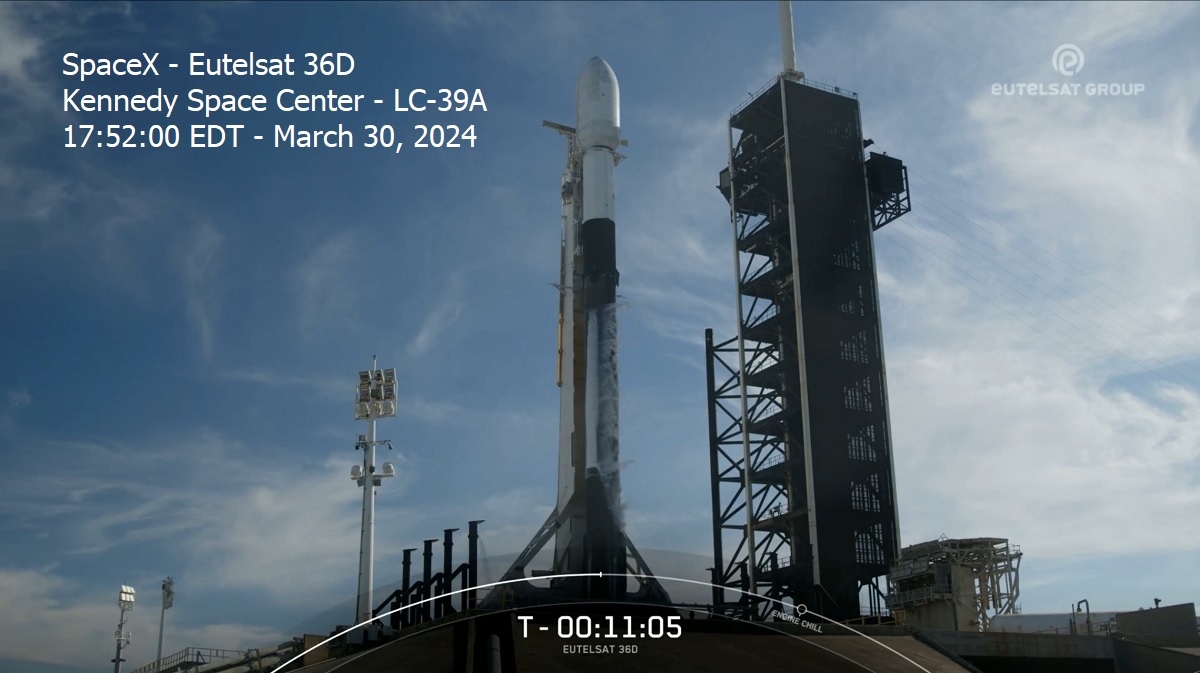
SpaceX - Eutelsat 36D

Screenshot from the launch of Eutelsat 36D. At last we get to see a normal GTO mission in daylight Mission Rundown: SpaceX Falcon 9 - Eutels...