Sunday, June 28, 2015

SpaceX Falcon 9 - CRS-7

  SpaceX Falcon 9 V1.1 - CRS-7 - Launching June 28, 2015

Screenshot from NASA TV of the launch of CRS-7

Mission Rundown: SpaceX V1.1 - CRS-7 accident

Written: February 2, 2021

Lift Off Time

June 28, 2015 - 14:21:12 UTC - 10:21:12 EDT

Mission Name

CRS-7

Launch Provider

SpaceX

Customer

NASA

Rocket

Falcon 9 V1.1 serial number B1018

Launch Location

Space Launch Complex 40 - SLC-40

Cape Canaveral Air Force Station, Florida

Payload

Cargo Dragon serial number C109

Payload mass

1 952 kg ~ 4 303 pounds

Where are the Dragon going?

Low Earth Orbit to the International Space Station

Will they be attempting to recover the first stage?

Yes - A new drone ship is ready downrange

Where will the first stage land?

Of Course I Still Love You - OCISLY - Newly build to replace the first Just Read The Instruction - JRTI

Will they be attempting to recover the fairings?

No. The Dragon capsule have a jettisonable nose cone and solar panel covers on the Trunk

This will be the:

– 19th flight of all Falcon 9 rockets

– 14th flight of Falcon 9 Full Trust V1.1 rocket

– 18th SpaceX launch from SLC-40

– 19th crash landing. Soft, hard, deliberate, ups…

– 1st attempted landing on the barge “OCISLY”

– 6th mission for SpaceX in 2015

Where to watch

Where to read more

There was found a now private SpaceX link

Scott Manley got an explanation as well

Want to know or learn more link visit Tim Dodd


Launch debriefing

(This is what happend)

T-00:00:12

T 00:00:00

T+00:01:30

T+00:02:19

T+00:02:20

T+00:02:21

T+00:02:22

T+00:02:26

T+00:02:28

T+00:02:29

T+00:02:36

T+00:02:48

-----

SpaceX:

T-00:19:08

Hosts:

T-00:13:00

T 00:00:00

T+00:01:30

T+00:01:45

T+00:02:19

T+00:02:19

T+00:02:22

T+00:02:24

T+00:02:26

T+00:02:28

T+00:02:29

-

-

NASA video feed at 00:00

Liftoff at 00:12

MaxQ at 01:42

Gaseous anomaly at 02:31

Flames visible at 02:32

Stage 2 explodes at 02:33

Dragon seen falling away at 02:34

First stage explodes at 02:38

First stage disintegrates at 02:40

Rocket debris seen flying at 02:41

NASA camera moves away at 02:48

NASA rap up from 02:50

--- --- --- ----

SpaceX feed finally found on NasaSpaceFlight com

Webcast blocked at 2:16

John Insprucker and Brian Mahlstedt - Audio only

Go - No Go Poll on launch from Flight Director at 8:24

Liftoff at 21:25 - No Flight Telemetry

MaxQ at 22:55 - Audio call out

Flight Telemetry engaged - Bad audio periodic

Gaseous anomaly at 23:44 - Frame 13

Oxygen gas reach combustion in Frame 17

Flames visible in oxygen cloud at 23:47

Stage 2 disintegrates at 23:49

Stage 1 explodes at 23:51 - Frame 21

First stage disintegrates at 23:52

Rocket debris seen flying at 23:54

SpaceX is silent until 27:58

John Insprucker explains - unknown inflight anomaly 


Don’t burp while flying

SpaceX CRS-7, also known as SpX-7, was a private American Commercial Resupply Service mission to the International Space Station, contracted to NASA, which launched and failed on June 28, 2015.

It disintegrated 139 seconds into the flight after launch from Cape Canaveral, just before the first stage was preparing to separate from the second stage.

It was the ninth flight for SpaceX's uncrewed Dragon cargo spacecraft and the seventh SpaceX operational mission contracted to NASA under a Commercial Resupply Services contract. The vehicle launched on a Falcon 9 v1.1 launch vehicle. It was the nineteenth overall flight for the Falcon 9 rocket and the fourteenth rocket flight for the substantially upgraded Falcon 9 v1.1. A NASA press conference was held after the accident. Watch.

The Launch/Mission Failure

Performance was nominal until 139 seconds into launch when a cloud of white vapor appeared, followed by a rapid loss of pressure in the liquid oxygen tank of the Falcon 9's second stage. The booster continued on its trajectory until the vehicle completely broke up 7 seconds later.

The Dragon CRS-7 capsule was ejected from the exploding launch vehicle and continued transmitting data until it impacted the ocean. SpaceX officials stated that it could have been recovered if the parachutes had deployed, but the software in the capsule did not include any provisions for parachute deployment in this situation. Dragon capsules does now include abort software programming especially in the future manned flights.

It’s assumed that the capsule crumpled and broke up on impact. Subsequent investigation traced the accident to the failure of a strut that secured a high-pressure helium bottle submerged inside the second stage's liquid-oxygen tank. With the helium pressurization system in the COPV integrity breached, excess helium quickly flooded the liquid-oxygen tank, causing it to over pressurize and burst.

The 5 foot tall COPV - Carbon Overwrapped Pressure Vessel was actually buoyant in the LOX - Liquid Oxygen so it shot up to the LOX surface hitting the top bulkhead and breaking it with catastrophic consequences for the launch vehicle. Given the fact that SpaceX had a number of related problems with test failures of COPV made by external suppliers, they should have been alerted to the fact that COPV was an achilles heel on Falcon 9.

The report from SpaceX pointed out that the stainless-steel eye bolt was rated for a load of 10000 pounds, but failed at 2000 pounds. Submerged in liquid Oxygen. Experiencing 3,2 G of force during flight. A frozen tread failed. The bolt snapped.

An independent investigation by NASA concluded that the most probable cause of the strut failure was a design error: instead of using a stainless-steel eye bolt made of aerospace-grade material, SpaceX chose an industrial-grade material without adequate screening and testing and overlooked the recommended safety margin.

The lost Dragon Payload

As of July 2013, the first International Docking Adapter, IDA-1, was scheduled to be delivered to the International Space Station on CRS-7. This 526 kg adapter would have been attached to one of the existing Pressurized Mating Adapters (specifically, PMA-2 or PMA-3) and convert the existing APAS-95 docking interface to the new NASA Docking System (NDS).

The new adapter is intended to facilitate future docking of new U.S. human-transport spacecraft. Previous United States cargo missions since the retirement of the Space Shuttle have been berthed, rather than docked, while docking is considered the safer and preferred method for spacecraft carrying humans.

The mission would have transported more than 4,000 pounds (1,800 kg) of supplies and experiments to the International Space Station including the Meteor Composition Determination investigation which would have observed meteors entering the Earth's atmosphere by taking high resolution photos and videos.

The Center for the Advancement of Science in Space had arranged for it to carry more than 30 student research projects to the station including experiments dealing with pollination in microgravity as well as an experiment to evaluate a sunlight blocking form of plastic.

In total, 2,477 kilograms (6,461 lb) of cargo was aboard the Dragon, including provisions, care packages and food for the crew, hardware for the station’s healthcare, life support, electrical and computer systems, 529 kilograms (1,166 lb) of scientific hardware for NASA, ESA and JAXA and hardware aka. parts of spacesuits for performing EVAs.

Dragon was also expected to return 675 kilograms (1,488 lb) of cargo to Earth.

Author William Graham link

link

Coauthor/Text Retriever Johnny Nielsen

link to launch list


Monday, April 27, 2015

SpaceX Falcon 9 - TurkmenÄlem52E - MonacoSat

  SpaceX Falcon 9 V1.1 - TurkmenÄlem52E - MonacoSat - Launching April 27, 2015

Screenshot from SpaceX Webcast of the launch of TurkmenÄlem52E - MonacoSat

Mission Rundown:

SpaceX Falcon 9 V1.1 - TurkmenÄlem52E - MonacoSat

Written: February 2, 2021

Lift Off Time

April 27, 2015 - 23:03:00 UTC - 19:03:00 EDT

Mission Name

TurkmenÄlem52E - MonacoSat

Launch Provider

SpaceX

Customer

Turkmenistan National Space Agency

Monaco Space System International

Rocket

Falcon 9 V1.1 serial number B1016

Launch Location

Space Launch Complex 40 - SLC-40

Cape Canaveral Air Force Station, Florida

Payload

Spacebus 4000C2 shared Communication Satellite

Payload mass

4 707 kg ~ 10 377 pounds

Where are the satellite going?

Geostationary Transfer Orbit - 211 km x 35 430 km

Will they be attempting to recover the first stage?

No. One way ticket flying “bareback” with no grid fins or landing legs + hydraulic tanks, pumps...

Where will the first stage land?

The Atlantic ocean east of Florida

Will they be attempting to recover the fairings?

No - Not expected to survive reentry or water impact

Are these fairings new?

Yes - Two Type 1 boat hull sized fairings - 34 x 17 feet with 10 evenly spaced ventilation ports in a circle

This will be the:

– 18th flight of all Falcon 9 rockets

– 13th flight of Falcon 9 V1.1 rocket

– 17th SpaceX launch from SLC-40

– 18th crash landing. Soft, hard, deliberate, Ups...

– 5th mission for SpaceX in 2015

Where to watch

Where to read more

SpaceX link

Want to know or learn more link visit Tim Dodd


Launch debriefing

(This is what happend)

T-00:19:35

-

T-00:12:36

T-00:20:00

T-00:19:35

T-00:14:12

T-00:22:39

T 00:00:00

T+00:01:25

T+00:03:00

T+00:03:08

T+00:03:58

T+00:08:55

T+00:26:00

T+00:27:00

T+00:32:15

SpaceX Webcast at 00:22

John Insprucker is hosting - Audio only

Clock stopped at 7:24 because of weather

Clock reset at 7:37

SpaceX resumes countdown at 39:22

Clock stopped at 44:48 because of weather

Clock reset at 46:18

Liftoff at 1:08:58 - No Flight Telemetry - 11:03 pm

MaxQ at 1:10:22

MECO 1:11:57, stage separation 1:11:59

SES-1 at 1:12:06

Faring separation at 1:12:55

SECO at 1:17:52 and coasting - 11:13 pm

SES-2 at 23:29 UTC or 11:29 pm - Doh - Same time

SECO-2 at 23:30 UTC or 11:30 pm

SpaceX doesn’t show deployment - 11:35 pm


Did you know they were friends?

SpaceX’s customer for this mission is Thales Alenia Space. With this flight, the Falcon 9 rocket will deliver the TurkmenÄlem52E/MonacoSat satellite to a geosynchronous transfer orbit. The Thales launch window is targeted to open at approximately 6:14pm EDT on Monday, April 27, 2015, from Space Launch Complex 40 at Cape Canaveral Air Force Station, Florida. If all goes as planned, the satellite will be deployed approximately 32 minutes after liftoff.

Weather delay postponed the launch twice 49 minutes to 23:03 UTC.

NOTAM area of Stage 1’s impact zone after launch of TurkmenÄlem52E - MonacoSat

The Payload

TürkmenÄlem 52°E / MonacoSAT (formerly referred to as TurkmenSat 1) is Turkmenistan's first satellite, built by Thales Alenia Space in the Cannes Mandelieu Space Center. Launched from Cape Canaveral on 27 April 2015 aboard a Falcon 9 v1.1 rocket, the satellite operates at 52°E in the geostationary orbit and has an anticipated service life of 15 years.

The 52°E position is controlled by the Principality of Monaco and the satellite includes 12 transponders that are referred to and commercialized as MonacoSAT as well as the 26 transponders referred to as TürkmenÄlem. The satellite is operated by the Turkmenistan National Space Agency. Wide Network Solutions is the satellite's biggest commercial operator.

The satellite was originally intended to be launched on a Chinese Long March 3B rocket but International Traffic in Arms Regulations prevented some US made parts being exported to China for the launch, and so it was switched to a SpaceX Falcon 9 v1.1 launcher in June 2013, and planned for late 2014/early 2015.

The launch was initially scheduled for 21 March 2015 but this was delayed to study a problem with a helium pressurization system on the Falcon 9 rocket, and a new launch date was set for no earlier than 24 April 2015.

SpaceX clarified the reason for the delay: "the issue wasn’t with the [helium] bottles themselves, but rather other bottles from a similar lot that failed testing at the company’s assembly plant. We identified a potential condition that could be shared with those on board the Thales vehicle."

Screenshot of the computer rendered TürkmenÄlem 52°E / MonacoSAT satellite with the Spacebus 4000C2 between the two solar panels and supporting three transponder beam reflectors

The spacecraft will maneuver to its final location via its onboard thrusters. The satellite’s primary propulsions system is an Astrium S400 bipropellant engine. After the subsequent launch on 27 April 2015 ground stations successfully positioned the satellite at 52°E.

12 of the 38 transponders have been leased to Space Systems International for the life of the satellite, in exchange for the use of Monaco’s geostationary slot at 52 degrees East. SSI have, in turn, leased these transponders to SES who will operate them under the name MonacoSat. Sharing the transmitters and cost on geostationary satellites is common.

TurkmenÄlem/MonacoSat is designed to operate for at least fifteen years.

Although TurkmenÄlem is Turkmenistan’s first true satellite, it is not the country’s first association with spaceflight. In August 2005, a capsule containing the country’s flag and the writings of then-President Saparmurat Niyazov was launched into orbit attached to the third stage of a Dnepr rocket. The capsule remains in orbit.

Author William Graham link

link

Coauthor/Text Retriever Johnny Nielsen

link to launch list


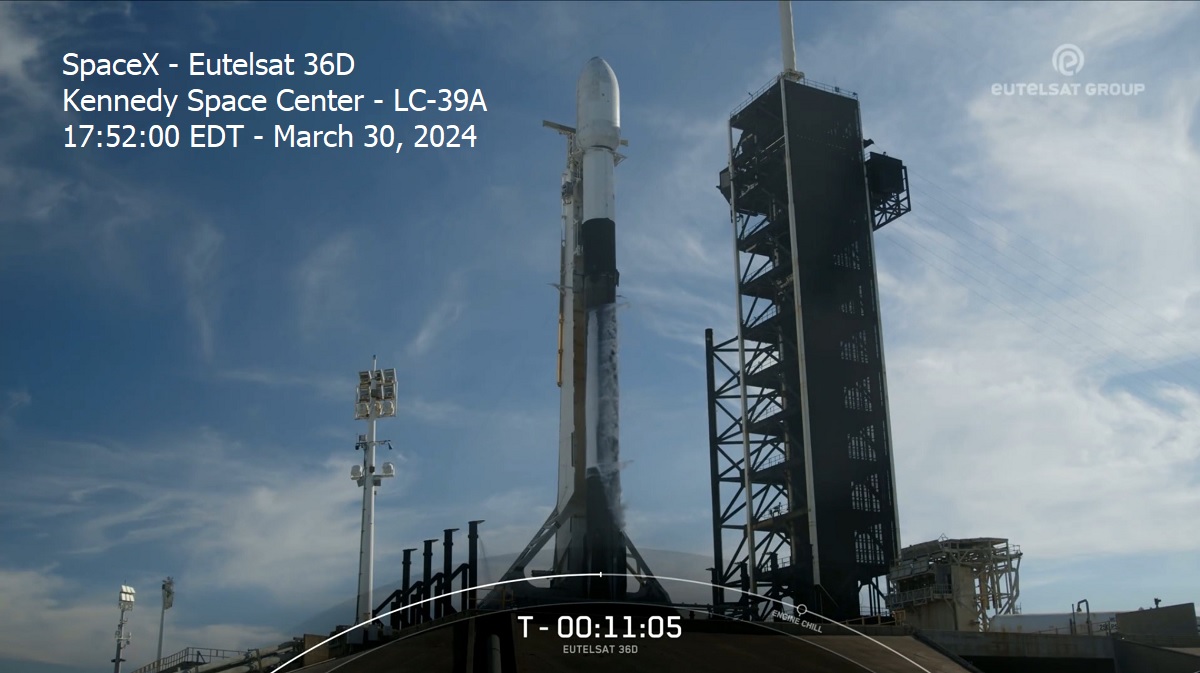
SpaceX - Eutelsat 36D

Screenshot from the launch of Eutelsat 36D. At last we get to see a normal GTO mission in daylight Mission Rundown: SpaceX Falcon 9 - Eutels...