Wednesday, February 11, 2015

SpaceX Falcon 9 - DSCOVR

  SpaceX Falcon 9 V1.1 - DSCOVR - Launching February 11, 2015

Screenshot from SpaceX Webcast of the launch of DSCOVR just before sunset

Mission Rundown: SpaceX Falcon 9 V1.1 - DSCOVR 

Written: February 3, 2015

Lift Off Time

February 11, 2015 - 23:03:32 UTC - 18:03:32 EST

Mission Name

DSCOVR

Launch Provider

SpaceX

Customer

U.S. Air Force

NOAA

Rocket

Falcon 9 V1.1 serial number B1013

Launch Location

Space Launch Complex 40 (SLC-40) at Cape Canaveral Air Force Station, Florida

Payload

Sun Earth Science Satellite

Payload mass

570 kg ~ 1 256 pounds

Where did the satellite go?

L1 Transfer Orbit 175 km x 1 371 156 km x 37,03° 

Will they be attempting to recover the first stage?

No. A soft controlled test landing on the Atlantic ocean - Bad weather and bad thruster kept JRTI in port

Where will the first stage land?

Atlantic ocean east of Florida

Will they be attempting to recover the fairings?

No - Not expected to survive reentry or water impact

Are these fairings new?

Yes - Two Type 1 boat hull sized fairings - 34 x 17 feet with 10 evenly spaced ventilation ports in a circle

This will be the:

– 15th flight of a Falcon 9

– 10th flight of a V1.1 booster 

– 14th SpaceX launch from SLC-40

– 15th crash landing. Soft, hard, deliberate, Ups...

– 2nd mission for SpaceX in 2015

Where to watch

Where to read more

SpaceX link - NASA TV all launch cameras

Scott Manley also have a link or two about DSCOVR

Want to learn more link visit Tim Dodd


Launch debriefing

(This is what happend)

T-00:15:38

Host:

T 00:00:00

T+00:01:30

T+00:02:49

T+00:02:59

T+00:03:41

T+00:06:56

T+00:08:40

T+00:08:15

T+00:09:44

T+00:31:10

-

T+00:35:58

SpaceX live feed at 00:21

Voice of John Insprucker keeping an eye on things

Liftoff at 16:00

MaxQ at 17:30

MECO 18:48, stage separation 18:50

SES-1 at 18:58

Faring separation at 19:40

Unseen Entry burn 23:00 by 3 Merlin 1D - 31 seconds

SECO at 24:40 and coasting - LOX tank view

Unseen Landing burn 24:48 by 1 Merlin 1D

Stage one splash down at 25:47 - Audio

SES-2 and SECO-2 in 66 seconds gave a velocity boost from 26 477 km/h to 37 136 km/h ??? - Unseen

SpaceX doesn’t show deployment of DSCOVR


What. Land in 7 meters high waves?

SpaceX’s customer for the DSCOVR mission is the United States Air Force and with NOAA and NASA. In this flight, the Falcon 9 rocket will deliver the DSCOVR satellite to a 187 x 1,241,000 km orbit at 37 degrees. The DSCOVR launch window is instantly and will open at approximately 6:03:32pm EST on Monday, February 11, 2015, from Space Launch Complex 40 at Cape Canaveral Air Force Station, Florida. If all goes as planned, the DSCOVR satellite will be deployed approximately 35 minutes after liftoff.

The Science Payload

Deep Space Climate Observatory (DSCOVR; formerly known as Triana, unofficially known as GoreSat) is a NOAA space weather, space climate, and Earth observation satellite. It was launched by SpaceX on a Falcon 9 launch vehicle on February 11, 2015, from Cape Canaveral This is NOAA's first operational deep space satellite and became its primary system of warning Earth in the event of solar magnetic storms.

DSCOVR was originally proposed as an Earth observation spacecraft positioned at the Sun-Earth L1 Lagrangian point, providing live video of the sunlit side of the planet through the Internet as well as scientific instruments to study climate change. Political changes in the United States resulted in the mission's cancellation, and in 2001 the spacecraft was placed into storage. 

We ain’t paying for that thing. U.S. Congress.

Proponents of the mission continued to push for its reinstatement, and a change in presidential administration in 2009 resulted in DSCOVR being taken out of storage and refurbished, and its mission was refocused to solar observation and early warning of coronal mass ejections while still providing Earth observation and climate monitoring.

It finally launched aboard a SpaceX Falcon 9 rocket on February 11, 2015, and after some fancy orbit changes reached L1 on June 8, 2015.

NOAA operates DSCOVR from its Satellite Operations Facility in Suitland, Maryland. The acquired space data that allows for accurate weather forecasts are carried out in the Space Weather Prediction Center in Boulder, Colorado. Archival records are held by the National Centers for Environmental Information, and processing of Earth sensor data is carried out by NASA.

DSCOVR is built on the SMEX-Lite spacecraft bus and has a launch mass of approximately 570 kg (1,257 lb). The main science instrument sets are the Sun-observing Plasma Magnetometer (PlasMag) and the Earth-observing NIST Advanced Radiometer (NISTAR) and Earth Polychromatic Imaging Camera (EPIC). DSCOVR has two deployable solar arrays, a propulsion module, boom, and antenna.

From its vantage point, DSCOVR monitors variable solar wind conditions, provides early warning of approaching coronal mass ejections and observes phenomena on Earth, including changes in ozone, aerosols, dust and volcanic ash, cloud height, vegetation cover and climate.

At its Sun-Earth L1 location it has a continuous view of the Sun and of the sunlit side of the Earth. After the spacecraft arrived on-site and entered its operational phase, NASA began releasing near-real-time images of Earth through the EPIC instrument's website. DSCOVR takes full-Earth pictures about every two hours and is able to process them faster than other Earth observation satellites.

The spacecraft orbits the L1 point in a six-month period, with a spacecraft Earth–Sun angle varying from 4° to 15°. In real life DSCOVR spirals around the Sun equally pulled by both the Earth’s and the Sun's gravity, so it doesn't waste energy maintaining its apparent position relative to both celestial bodies.

Landing Test Results

SpaceX planned to conduct a test flight where they would attempt to bring the first stage back through the atmosphere and land the expended first stage on a 90-by-50-meter (300 ft × 160 ft) floating landing platform.

Relative to earlier tests, the first-stage return on DSCOVR was much more challenging, especially in atmospheric reentry due to the deep-space nature of the Earth–Sun L1 launch trajectory for DSCOVR.

This would only be the second time that SpaceX ever tried to recover the first stage of the Falcon 9 launch vehicle. SpaceX expected deceleration-force loads to be twice as high and rocket heating to quadruple over the reentry conditions on Falcon 9 Flight 14 CRS-5.

Before the launch, the drone ship was in ocean surface conditions that made the barge landing infeasible. Therefore, the landing platform attempt was called off, and the first stage made an over-water soft landing test instead. This continued the collection of returnable first-stage test data on all the earlier phases of the flight test and added data on stage survival following a high-speed, high-load atmospheric entry.

With calm waters the first stage booster could have made a historic first landing.

Author William Graham link

link

Coauthor/Text Retriever Johnny Nielsen

link to launch list


Saturday, January 10, 2015

SpaceX Falcon 9 - CRS-5

  SpaceX Falcon 9 V1.1 - CRS-5 - Launching January 11, 2015

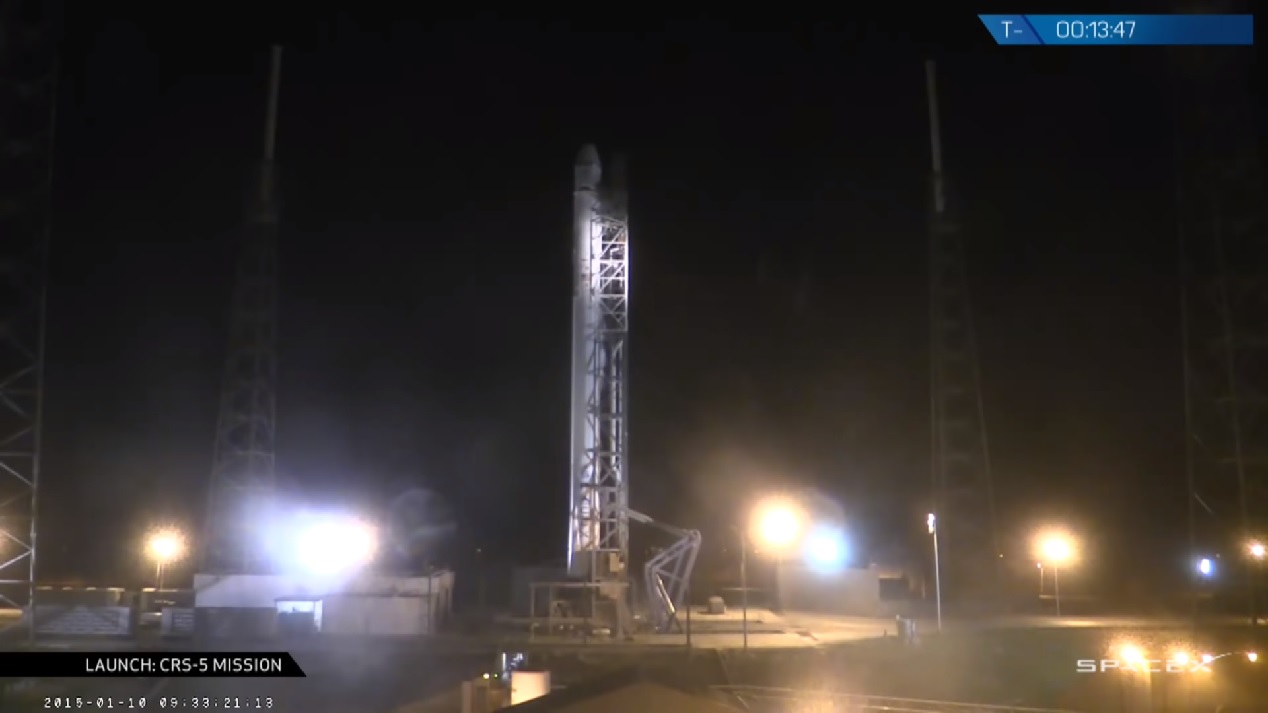
Screenshot from SpaceX Webcast of the launch of CRS-5

Mission Rundown: SpaceX Falcon 9 V1.1 - CRS-5

Written: February 3, 2021

Lift Off Time

January 10, 2015 - 09:47:10 UTC - 04:47:10 EST

Mission Name

CRS-5

Launch Provider

SpaceX

Customer

NASA

Rocket

Falcon 9 V1.1 serial number B1012

Launch Location

Space Launch Complex 40 - SLC-40

Cape Canaveral Air Force Station, Florida

Payload

Cargo Dragon serial number C107

Payload mass

2 385 kg ~ 5 258 pounds

Where are the Dragon going?

Low Earth Orbit to the International Space Station

Will they be attempting to recover the first stage?

Yes - By having a drone ship waiting 320 km downrange

Where will the first stage land?

A hard uncontrolled test landing on Just Read The Instruction placed of North Carolina coast

Will they be attempting to recover the fairings?

No. The Dragon capsule have a jettisonable nose cone and solar panel covers on the Trunk

This will be the:

– 14th flight of all Falcon 9 rockets

– 9th flight of Falcon 9 V1.1 rocket

– 13th SpaceX launch from SLC-40

– 14th crash landing. Soft, hard, deliberate, ups...

– 5th test landing attempt this time on JRTI

– 1st mission for SpaceX in 2015

Where to watch

Where to read more

SpaceX link

NASA TV recorded by a Portuguese

Want to know or learn more link visit Tim Dodd


Launch debriefing

(This is what happend)

T-00:15:36

Host:

T  00:00:00

T+00:01:36

T+00:02:42

T+00:02:53

T+00:03:35

T+00:04:34

T+00:06:50

T+00:08:07

T+00:09:22

T+00:09:57

T+00:11:58

-

-

T+51:06:50

752:23:50

757:57:50

SpaceX live feed at 00:22

His master's voice by John Insprucker

Liftoff at 15:58 - 09:47:10 UTC - January 10, 2015

MaxQ at 17:35

MECO 18:41, stage separation 18:43

SES-1 at 18:53

Nose cone seen after separation at 19:34

Boost back brake burn at 20:33 for 40 seconds

Entry burn 22:50 by 3 Merlin 1D for 15 seconds

Landing burn 26:06 by 1 Merlin 1D - failure

SECO at 25:21 and coasting

Dragon deployment at 25:56

Solar panels deployment at 27:58

Rap up from SpaceX at 31:40

Other events during this CRS-5 mission was:

Berthing with ISS Harmony Nadir airlock at 12:54 UTC

Released from ISS after 29 days at 18:11 UTC

Landed in Pacific Ocean near NRC Quest at 23:45 UTC


Okay. I’m waiting right here. For what?

After five successful missions to the International Space Station, including four official resupply missions for NASA, SpaceX’s Falcon 9 rocket and Dragon spacecraft are set to liftoff from Launch Complex 40 at the Cape Canaveral Air Force Station, Florida, for their fifth official Commercial Resupply (CRS-5) mission to the International Space Station, mankind’s orbiting lab.

The launch is currently targeted for Saturday, January 10 at 4:47am EST. A live launch webcast will begin at approximately 4:30am EST. If all goes as planned, Dragon C107 will arrive at the station approximately two days after liftoff.

The Dragon Payload

SpaceX CRS-5, also known as SpX-5, was a Commercial Resupply Service mission to the International Space Station, conducted by SpaceX for NASA, and was launched on 10 January 2015 and ended on 11 February 2015. It was the seventh flight for SpaceX's uncrewed Dragon cargo spacecraft and the fifth SpaceX operational mission contracted to NASA under an ISS resupply services contract.

The Falcon 9 rocket carrying the CRS-5 Dragon spacecraft successfully launched on 10 January 2015 at 9:47 UTC. Dragon reached the station on 12 January. It was grappled by the Space Station Remote Manipulator System at 10:54 UTC and berthed to the Harmony module at 13:56 UTC.

The Dragon spacecraft for CRS-5 carried 2,317 kilograms (5,108 lb) of cargo to the ISS. Included in this was 490 kg (1,080 lb) of provisions and equipment for the crew, 717 kg (1,581 lb) of station hardware, 577 kg (1,272 lb) of science equipment and experiments, and the 494 kg (1,089 lb) Cloud Aerosol Transport System (CATS).

CATS is a LIDAR remote sensing instrument designed to measure the location, composition and distribution of pollution, dust, smoke, aerosols and other particulates in the atmosphere. CATS is to be installed on the Kibo external facility and is expected to run for at least six months, and up to three years.

Dragon was loaded with 1,332 kg (2,937 lb) of outgoing cargo, returning it back to Earth in a parachute assisted splashdown off the coast of southern California. Cargo Dragon C107 spent 29 days 3 hours and 17 minutes in space.

The test landing of booster B1012

In an unprecedented test flight, SpaceX attempted to return the nearly-empty first stage of the Falcon 9 through the atmosphere and land it on a 90-by-50-meter (300 ft × 160 ft) floating platform called the autonomous spaceport drone ship. In October 2014, SpaceX had revealed that the barge Marmac 300 was being rebuilt for SpaceX in Louisiana, by mid-December, the barge was docked in Jacksonville, Florida, ready to go to sea to support the test flight landing attempt.

SpaceX attempted a landing on the drone ship on 10 January. Many of the test objectives were achieved, including precision control of the rocket's descent to land on the platform at a specific point in the south Atlantic Ocean and a large amount of test data was obtained from the first use of grid fin control surfaces used for more precise reentry positioning. However, the rocket was destroyed due to a hard landing.Musk said that one of the problems was the grid fins running out of hydraulic fluid but that is RP-1,

The SpaceX webcast indicated that the boostback burn and reentry burns for the descending first stage occurred, and that when the descending rocket then went "below the horizon," as expected, the live telemetry signal will be eliminated .

Shortly thereafter, SpaceX released information that the rocket did get to the drone spaceport ship as planned, but "landed hard ... Ship itself is fine. Some of the support equipment on the deck will need to be replaced."

Meanwhile on the Atlantic Ocean, JRTI is thinking: I got a headache. What happened?

SpaceX made a video of the landing attempt available on Vine.

Other things we learned

Special view at 18:44 of the first stage RP-1 tank during MECO, when the RP-1 becomes weightless. The yellow coloring of baffles and the black bottom layer made me think twice about the propellant tank content. LOX appears to be azur blue in color.

At 22:57 - 23:30 - 24:03 - 24:36 - 25:23 - 26:11 several views of the second stage LOX tank, the last two shows LOX becoming weightless and LOX really being weightless. And at 29:27 - 30:27 - 31:27 there is LOX just drifting around doing nothing. Now isn’t that material for a computer pause screen. Maybe even put a Goldfish in it. If it’s water.

But seriously we can learn a lot from these clips about LOX tanks internal structure, the diminishing amount of LOX during the second stage burn, and why it is important to push the LOX toward the engines intake valves, before you start SES-2 and maybe SES-3.

Any spare fuel in a tank should be ready to use at a moment's notice, so a thick pipe with a gas driven piston plunger filled with propellant will be a valuable thing in an emergency start up situation. Pressurized Helium gas spins up the turbopump, the preburner is ignited by propellant from the pipe, gravity and the turbopump forces the remaining propellant into the main combustion chamber and a shot of TEA-TEB ignites the rocket engine.

You never know when it's time to avoid something hard and change your course.

Author William Graham link

link

Coauthor/Text Retriever Johnny Nielsen

link to launch list


SpaceX - Eutelsat 36D

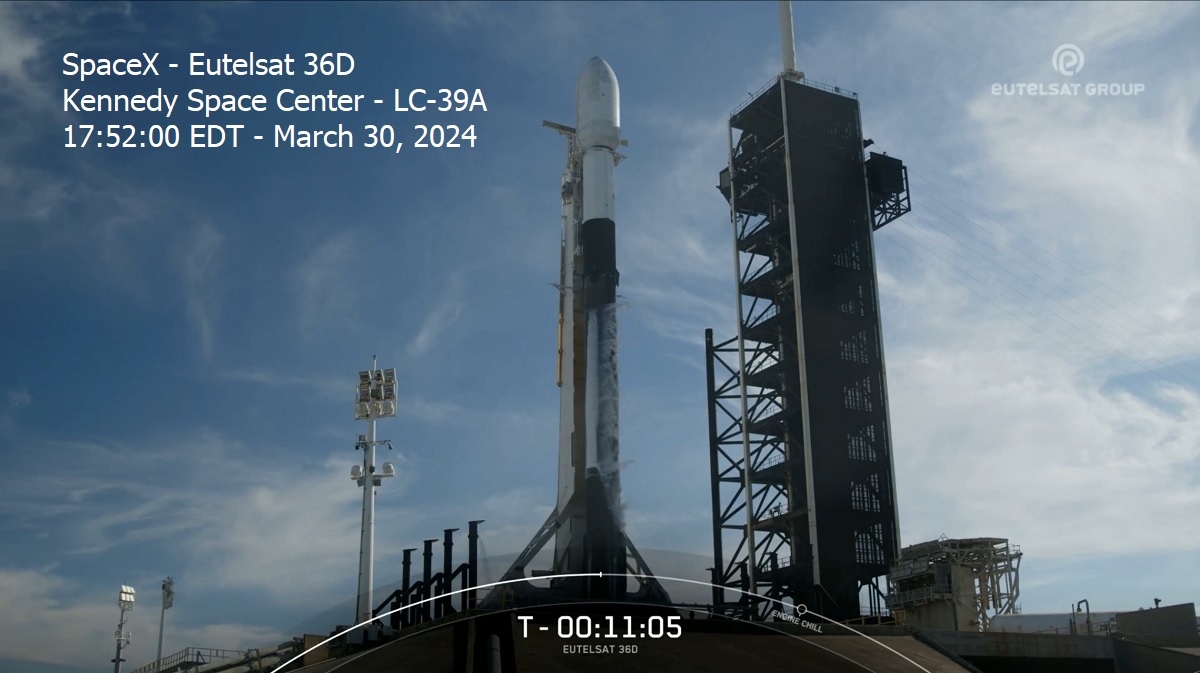
Screenshot from the launch of Eutelsat 36D. At last we get to see a normal GTO mission in daylight Mission Rundown: SpaceX Falcon 9 - Eutels...