Tuesday, May 22, 2012

SpaceX Falcon 9 - COTS C2+

  SpaceX Falcon 9 V1.0 - COTS C2+  - Launching May 22, 2012
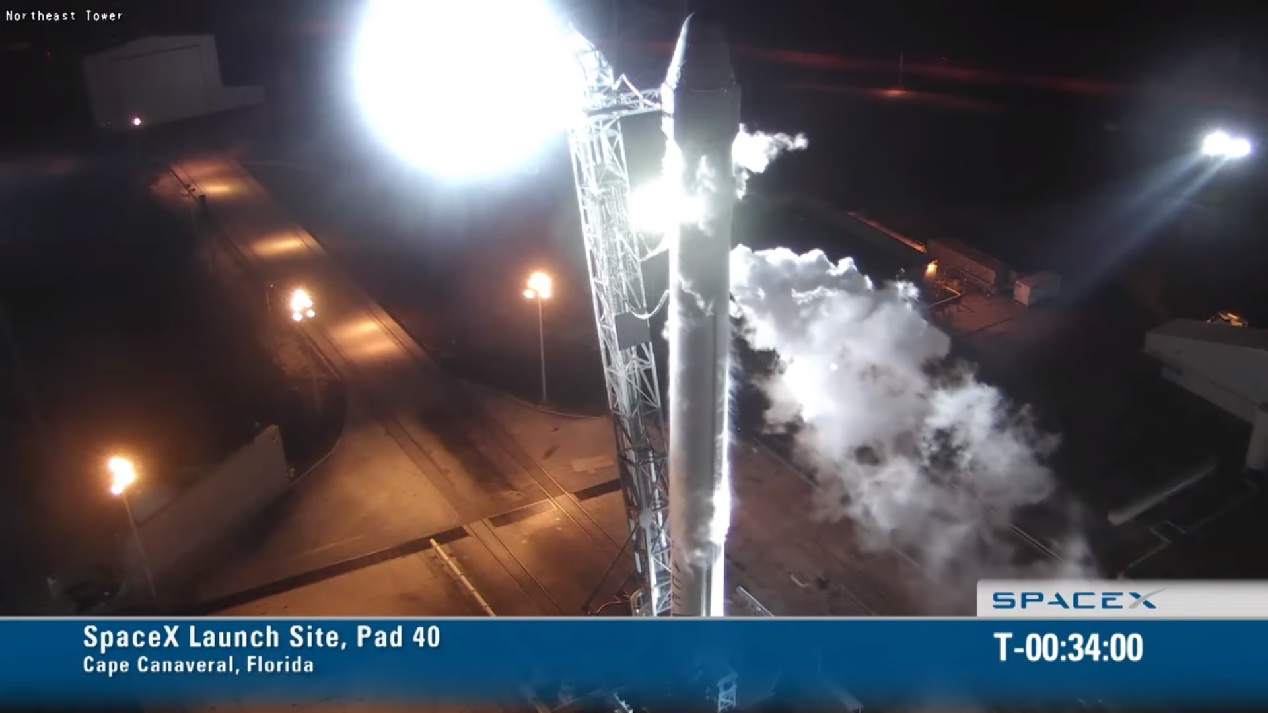
Screenshot from SpaceX Webcast of the launch of COTS-2+

Mission Rundown: SpaceX Falcon 9 V1.0 - COTS C2+

Written: February 6, 2021

Lift Off Time

May 22, 2012 - 07:44:38 UTC - 03:44:38 EST

Mission Name

COTS C2+

Launch Provider

SpaceX

Customer

NASA

Rocket

Falcon 9 V1.0 serial number B0005

Launch Location

Space Launch Complex 40 (SLC-40) at Cape Canaveral Air Force Station, Florida

Payload

Experimental Cargo Dragon serial number C102

Payload mass

525 kg ~ 1 157 pounds

Where are the Dragon going?

Low Earth Orbit to the International Space Station

Will they be attempting to recover the first stage?

No. It’s a regularly rocket - One way ticket only

Where will the first stage land?

The Atlantic ocean east of North Carolina

Will they be attempting to recover the fairings?

No. The Dragon capsule has a jettisonable nose cone and solar panel covers on the Trunk

This will be the:

– 3rd flight of Falcon 9 V1.0 rocket

– 3rd SpaceX launch from SLC-40

– 3rd crash landing. Soft, hard, deliberate, ups...

– 1st mission for SpaceX in 2012

– 52nd unmanned resupply mission to dock with ISS

– 123rd spacecraft to launch towards ISS

Where to watch

Where to read more

SpaceX link

The launch from NASA plus Press conference

Just the launch from The Pvpness

Want to know or learn more link visit Tim Dodd


Launch debriefing

(This is what happend)

Be aware that rocket based inflight video is delayed 3-4 seconds due to signal relays

T-00:44:20

Hosts:

T 00:00:00

T+00:01:25

T+00:02:52

T+00:03:03

T+00:03:15

T+00:03:55

T+00:08:22

T+00:09:27

T+00:10:00

T+00:11:38

-

-

T+80:17:22

218:04:22

223:57:22

SpaceX webcast at 00:16 - Clock unstable til 35:50

Jessica Jensen, John Insprucker and Kevin Brogan

Liftoff at 44:33 - 07:44:38 UTC - May 22, 2012

MaxQ at 45:57

MECO engine 1 and 9 at 47:24

MECO engine 2-8 at 47:36, stage separation 47:40

SES-1 at 47:48

Nose cone separation at 48:28 - Unseen

Exhaust illuminated by sunlight at 52:54

SECO at 53:59 - Belching and coasting

Dragon deployment  at 54:33

Solar Cell panels deployment at 56:10

Rap up from SpaceX at 58:22

Other events during this COTS C2+ mission were:

Berthing with ISS Harmony Nadir airlock at 16:02 UTC

Released from ISS after 6 days at 09:49 UTC

Landed in Pacific Ocean near NRC Quest at 15:42 UTC


Getting close to catch a Dragon’s tooth?

The third SpaceX Falcon 9 rocket successfully orbited the company's first fully functional Dragon spacecraft on the COTS C2+ Demonstration Mission for NASA on May 22, 2012.  The two stage, kerosene fueled rocket lifted off from Cape Canaveral Space Launch Complex 40 at 07:44 UTC, beginning an ambitious mission that, if fully implemented, would see the spacecraft docked to the International Space Station for two weeks. 

It was Falcon 9's first night launch. The liftoff ended a 17 month hiatus for the launch vehicle as SpaceX worked to prepare Dragon for the C2+ mission.
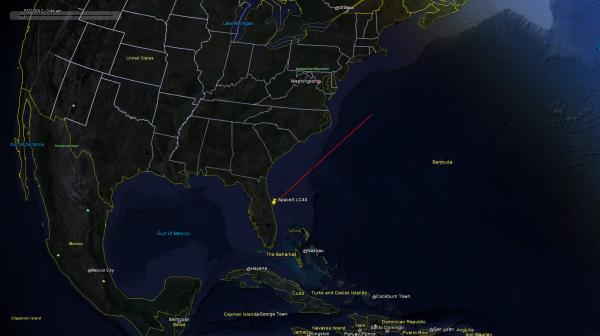
Red flight path of Falcon 9 first stage - It’s a nighttime launch 51,6 degree along the east coast

Falcon 9's first stage burned for three minutes, its second stage for an additional 6 minutes 14 seconds, to inject Dragon into a 297 x 346 km x 51.6 deg phasing orbit.  Dragon's twin solar arrays, on their inaugural flight, deployed shortly after spacecraft separation.  The arrays were attached to Dragon's "trunk", an aft module attached to the cone shaped spacecraft that was also on its first fully configured flight.  

The launch occurred three days after a last launch abort that was caused by a faulty helium purge check valve on the launcher's center Merlin 1C engine no. 5.

Crews identified the problem and replaced the valve while Falcon 9 remained vertical on the pad. Which means there is room enough between the engines for minor repairs, but it’s suspected that this is a two man repair job with no propellant loaded.

The Dragon Payload

Dragon carried 525 kg of demonstration cargo for ISS. Plans call for it to return 620 kg of cargo when it reenters and splashes down in the Pacific Ocean. But the ISS docking is contingent on Dragon successfully completing a series of demonstration maneuvers for NASA during the first two days of its mission, before it will be allowed to approach ISS for a capture and the following berthing.

It is the first visit by a commercial spacecraft to the International Space Station. At this point in the flight, Dragon C2 had begun to demonstrate objectives originally intended for the following standalone "C3" mission. It was now COTS C2+.

ISS crew successfully captured the SpaceX Dragon C2+ spacecraft at 13:56 UTC on May 25, 2012, after a slight delay due to a LIDAR issue.  The 5-7 tonne spacecraft (SpaceX had not revealed its dry mass) was subsequently berthed to the ISS Harmony module earth facing Nadir airlock at 16:02 UTC.

The pressurized section carried 525 kg (1,157 lb) of cargo to the ISS, which included food, water, clothing, cargo bags, computer hardware, the NanoRacks Module 9 (student experiments and scientific gear) and other miscellaneous cargo. No unpressurized cargo was delivered on this mission.

An unannounced addition to the cargo manifest, made public after the launch, was a small canister, affixed to the second stage's top, containing the 1-gram ash remains of over 300 people including Project Mercury Astronaut Gordon Cooper, and James Doohan, the actor who played Scotty on the television show Star Trek in the 1960s.

The remains were flown semi-secretly by Celestis, a company that has flown burial canisters in the past on SpaceX's Falcon 1 launch vehicle. The second stage and the burial canister remained in the initial orbit Dragon C2+ was inserted to, and burned up in the Earth's atmosphere a month later.

On its return to Earth, Dragon brought back 665 kg (1,466 lb) worth of pressurized cargo back to Earth; the cargo included experiment samples, experiment hardware, ISS' systems hardware and Extravehicular Mobility Unit hardware.

One of the experiments returned by Dragon was the Shear History Extensional Rheology Experiment (SHERE) administered by NASA's Glenn Research Center.

Another experiment returning with Dragon was the Multi-user Droplet Combustion Apparatus (MDCA), and the Combustion Integrated Rack-Fluids and Combustion Facility (CIR). The return flight was planned to carry 660 kg (1,460 lb).

Another experiment returning on this mission was the Material Science Research Rack (MSRR), which investigated microgravity experiments on aluminum-alloy rods.

Four hours after Dragon left the station, it began to conduct its nine-minute-long deorbit burn. The Dragon capsule jettisoned its trunk and re-enter Earth's atmosphere. Its heat shield protected it during most of the re-entry and when low enough in altitude its two drogue parachutes were deployed, followed by its three main parachutes.
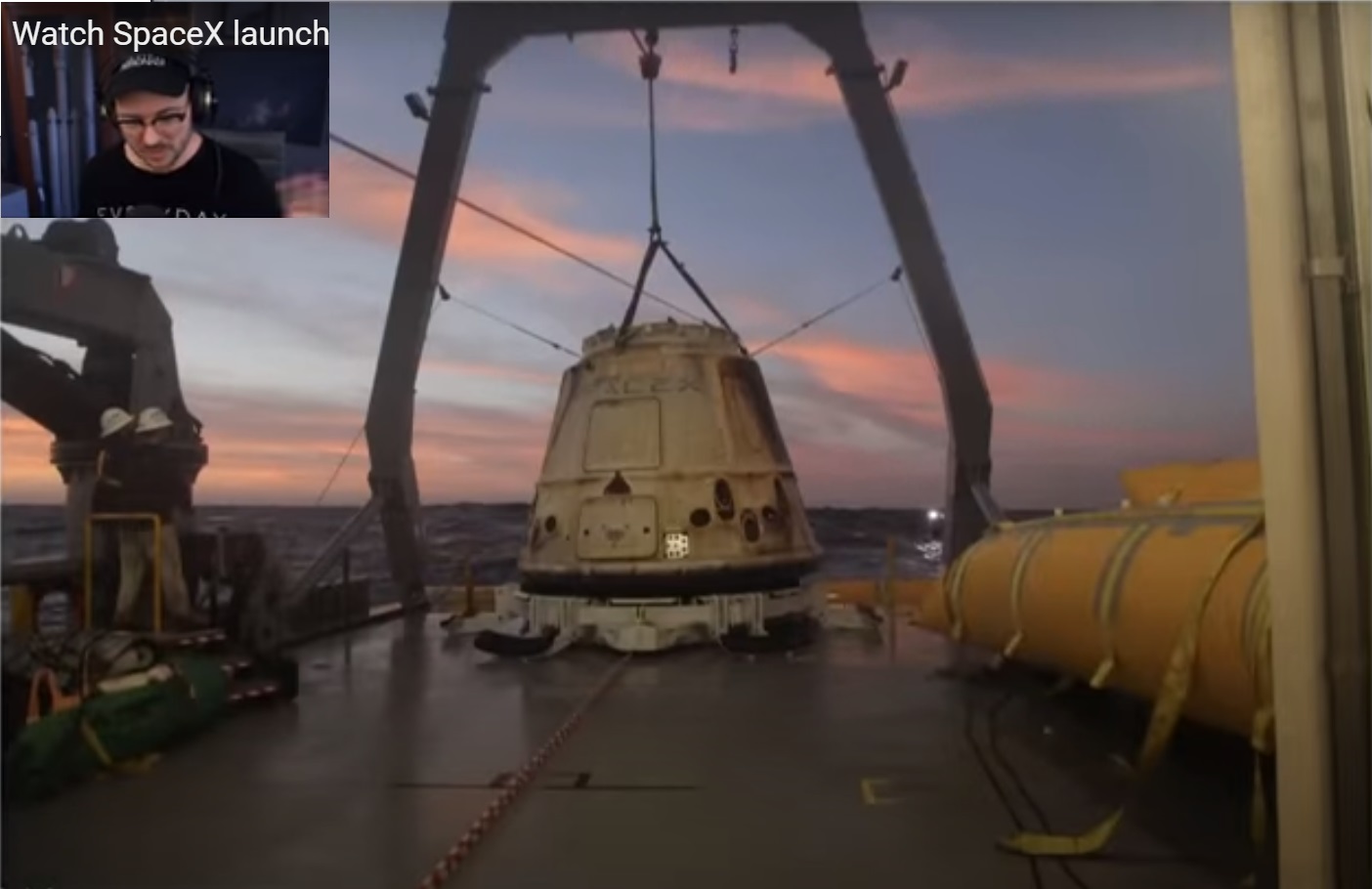
Screenshot of an recovered Dragon CRS-6 on the deck of Go Searcher in the Pacific Ocean

The Dragon capsule splashed down into the Pacific Ocean about 900 km (560 mi) from the Baja Peninsula at approximately 11:42 EDT (15:42 UTC) on May 31, 2012 and was recovered by a small fleet of recovery vessels from the contractor hired by SpaceX, American Marine.

Dragon had departed the International Space Station about 5.5 hours earlier, at 08:07 UTC. The reentry and splashdown ended Dragon's COTS C2+ demonstration mission for NASA, opening the way for official commercial cargo flights for NASA.

Author William Graham link

link

Coauthor/Text Retriever Johnny Nielsen

link to launch list


Wednesday, December 8, 2010

SpaceX Falcon 9 - COTS C1

  SpaceX Falcon 9 V1.0 - COTS C1  - Launching December 8, 2010

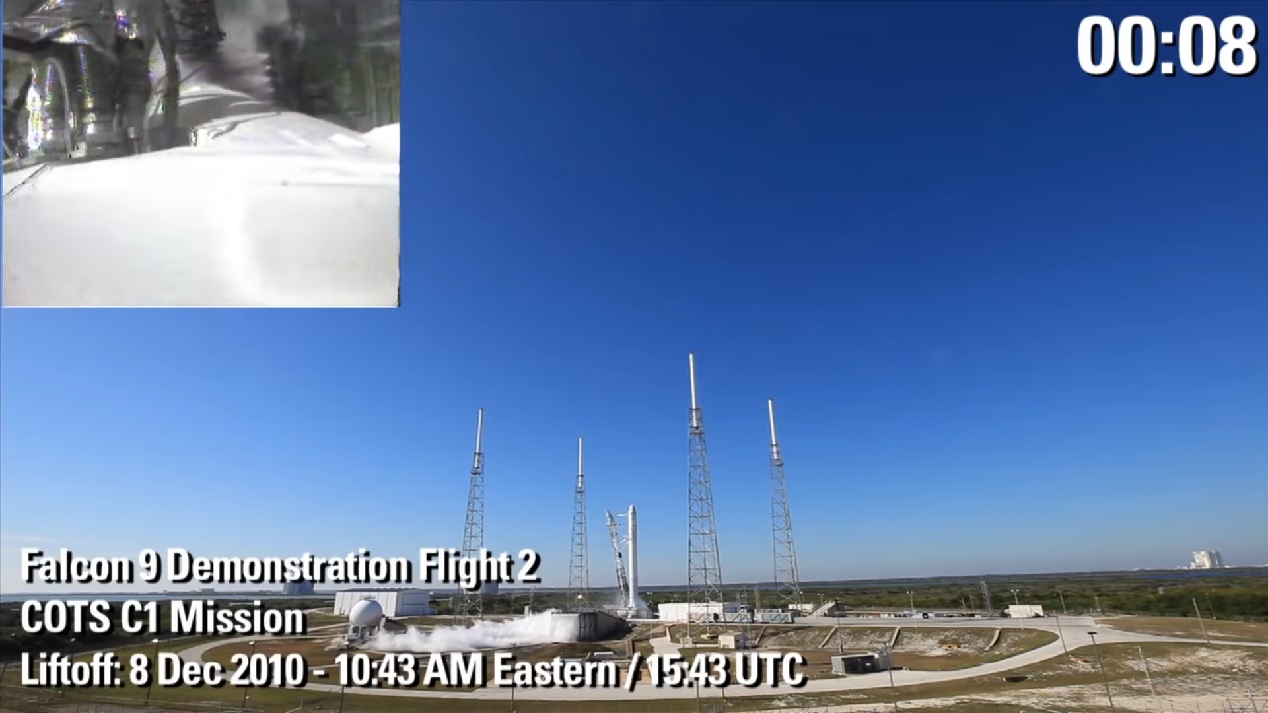
Screenshot from SpaceX Webcast of the launch of COTS C1

Mission Rundown: SpaceX Falcon 9 V1.0 - COTS C1

Written: February 6, 2021

Lift Off Time

December 8, 2010 - 15:43:00 UTC - 10:43 EST

Mission Name

COTS C1

Launch Provider

SpaceX

Customer

NASA

U.S. Army

NRO

Rocket

Falcon 9 V1.0 serial number B0004

Launch Location

Space Launch Complex 40 - SLC-40

Cape Canaveral Air Force Station, Florida

Payloads

Experimental Cargo Dragon serial number C101

1 SMDC-ONE CubeSat 

2 QBX CubeSats

1 Mayflower CubeSat 

4 Perseus CubeSats

Payload mass

Dragon dry weight ~ 4 201 kg plus weight of propellant and weight of mass simulator

CubeSats ~ 7 kg plus weight of dispensers

Where are the Dragon going?

Low Earth Orbit Demonstration Flying two orbits

2nd Stage Transfer Orbit Test: 278 km x 11 083 km

Splash down time

December 8, 2010 - 19:02:52 UTC - 11:02:52 am PDT

The Pacific ocean west of Baja California

Will they be attempting to recover the first stage?

Yes. There were parachutes onboard, but the first stage disintegrated upon reentry

Where will the first stage land?

The Atlantic ocean east of North Carolina

Will they be attempting to recover the fairings?

No. The Dragon capsule has a jettisonable nose cone

This will be the:

– 2nd flight of Falcon 9 V1.0 rocket

– 1st free flight of Dragon capsule C101

– 2nd SpaceX launch from SLC-40

– 2nd crash landing. Soft, hard, deliberate, ups...

– 2nd mission for SpaceX in 2010

Where to watch

Where to read more

SpaceX link short clip - Longer clip saved by TMRO

NASA shows launch from ground camera

TMRO shows SpaceX launch from T-00:01:00

Replay of Dragon ascent at T+00:53:50

Want to know or learn more link visit Tim Dodd


Launch debriefing

(This is what happend)

Hosts:

-

T-00:00:11

T 00:00:00

T+00:01:25

T+00:02:44

T+00:02:52

T+00:03:04

T+00:03:47

T+00:08:51

T+00:09:26

T+00:54:47

T+01:36:00

T+03:19:52

Lauren Lyons?, John Insprucker and Kevin Brogan seen in the longer clip by TMRO during rap up.

SpaceX live feed at 00:02 - Short highlight clip

Liftoff at 00:13 - Launch at 2:43 pm - 15:43 UTC

MaxQ at 01:38 - Contrail begins in long clip

MECO engine 1 and 9 at 01:18 - cut in clips

MECO engine 2-8 at 01:26, stage separation at 01:31

SES-1 at 01:39

Nose cone separation at 01:58

SECO at 02:21 and coasting

Dragon C101 deployment at 02:36 - With no trunk

Restart second stage at 03:34 for 19 seconds

CubeSats on trunk edge deployed at 4:19 pm

Dragon splashdown 03:13 after two orbits


Can this Dragon fly on its own?

SpaceX COTS Demo Flight C1 was the first orbital spaceflight of the Dragon cargo spacecraft, and the second overall flight of the Falcon 9 rocket manufactured by SpaceX. It was also the first demonstration flight for NASA's Commercial Orbital Transportation Services (COTS) program.

The primary mission objectives were to test the orbital maneuvering and reentry of the Dragon capsule. The mission also aimed to test fixes to the Falcon 9 rocket, particularly the unplanned roll of the first stage that occurred during flight 1. Liftoff occurred on 8 December 2010 at 15:43 UTC.

The success of the mission allowed SpaceX to advance its vehicle testing plan. With two back-to-back "near-perfect" Falcon 9 launches and satisfactory tests of the first Dragon capsule, SpaceX "asked NASA to combine objectives laid out for the remaining two COTS missions... and permit a berthing at the ISS during its next flight". This combined test mission was completed in May 2012, and achieved its objectives, opening the path to regular cargo deliveries by Dragon to the International Space Station (ISS) under the Commercial Resupply Services (CRS) contract. Commercial flights started in October 2012 with CRS-1.

The second launch attempt was targeted for 15:43 UTC, and was successful. First stage engines cut off at T+02:56, the nose cone separated at T+03:47, second stage engines cut off at T+08:56, all as planned. The Dragon vehicle separated at T+09:30 and achieved a near circular orbit, with a perigee of 288 km (179 mi), an apogee of 301 km (187 mi) and an inclination of 34.53°. These were close to targeted marks of a 300 km (190 mi) circular orbit at an inclination of 34.5°.

The Dragon Payload

In addition to Dragon C101, Falcon 9 carried eight CubeSats or nano satellites into orbit as well. These were Space and Missile Defense Command — Operational Nanosatellite Effect, SMDC-ONE 1 for the US Army, Mayflower for Northrop Grumman and the University of Southern California, QbX-1 and QbX-2 for the US National Reconnaissance Office, and Perseus 000, 001, 002 and 003 for the Los Alamos National Laboratory.

These CubeSats were all deployed into orbit from the Dragon trunk still attached to the second stage which decayed quickly.

One of the weight ballasts inside the Dragon spacecraft was a metal barrel containing a wheel of French Le Brouère cheese. This cheese is produced in Bulgnéville, Vosges. It was packed as a joke, and references the Cheese Shop sketch from Monty Python's Flying Circus. The barrel's lid was pasted with an image from the poster for the 1984 spoof film Top Secret!. SpaceX's CEO didn’t reveal the “cargo'' during the post-splashdown news conference, for fear of the joke overshadowing the company's accomplishments.

While in orbit, a battery of automated tests were performed including thermal control and attitude control to maintain uninterrupted TDRS data links. At 16:15 UTC, SpaceX announced that it had achieved contact with the Dragon module through the TDRS system. After the two planned orbits, the spacecraft was manually commanded to begin a deorbit burn, resulting in it splashing down in the Pacific Ocean at 19:02 UTC approximately 800 km (500 mi) west of Baja California after all three parachutes successfully deployed.

SpaceX reported that all test objectives were completed, and the recovery craft arrived to retrieve the spacecraft within 20 minutes of splashdown. The craft landed within 800 m (2,600 ft) of the targeted location, well within the 60-by-20-kilometer (37 by 12 mi) recovery zone. From launch to splashdown, the demonstration flight lasted for 3 hours, 19 minutes, 52 seconds.

DRAGON COTS C1 DEMO was successfully completed. Now next launch. Please.

Second stage secondary mission

The second stage engine was reignited in orbit after separation from the Dragon capsule. This allowed SpaceX to work on a secondary mission objective of expanding the launch capability envelope by testing in-space engine reignition and ability of the vehicle to achieve a beyond-LEO (Low Earth Orbit) or a Transfer Orbit.

Even though the nozzle of the Merlin 1C Vacuum second-stage engine had been substantially trimmed by six inches—due to two cracks discovered only a few days before the scheduled launch—the second stage reached an altitude of 11,000 kilometers (6,800 mi) in an elliptical transfer orbit.

If a small satellite was carried by the second stage, and was deployed at apogee. It would be able to carry out its mission in a High Earth Orbit, if it circuliced its orbit. Stage two was carrying the Dragon Trunk mounted with 3-7 CubeSats dispencere already, so it was a technical possibility.

There is no information about whether or not the dispensere were meant for six to eight 1-3U CubeSats, but since NORAD tracked 8 targets, I think the latter.

Ha! Tin snips! The red arrow points to an incredibly lowtech tool. Whatever. If it works. Use it.

SpaceX “employee“ Marty Anderson inside Falcon 9 interstage trimming the Merlin 1C engine bell, or is he mounting the brown ring stiffeners near the gray pressure bottles, that probably is a part of the stage separation mechanism. The reflective walls behind him are honeycomb aluminium plates mounted on a glasfiber or carbonfiber tube bolted on top of the propellant tanks, and there is a power/data plug next to his thigh.

He is also working on top of the bulkhead to the first stage LOX tank, and he might be sitting on a parachute used in a failed recovery attempt. The first stage comes in at extremely high speeds over 8 000 km/h when reentering the upper atmosphere at about 60 km altitude, where the drogeshutes hardly have time to slow the first stage down, so the main parachute can be deployed at 30 km altitude.

I have currently no information source to tell me the dry mass of the first stage, so I can't give any calculation on the aerodynamic forces the first stage faces. But I found a calculation on the Dragon capsule. “In that one great the force is.” Master Yoda.

Author William Graham link

link

Coauthor/Text Retriever Johnny Nielsen

link to launch list


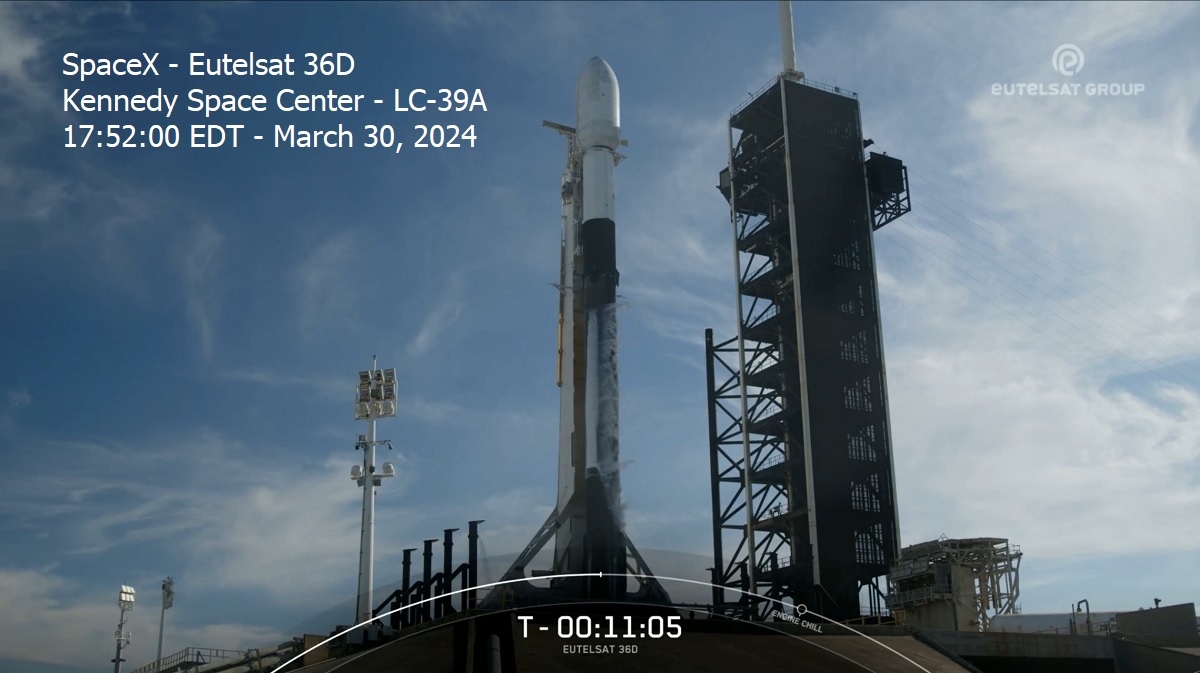
SpaceX - Eutelsat 36D

Screenshot from the launch of Eutelsat 36D. At last we get to see a normal GTO mission in daylight Mission Rundown: SpaceX Falcon 9 - Eutels...