Wednesday, June 15, 2016

SpaceX Falcon 9 - Eutelsat 117 West B - ABS-2A

  SpaceX Falcon 9 Full Thrust - Eutelsat 117 West B - ABS-2A - Launching June 15, 2016

Screenshot from SpaceX Webcast of the launch of Eutelsat 117 West B - ABS-2A

Rundown: SpaceX FT - Eutelsat 117 West B + ABS-2A

Written: January 30, 2021

Lift Off Time

June 15, 2016 - 14:29 UTC - 10:29 EDT

Mission Name

Eutelsat West 117 B at 117o West

ABS-2A at 75o East

Launch Provider

SpaceX

Customers

Eutelsat

ABS

Rocket

Falcon 9 Full Thrust serial number B1024

Launch Location

Space Launch Complex 40 - SLC-40

Cape Canaveral Air Force Station, Florida

Payload

2 Boeing 702SP Communication Satellites

Payload mass

Eutelsat West 117 B - 2 205 kg ~ 4 861 pounds

ABS-2A - 2 205 kg ~ 4 861 pounds

Where are the satellites going?

Geostationary Transfer Orbit - 395 km x 62 591 km x initially with a 24,68o Inclination

Will they be attempting to recover the first stage?

Yes - A drone ship has been towed downrange

Where will the first stage land?

OCISLY is waiting about 680 km downrange

Will they be attempting to recover the fairings?

No - Engineers are looking for ways to do this

Are these fairings new?

Yes - Two Type 1 boat hull sized fairings - 34 x 17 feet with 10 evenly spaced ventilation ports in a circle

This will be the:

– 26th flight of all Falcon 9 rockets

– 6th flight of Falcon 9 Full Trust “V1.2” booster 

– 24th SpaceX launch from SLC-40

– 22th crash landing. Soft, hard, deliberate, Ups...

– 6th mission for SpaceX in 2016

Where to watch

Where to read more

SpaceX link

Want to learn more link visit Tim Dodd


Launch debriefing

(This is what happend)

Nitrox gas is a controlled mixture of nitrogen and oxygen gasses that are void of atmospheric humid air.

Pressurization of the fairing compartment secures that moisture and other pollutants can’t enter the fairing and the satellites within.

T-00:17:27

Hosts:

-

T-00:00:02

T 00:00:00

T+00:01:20

T+00:02:41

T+00:02:48

T+00:03:37

T+00:06:41

T+00:08:26

T+00:09:13

T+00:24:51

T+00:26:00

-

T+00:30:27

T+00:35:27

-

SpaceX live feed at 00:31

Michael Hammersley, Kate Tice, Brian Mahlstedt and John Insprucker are the four man relay team today

TEA-TEB Ignition - Full Thrust check

Liftoff at 17:59

MaxQ at 19:20

MECO at 20:40, stage separation at 20:42

SES-1 at 20:47

Fairing separation at 21:36 - Filled with NITROX gas

Entry burn 24:40 by 3 Merlin 1D+ for 30 seconds

Landing burn 26:25 by 1 Merlin 1D+ for 18 seconds

SECO at 27:12 and coasting

SpaceX resumes live feed at 42:50

SES-2 - SECO-2 in 58 seconds gave a velocity boost from 27 435 km/h to 35 529 km/h at 43:59

SpaceX doesn’t show deployment 1 at 48:27

SpaceX does show deployment 2 at 53:27

Rap up from SpaceX at 54:00


Why is this landing thing still so hard?

SpaceX’s Falcon 9 rocket will deliver two commercial communications satellites to Geostationary Transfer Orbits (GTO). The two satellites, EUTELSAT 117 West B and ABS-2A, are operated respectively by Eutelsat and ABS – two companies that provide global communications services to a variety of users.

SpaceX are targeting the launch from Space Launch Complex 40 at Cape Canaveral Air Force Station, Florida on June 15. The approximately 45-minute launch window opens on June 15 at 10:29 am EDT, 2:29 pm UTC. EUTELSAT 117 West B will be deployed approximately 30 minutes after liftoff, and ABS-2A will be deployed 5 minutes later.

The experimental three engine landing burn went wrong, because one engine's propellant intake got starved, so it died during descent. The first stages landed hard, buckled all landing legs and damaged the engines so much, it caught fire. Apparently a one engine landing burn is less fuel efficient compared to a three engine landing burn.

With a 28-30 second single engine landing burn and 10-12 second triple engine landing burn, I’m pressed to see the fuel gain on the latter landing burn. Hmm. Three engines splitting the workload in a third of the time. I think I got it. So long, booster B1024. Rest in pieces. OCISLY is now three for three with crashes and landings.

The payloads

Eutelsat 117 West B (previously SATMEX 9) is a communications satellite that is operated by Eutelsat, providing video, data, government, and mobile services for the Americas. The satellite was designed and manufactured by Boeing Space Systems, and is a Boeing 702SP model communication satellite. It is located at 117 degrees west longitude. It was launched on board a SpaceX Falcon 9 rocket on June 15, 2015 (UTC time).

The satellite is solely propelled by electrically powered spacecraft propulsion, with the onboard thrusters used for both geostationary orbit insertion and station keeping. The XIPS-25, or 25-cm Xenon Ion Propulsion System, is a gridded ion thruster manufactured by L-3 Communications. The XIPS-25 engine is used on Boeing 702 class satellites for station-keeping as well as orbit-raising.

XIPS is 10 times more efficient than conventional liquid-fuel systems. On a XIPS equipped 702 satellite, four 25 cm (9.8 in) thrusters provide economical station keeping, needing only 5 kg (11 lb) of fuel per year, "a fraction of what bipropellant or arcjet systems consume". An XIPS-equipped satellite can be used for final orbit insertion, conserving even more payload mass, as compared to using a traditional on-board liquid apogee engine.

The two satellites each had a launch mass of 4,861 pounds (2,205 kg). It is notable for being the second pair of commercial communications satellites in orbit to use electric propulsion, providing significant weight savings. The first pair - Eutelsat 115 West B and ABS-3A - was launched on an earlier flight with Falcon 9.

Eutelsat 117 West B is planned to be the second in a family of 4 satellites in the Eutelsat constellation.

The launch is also notable for being the second flight of Boeing's stacked satellite configuration for the Boeing 702SP, a configuration Boeing designed specifically to take advantage of the SpaceX Falcon 9 Full Thrust capabilities.

ABS-2A — The sister-satellite 702SP from the same launch became fully operational as a geosynchronous communications satellite in the first quarter of 2017 after a handover from Boeing to ABS for on-orbit operations on March 23, 2017. An earlier  press release on January 16, 2017 stated that Eutelsat 117 West B also has started providing service.

How to stack two satellites before shipping them to SpaceX. ABS-2A is the bottom one.

ABS-2A will join Asia Broadcast Satellite’s fleet at a longitude of 75 degrees East, where it will be co-located with the existing ABS-2 which was launched in February 2014.

ABS-2A carries 48 Ku-band transponders which will be used to provide communications to Russia, India, Africa, the Middle East and South and South-East Asia.

Not much is written about Eutelsat 117 West B, so I’m taking my data from the sister satellite 115 West from Wikipedia, therefore dates are wrong among other things.

Sorry. My bad. They are now corrected.

I have much later found a more reliable source of data in NASAspaceflight.com

At T+03:39 and videotime 21:39 you see a third engine camera on top between the two normal cameras, pay attention to the exhaust pipe on the engine bell. It’s above the two regular engine bell cameras of which one is mounted upside down. Because with Earth to the left that makes it look like it's flying backwards. Weird camera view.

Author William Graham link

link

Coauthor/Text Retriever Johnny Nielsen

link to launch list


Friday, May 27, 2016

SpaceX Falcon 9 - THAICOM 8

  SpaceX Falcon 9 Full Thrust - THAICOM 8 - Launching May 27, 2016

Screenshot from SpaceX Webcast of the launch of THAICOM 8

Mission Rundown: SpaceX Falcon 9 FT - Thaicom 8

Written: January 31, 2021

Lift Off Time

May 27, 2016 - 09:39 UTC - 05:39 EDT

Mission Name

THAICOM 8

Launch Provider

SpaceX

Customer

THAICOM Public Limited Company

Rocket

Falcon 9 Full Thrust serial number B1023-1

Launch Location

Space Launch Complex 40 - SLC-40

Cape Canaveral Air Force Station, Florida

Payload

GEOStar-2.3 Communication Satellite - serial no. 36

Payload mass

3 200 kg ~ 6 800 pounds

Where did the satellite go?

Geostationary Supersynchronous Transfer Orbit

349 km x 91 392 km x 21.21° - Target 78,5° East

Will they be attempting to recover the first stage?

Yes - A drone ship has been towed downrange

Where will the first stage land?

OCISLY is waiting about 680 km downrange

Will they be attempting to recover the fairings?

No - Engineers are looking for ways to do this

Are these fairings new?

Yes - Two Type 1 boat hull sized fairings - 34 x 17 feet with 10 evenly spaced ventilation ports in a circle

This will be the:

– 25th flight of all Falcon 9 rockets

– 5th flight of Falcon 9 Full Trust “V1.2” booster 

– 23rd SpaceX launch from SLC-40

– 4th booster landing overall

– 5th mission for SpaceX in 2016

Where to watch

Where to read more

SpaceX link

Want to know or learn more link visit Tim Dodd


Launch debriefing

(This is what happend)

T-00:20:57

Hosts:

-

T-00:00:02

T 00:00:00

T+00:01:22

T+00:02:39

-

T+00:02:47

T+00:03:41

T+00:06:34

T+00:08:21

T+00:08:56

T+00:25:47

T+00:27:07

-

T+00:32:00

-

SpaceX live feed at 00:31

Brian Mahlstedt, Tom Praderio, Lauren Lyons and John Federspiel

TEA-TEB Ignition - Full Thrust check

Liftoff at 21:30

MaxQ at 22:52

MECO at 24:09, stage separation at 24:14

Velocity 8 343 km/h - Altitude 65,6 km

SES-1 at 24:17 - Velocity 8 227 km/h - 74,7 km

Faring separation at 25:10

Entry burn 28:03 by 3 Merlin 1D+ for 18 seconds

Landing burn 29:50 by 1 Merlin 1D+ for 20 seconds

SECO at 30:26 - 26 930 km/h - 164 km

SpaceX resumes live feed at 47:17 - Audio

SES-2 - SECO-2 in 74 seconds gave a velocity boost from 26 448 km/h to 36 440 km/h at 48:37

SpaceX doesn’t show deployment at 53:29 - Cheers

Rap up from SpaceX at 54:10


An der schönen blauen Donau

SpaceX’s Falcon 9 rocket will deliver THAICOM 8, a commercial communications satellite for Thaicom, to a supersynchronous transfer orbit. Thaicom is one of Asia’s leading Asian satellite operators, influencing and innovating communications on a global scale. Other news sources.

SpaceX is targeting the launch of THAICOM 8 from Space Launch Complex 40 at Cape Canaveral Air Force Station, Florida on May 27. The approximately two-hour launch window opens on May 27 at 05:40 EDT, 09:40 UTC. The satellite will be deployed about 32 minutes after liftoff.

The Payload

THAICOM 8 (Thai: ไทยคม 8) is a Thai satellite of the THAICOM series, operated by Thaicom Public Limited Company, a subsidiary of INTOUCH, and is considered to be the 8th THAICOM satellite headquartered in Bangkok, Thailand.

Manufactured by Orbital ATK, the 3,100-kilogram (6,800 lb) THAICOM 8 communications satellite will serve Thailand, India, and Africa from the 78.5° East geostationary location. It is equipped with 24 active Ku-band transponders for sending high-definition television signals through the satellite to residential dwellings.

Designed for fifteen years of service, the spacecraft is powered by twin four-panel solar arrays consisting of ultra-triple-junction cells. Propulsion is provided by a BT-4 engine constructed by Japan’s IHI Corporation, with smaller monopropellant thrusters for maneuvering and – alongside reaction wheels – for attitude control.

In addition to Thaicom 5 and 6, Thaicom 8 joins a fleet that includes the eleven-year-old Thaicom 4 satellite at 119.5 degrees East and Thaicom 7 – That has leased transponders aboard the AsiaSat-6 satellite at 120 degrees East.

The satellite will be stationed at a longitude of 76.5 degrees East, alongside Thaicom 5 – which has been in orbit since its launch on an Ariane 5 in May 2006 – and Thaicom 6. Thaicom 5 has four years remaining of its fourteen-year design life, while Thaicom 6 is expected to remain in service until 2029.

What a spoiler is this

At T-09:41 or 11:48 in the SpaceX video there is a short clip of a fairing tumbling down after fairing separation, which means their engineers are studying the ballistic properties of the fairing's return profile falling back through the atmosphere.

Screenshot of tumbling fairing from a previous launch. 2nd stage just by the fairing edge i a haze

A technical camera was found on a piece of fairing debris on the beach. It recorded the fall of the fairing through the reentry plasma burns and the hard ocean impact. It didn’t sink but floated around until it washed ashore on a Bahama beach. It would be interesting to know which flight this footage was from, and how many cameras were launched until this one was found relatively intact on the beach.

The fairing is made of a honey coned aluminium layer sandwiched between two carbon fiber shells - an inner and an outer layer creating a solid fairing half about two inches thick by the looks of it. The interstage tube section are constructed in a similar way. The found debris piece is from a “male” fairing half which the pusher rod on the edge indicates.

There are also barnacles growing on the camera housing which tells me that it must have floated around for at least a year before being found. So for how long and from which previous mission did this fairing and other fairings have cameras installed.

The next step for SpaceX rocket engineers is gaining control over fairing flight position, aerodynamic balancing to prevent stalling, angle of flight profile and lastly landings wet or hopefully dry in the ocean with parachutes and giant nets.

Author William Graham link

link

Coauthor/Text Retriever Johnny Nielsen

link to launch list


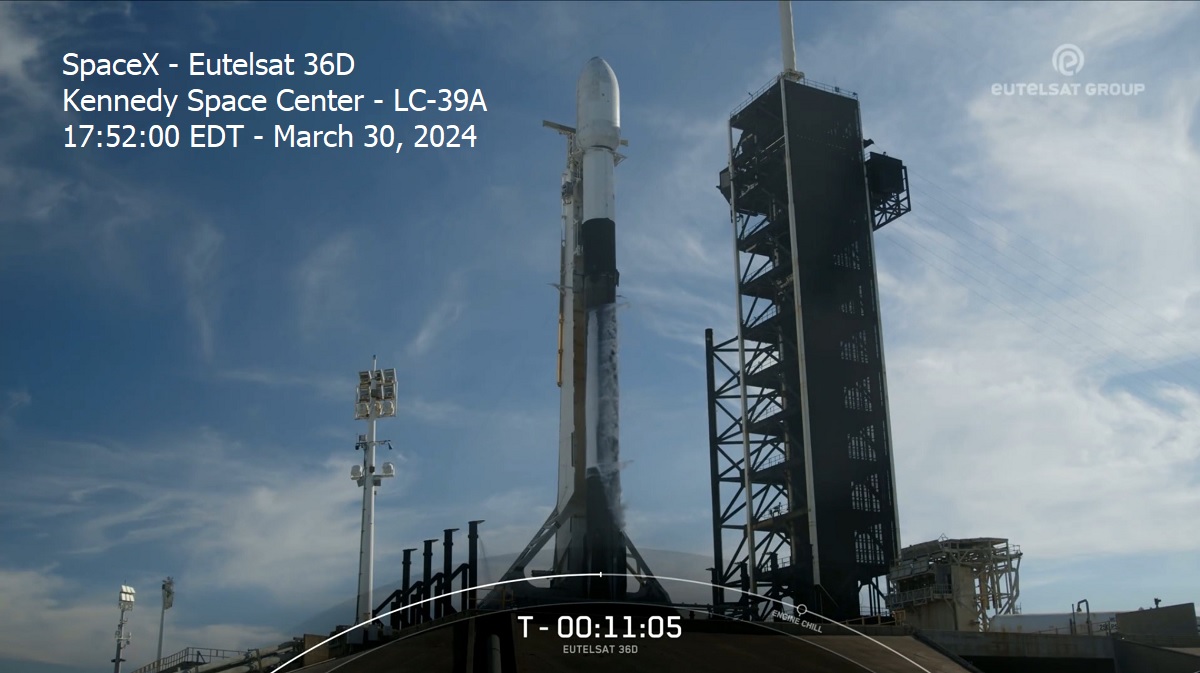
SpaceX - Eutelsat 36D

Screenshot from the launch of Eutelsat 36D. At last we get to see a normal GTO mission in daylight Mission Rundown: SpaceX Falcon 9 - Eutels...