Friday, May 6, 2016

SpaceX Falcon 9 - JCSAT-14

  SpaceX Falcon 9 Full Thrust - JCSAT-14 - Launching May 6, 2016

Screenshot from SpaceX Webcast of the launch of JCSAT-14

Mission Rundown: SpaceX Falcon 9 FT - JCSAT-14

Written: January 31, 2021

Lift Off Time

May 6, 2016 - 05:21 UTC - 01:21 EDT

Mission Name

JCSAT-14

Launch Provider

SpaceX

Customer

SKY Perfect JSAT Corporation

Rocket

Falcon 9 Full Thrust serial number B1022

Launch Location

Space Launch Complex 40 - SLC-40

Cape Canaveral Air Force Station, Florida

Payload

SSL1300 Communication Satellite

Payload mass

4 696 kg ~ 10 353 pounds

Where did the satellite go?

Geostationary Transfer Orbit - 187 km x 35 908 km with a target station at 154° East longitude

Will they be attempting to recover the first stage?

Yes - A drone ship has been towed downrange

Where will the first stage land?

OCISLY - 658 km ~ 409 miles downrange east of SLC-40

Will they be attempting to recover the fairings?

No - Engineers are looking for ways to do this

Are these fairings new?

Yes - Two Type 1 boat hull sized fairings - 34 x 17 feet with 10 evenly spaced ventilation ports in a circle

This will be the:

– 24th flight of all Falcon 9 rockets

– 4th flight of Falcon 9 Full Trust “V1.2” booster 

– 22nd SpaceX launch from SLC-40

– 3rd booster landing overall

– 4th mission for SpaceX in 2016

– 2nd Falcon 9 booster used once - Tested for endurance

Where to watch

Where to read more

SpaceX link

Want to learn more link visit Tim Dodd


Launch debriefing

(This is what happend)

T-00:20:27

Hosts:

-

T-00:00:02

T 00:00:00

T+00:01:24

T+00:02:39

T+00:02:51

T+00:03:39

T+00:06:43

T+00:08:25

T+00:08:56

T+00:26:10

T+00:26:28

-

T+00:32:05

-

SpaceX live feed at 00:32

Kate Tice, Michael Hammersley, John Federspiel and John Insprucker are having a late night snack

TEA-TEB Ignition - Full Thrust check

Liftoff at 21:00

MaxQ at 22:24

MECO 23:40, stage separation 23:42

SES-1 at 23:52 - Determined by flight telemetry

Faring separation at 24:39

Entry burn 27:44 by 3 Merlin 1D+ for 25 seconds

Landing burn 29:25 by 3 Merlin 1D+ for 10 seconds

SECO at 29:57 and coasting

SpaceX resumes live feed at 47:10

SES-2 - SECO-2 in 61 seconds gave a velocity boost from 26 573 km/h to 35 276 km/h at 47:29

SpaceX shows deployment at 53:06

Rap up from SpaceX at 53:50


How fast can this rocket land?

SpaceX’s Falcon 9 rocket will deliver JCSAT-14, a commercial communications satellite for SKY Perfect JSAT Corporation, to a Geostationary Transfer Orbit (GTO). SKY Perfect JSAT is a leading satellite operator in the Asia-Pacific region and provides high-quality satellite communications to its customers using its fleet of 15 satellites. Following stage separation, the first stage of Falcon 9 will attempt an experimental landing on the “Of Course I Still Love You” droneship.

Given this mission’s GTO destination, the first-stage will be subject to extreme velocities and re-entry heating, making a successful landing unlikely. In addition to its launch burn of 160 seconds with 9 Merlin 1D+ engines, it performed a 25 second reentry burn on 3 Merlin 1D+ engines and a 10 second landing burn also with 3 Merlin 1D+ engines and was after landing standing with only 3 seconds burn time, aka. propellant left.

The first stage of the rocket encountered "extreme temperatures during its reentry into Earth atmosphere" and was subsequently identified as a candidate for reflight, and as a "reference vehicle" for further testing. It was subjected to a series of tests, including a 150-second full-duration engine firing completed on 28 July 2016.

Additional tests were planned before SpaceX determined the stage's suitability for reuse on a subsequent launch. SpaceX has since completed at least 7 more full-duration firings of the core, and has indicated that this stage will be used solely for ground testing purposes. It’s currently in McGregor, Texas.

There are also signs of SpaceX engineers putting cameras on payload fairings to see the descent profile of them. I take it that fairly large pieces survive reentry, but not the impact with the ocean after their return fall back to earth. A fairing is a two ton boatsized hull which tumbles down through the atmosphere like a giant leaf.

I take it they cut through the air like boats until they stall and start tumbling until they find their balance point and start cutting through the air until the next stall. There is probably no inherent aerodynamic stability in them. They will stall.

Each fairing cost 6 million dollars to produce and is a potential cost-benefit saving.

The payload

JCSAT-14 is a geostationary communications satellite operated by SKY Perfect JSAT Group and designed and manufactured by SSL on the SSL 1300 platform. It had a launch weight of 4 696,2 kg (10 353 lb), a power production capacity of 9 to 9.9 kW at end of life and a 15-year design life. Its payload is composed of 26 C band and 18 Ku band transponders with a total bandwidth of 2 853 MHz.

On June 11, 2013, SSL announced that it had been awarded a contract by SKY Perfect JSAT Group to manufacture JCSAT-14. It would be a 10 kW satellite with 26 C band and 18 Ku band transponders with a 15 years of expected life. It was scheduled for launch in 2015.

On January 10, 2014, JSAT announced that it had signed a launch service contract with SpaceX for the launch of JCSAT-14 aboard a Falcon 9 rocket. The expected launch date was the second half of 2015. But the failure of Falcon 9 Flight 19 meant a delay of at least six months on the launch.

On March 14, 2016 SSL delivered JCSAT-14 to the launch site, at Cape Canaveral Air Force Station, for launch processing and integration. JCSAT-14 was launched on May 6, 2016 at 05:21 UTC by a Falcon 9 rocket. The next day, SSL announced that the satellite had deployed the solar arrays, was in full control and was performing orbital maneuvers to reach its operational position.

Since July 2016, JCSAT-14 the now rechristened JCSAT-2B has been commissioned and operational at the 154° East orbital slot.

The second stage spent 1 year 4 month and 10 days in Geostationary Transfer Orbit before finally reentering the earth's atmosphere on september 16, 2017.

Space Launch Complex 40 - SLC-40

In the JCSAT-14 article there is a list of previous historical launches of the Titan rockets from SLC-40 and SLC-41. It was a little unclear, so I’m relisting them.

From June 1965 - Titan IIIC - Maiden voyage - followed by 25 more Titan IIIC/III(23)C

From 1982 upgraded to Titan III(34)D - 8 launches + 7 more launched from SLC-41

From 1990 commercial launches of 4 Titan III 34D including the JCSAT-2 satellite

From 1994 to 2004 launches of 5 Titan IV-A followed by 12 Titan IV-B launches

SLC-40 mothballed and decommissioned until SpaceX leased it in 2007

A total of 55 Titan launches and now 22 Falcon 9 launches from SLC-40, which by March 11, 2021 are counted to be 67 Falcon 9 launches. 122 launches from SLC-40 and we didn’t even celebrate launch number 100 in november 2019 with Starlink L1.

Only two missions have been launched from Vandenberg Air Force Base Space Launch Complex 4E so far out of 24 launches performed by SpaceX.

Author William Graham link

link

Coauthor/Text Retriever Johnny Nielsen

link to launch list


Friday, April 8, 2016

SpaceX Falcon 9 - CRS-8

  SpaceX Falcon 9 Full Thrust - CRS-8 - Launching April 8, 2016

Screenshot from SpaceX Webcast of CRS-8

Mission Rundown: SpaceX Falcon 9 FT - CRS-8

Written: January 31, 2021

Lift Off Time

April 8, 2016 - 20:34:32 UTC - 16:34:32 EST

Mission Name

CRS-8

Launch Provider

SpaceX

Customer

NASA

Rocket

Falcon 9 Full Thrust serial number B1021-1

Launch Location

Space Launch Complex 40 (SLC-40) at Cape Canaveral Air Force Station, Florida

Payload

Cargo Dragon serial number C110-1

Payload mass

3 136 kg ~ 6 914 pounds

Where are the Dragon going?

Low Earth Orbit to the International Space Station

Will they be attempting to recover the first stage?

Yes - A drone ship is waiting downrange

Where will the first stage land?

OCISLY has been towed 295 km downrange

Will they be attempting to recover the fairings?

No. The Dragon capsule have a jettisonable nose cone and solar panel covers on the Trunk

This will be the:

– 23th flight of all Falcon 9 rockets

– 3rd flight of Falcon 9 Full Trust “V1.2” booster 

– 21st SpaceX launch from SLC-40

– 2nd booster landing overall

– 1st booster landing on Marmac 304 - OCISLY

– 3rd mission for SpaceX in 2016

Where to watch

Where to read more

SpaceX link

Want to know or learn more link visit Tim Dodd


Launch debriefing

(This is what happend)

T-00:18:26

Hosts:

-

T-00:00:02

T 00:00:00

T+00:01:14

T+00:02:37

T+00:02:46

T+00:03:18

T+00:04:22

T+00:06:41

T+00:08:01

T+00:08:36

T+00:09:55

T+00:10:43

T+00:13:01

-

-

T+00:14:10

-

T+41:13:28

784:35:28

790:07:28

SpaceX live feed at 00:33

Kate Tice, Brian Mahlstedt in Florida, John Federspiel and Tom Praderio are all having a late afternoon cup of tea

TEA-TEB Ignition - Full Thrust check

Liftoff at 19:01 - 20:43:32 UTC on April 8, 2016

MaxQ at 20:15

MECO 21:37, stage separation 21:40

SES-1 at 21:47 - Velocity 6 480 km/h

Nose cone in view at 22:27

Boost break burn 23:22 - 3 Merlin 1D+ 40 seconds

Entry burn 25:42 by 3 Merlin 1D+ for 10 seconds

Landing burn 27:07 by 1 Merlin 1D+ for 35 seconds

First Stage landing on OCISLY - Cherings galore

SECO at 28:56 and coasting - Not shown

Cargo Dragon C110-1 separation at 29:44 - Not shown

Deployment of solar array at 32:02

SES - SECO duration of 430 seconds gave a velocity boost from 6 480 km/h to 27 108 km/h

Rap up from SpaceX at 33:10

Other events during this CRS-8 mission was:

Berthing with ISS Harmony Nadir airlock at 13:57 UTC

Released from ISS after 30 days at 13:19 UTC

Landed in Pacific Ocean near NRC Quest at 18:51 UTC


The Falcon has landed. Again

SpaceX’s Falcon 9 rocket will launch the Dragon C110-1 spacecraft to low Earth orbit to deliver supplies and critical cargo to the International Space Station (ISS) for NASA. SpaceX is targeting an afternoon launch of its eighth Commercial Resupply Services mission (CRS-8) from Space Launch Complex 40 at Cape Canaveral Air Force Station.

The instantaneous launch window opens on April 8th at 8:43:32pm UTC. The Dragon will be deployed about 10 minutes after liftoff and attached to the ISS about two days later.

Following stage separation, the first stage of the Falcon 9 will attempt an experimental landing on the “Of Course I Still Love You” drone ship in the Atlantic Ocean. Great helicopter footage of the landing at T+08:25.

The Mission step by step

CRS-8 is part of the original order of twelve missions awarded to SpaceX under the Commercial Resupply Services contract.

SpaceX CRS-8, also known as SpX-8, was a Commercial Resupply Service mission to the International Space Station (ISS) which was launched on April 8, 2016, at 20:43 UTC. It was the 23rd flight of a Falcon 9 rocket, the tenth flight of a Dragon cargo spacecraft and the eighth operational mission contracted to SpaceX by NASA under the Commercial Resupply Services program.

The launch was initially scheduled by NASA to occur no earlier than September 2, 2015. The launch date went under review pending the outcome of the analysis of the failure of the Falcon 9 launch vehicle in SpaceX CRS-7, a June 2015 flight. The return-to-flight (RTF) project included additional improvements.

With additional manifest changes announced by SpaceX in mid-October, CRS-8 was scheduled to be the third launch of the upgraded Falcon 9 Full Thrust rocket. By March 2016, the launch date was set to April 8, 2016, with a backup launch window the next day.

The spacecraft was finally launched on schedule, at 20:43:32 UTC on April 8, 2016. The rocket first stage separated around 2 minutes 40 seconds after liftoff, and the second stage separated around ten minutes 30 seconds after liftoff.

The Payload

NASA has contracted for the CRS-8 mission from SpaceX and therefore determines the orbital parameters for the primary payload – the Dragon space capsule.

The mission delivered 3,136 kilograms (6,914 lb) of supplies, experiments, and hardware to the ISS. These include the station's first expandable 1 412 kg module, called the Bigelow Expandable Activity Module (BEAM), which is expected to remain on the station for at least two years of observation and testing.

It's a giant space suit-like fabric bag that's being tested as an inflatable International Space Station module, and future modules should at least be used as storage rooms for garbage, unused science equipment and bulky supplies from Earth that don't need constant airflow.

The Dragon capsule and The Bigelow module getting ready for launch

The pressurized cargo being delivered to the space station by CRS-8 comes to a total mass of 1,723 kilograms (3,799 lb).

This includes 640 kg (1411 lb) of scientific equipment, 547 kg (1,206 lb) of supplies and provisions for the crew, 108 kg (238 lb) of computer equipment, 12 kg (26 lb) of hardware to support EVAs using the US Extravehicular Mobility Unit (EMU) spacesuits, 306 kg (675 lb) of hardware for the US segment of the outpost and 33 kg (73 lb) to the Russians.

Also delivered in the Dragon were sixteen Flock 2d 3U CubeSats for the Earth-observing Flock constellation, built and operated by Planet Labs, which will be deployed by the NanoRacks CubeSat Deployer

After splashdown, the mission returned more than 3,700 lb (1,700 kg) of cargo from the station back to Earth.

Author William Graham link

link

Coauthor/Text Retriever Johnny Nielsen

link to launch list


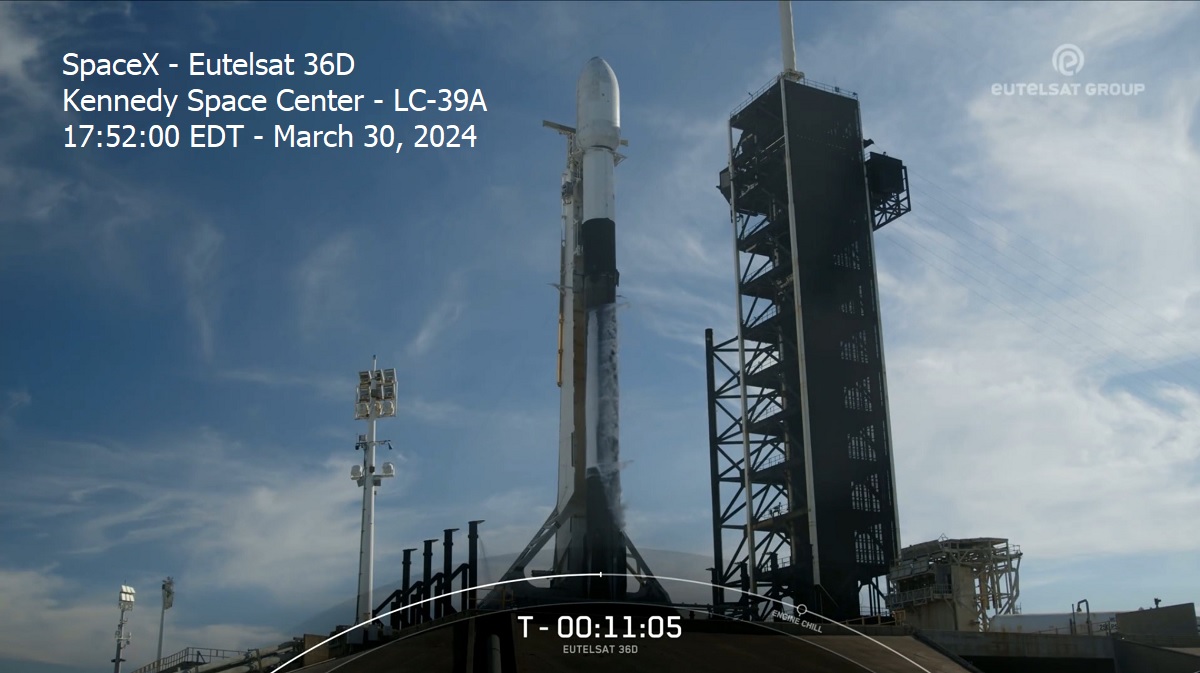
SpaceX - Eutelsat 36D

Screenshot from the launch of Eutelsat 36D. At last we get to see a normal GTO mission in daylight Mission Rundown: SpaceX Falcon 9 - Eutels...