Tuesday, April 14, 2015

SpaceX Falcon 9 - CRS-6

  SpaceX Falcon 9 V1.1 - CRS-6 - Launching April 14, 2015

Screenshot from SpaceX Webcast of the launch of CRS-6

Mission Rundown: SpaceX Falcon 9 V1.1 - CRS-6

Written: February 2, 2021

Lift Off Time

April 14, 2015 - 20:10:41 UTC - 16:10:41 EDT

Mission Name

CRS-6

Launch Provider

SpaceX

Customer

NASA

Rocket

Falcon 9 V1.1 serial number B1015

Launch Location

Space Launch Complex 40 - SLC-40

Cape Canaveral Air Force Station, Florida

Payload

Cargo Dragon serial number C108-1

Payload mass

1 898 kg ~ 4 184 pounds - That’s without packaging

Where are the Dragon going?

Low Earth Orbit to the International Space Station with an orbit of 199,4 km x 363,8 km x 56,16 degrees

Will they be attempting to recover the first stage?

Yes - A drone ship will be waiting downrange

Where will the first stage land?

A soft controlled test landing on “Just Read The Instruction” placed East of Jacksonville

Will they be attempting to recover the fairings?

No. The Dragon capsule have a jettisonable nose cone and solar panel covers on the Trunk

This will be the:

– 17th flight of all Falcon 9 rockets

– 12th flight of Falcon 9 V1.1 rocket

– 16th SpaceX launch from SLC-40

– 17th crash landing. Soft, hard, deliberate, Ups...

– 7th ocean test landing attempt

– 2nd ASDS test landing attempt

– 4th mission for SpaceX in 2015

Where to watch

Where to read more

SpaceX link

Want to know or learn more link visit Tim Dodd


Launch debriefing

(This is what happend)

T-00:15:35

Host:

T-00:12:59

-

T 00:00:00

T+00:01:25

T+00:02:40

T+00:02:49

T+00:03:45

T+00:04:35

T+00:06:43

T+00:08:06

T+00:09:30

T+00:10:07

T+00:12:36

T+00:12:37

-

-

T+63:18:19

876:54:19

882:31:19

SpaceX live feed at 00:23

Voice of John Insprucker - Mr Rocket Man himself

View of “Kennedy” launch control center

GO - NO GO Poll count by Flight Director

Liftoff at 15:59 - No Flight Telemetry - 20:10:41 UTC

MaxQ at 17:24

MECO 18:39, stage separation 18:42

SES-1 at 18:48

Nose cone of at 19:43 - In frame at 20:14:30 UTC

Boost brake burn at 20:34 - 35 seconds

Entry burn at 22:42 by 3 Merlin 1D for 20 seconds

Landing burn at 26:05 by 1 Merlin 1D - Failure

SECO at 25:29 and coasting

Cargo Dragon C108-1 deployment at 26:05

Solar panel fairings pop of at 28:35 - Rare sight

Solar panels deployment at 28:36

Rap up from SpaceX at 29:52

Other events during this CRS-6 mission was:

Berthing with ISS Harmony Nadir airlock at 13:29 UTC

Released from ISS after 34 days at 11:05 UTC

Landed in Pacific Ocean near NRC Quest at 16:42 UTC


Incoming. Where’s my helmet?

After six successful missions to the International Space Station, including five official resupply missions for NASA, SpaceX’s Falcon 9 rocket and Dragon spacecraft are set to liftoff from Launch Complex 40 at the Cape Canaveral Air Force Station, Florida, for their sixth official Commercial Resupply Services (CRS-6) mission to ISS.

Liftoff was targeted for Tuesday April 14, 2015, at 4:10pm EDT. Cargo Dragon C108-1 will arrive at the station approximately two days after liftoff.

Cargo Dragon C108-1 is expected to return to Earth approximately five weeks later for a parachute assisted splashdown off the coast of southern California.

The Dragon Payload

As of July 2014, the launch was tentatively scheduled by NASA for February 2015, with berthing to the station occurring two days later. However, as a result of delays in the launch of the previous SpaceX CRS-5 mission, CRS-6 launched on 14 April 2015 due to bad weather conditions the day before.

NASA has contracted for the CRS-6 mission from SpaceX and therefore determines the primary payload, date/time of launch, and orbital parameters for the Dragon space capsule. The Dragon spacecraft was filled with 2 015 kg (4,387 pounds) of supplies and payloads, including critical materials to directly support about 40 of the more than 250 science and research investigations that will occur during Expeditions 43 and 44.

A part of this payload includes science experiments from high schools, such as a project from Ambassador High School in Torrance, California.

For its return journey, Dragon will be loaded with 1,370 kilograms (3,020 lb) of hardware to be brought back to Earth.

The Dragon is the only spacecraft that allows a significant amount of hardware to be returned to Earth from the space station – the only other spacecraft capable of returning items is Russia’s Soyuz, which is limited to what can be fit into the spacecraft around its crew of three cosmonauts.

Many of the US and Japanese ISS resupply missions carry CubeSats or other small payloads to be deployed from the space station. CRS-6 is no exception, as the Arkyd-3R technology demonstrator and fourteen Flock-1 Earth observation satellites are hitching a lift to orbit on the launch.

A replacement for the Arkyd-3 satellite, lost in October’s Antares launch failure, Arkyd-3R is a three-unit (3U) CubeSat to be operated by Planetary Resources as a pathfinder for its Arkyd-100 telescope constellation.

The 14 Flock-1e satellites will join Planet Labs’ Flock constellation. Utilizing a very large fleet of short-lived satellites, named Doves, Planet Labs aims to provide quick and updated good-resolution images of the Earth, at a lower cost than with bigger imaging satellites.

The test landing of booster B1015

After the separation of the second stage, SpaceX conducted a flight test and attempted to return the nearly-empty first stage of the Falcon 9 through the atmosphere and land it on a 90x50-meter (300 ft×160 ft) floating platform as an autonomous spaceport drone ship.

The Marmac 300 barge was rebuild and named “Just Read The Instructions” by SpaceX

The unmanned rocket technically landed on the floating platform, however it came down with too much lateral velocity, tipped over, and was destroyed on impact. Elon Musk later explained that the bipropellant valve was stuck, and therefore the control system could not react rapidly enough for a successful landing.

This was SpaceX's second attempt to land the booster on a floating platform after an earlier test landing attempt in January 2015 had to be abandoned due to bad weather conditions. The booster was fitted with a variety of technologies to facilitate the flight test, including grid fins and landing legs to facilitate the post-mission test.

If successful, this would have been the first time in history that a rocket booster was returned to perform a vertical landing.

On 15 April, SpaceX released a video of the terminal phase of the descent, the landing, the tip over, and a small deflagration as the stage broke up on the deck of the first ASDS “Just Read The Instruction” aka. the barge Marmac 300.

Author William Graham link

link

Coauthor/Text Retriever Johnny Nielsen

link to launch list


Monday, March 2, 2015

SpaceX Falcon 9 - ABS 3A + EUTELSAT 115 West B

  SpaceX Falcon 9 V1.1 - ABS 3A + EUTELSAT 115 West B - Launching March 3, 2015

Screenshot from SpaceX Webcast of the launch of ABS 3A and EUTELSAT 115 West B

Rundown: SpaceX V1.1 - ABS 3A + EUTELSAT 115 West B

Written: January 3, 2021

Lift Off Time

March 3, 2015 - 03:50:00 UTC

March 2, 2015 - 22:50:00 EST

Mission Name

ABS 3A

EUTELSAT 115 West B

Launch Provider

SpaceX

Customers

Eutelsat S.A. European Telecommunications Satellite Organization

ABS Asia Broadcast Satellite

Rocket

Falcon 9 V1.1 serial number B1014

Launch Location

Space Launch Complex 40 - SLC-40

Cape Canaveral Air Force Station, Florida

Payload

2 Boeing 702SP Communication Satellites

Payload mass

Both satellites - 4 159 kg ~ 9 169 pounds

ABS 3A - 1 954 kg ~ 4 307 pounds

Eutelsat - 2 205 kg ~ 4 861 pounds

Where are the satellites going?

A supersynchronous transfer orbit - 406 km reaching a max. apogee of 63 066 km and 24.840 inclination

Will they be attempting to recover the first stage?

No. One way ticket flying “bareback” with no grid fins or landing legs + hydraulic tanks, pumps...

Where will the first stage land?

In the Atlantic ocean east of Florida

Will they be attempting to recover the fairings?

No - Not expected to survive reentry or water impact

Are these fairings new?

Yes - Two Type 1 boat hull sized fairings - 34 x 17 feet with 10 evenly spaced ventilation ports in a circle

This will be the:

– 16th flight of all Falcon 9 rockets

– 11th flight of Falcon 9 V1.1 rocket

– 15th SpaceX launch from SLC-40

– 16th crash landing. Soft, hard, deliberate, Ups...

– 3rd mission for SpaceX in 2015

Where to watch

Where to read more

SpaceX link

Want to know or learn more link visit Tim Dodd


Launch debriefing

(This is what happend)

T-00:14:37

Host:

T 00:00:00

T+00:01:25

T+00:03:03

T+00:03:11

T+00:03:54

T+00:08:58

T+00:11:26

T+00:25:52

-

T+00:35:18

T+00:40:18

SpaceX live feed at 00:20

Voice of grand old man Mr John Insprucker

Liftoff at 14:57

MaxQ at 16:22

MECO 18:00, stage separation 18:02

SES-1 at 18:08

Faring separation at 18:31

SECO at 23:55 and coasting

SpaceX Webcast ends at 26:23

SES-2 - SECO-2 in 59 seconds gave a velocity boost from 26 477 km/h to 36 136 km/h Ish...

SpaceX doesn’t show deployment one

SpaceX doesn’t show deployment two


It’s a two for one kind of deal

In this double header mission, SpaceX's Falcon 9 rocket will deliver the ABS 3A and EUTELSAT 115 West B satellites to a supersynchronous transfer orbit. The ABS/Eutelsat-1 launch window is targeted to open at approximately 10:50 pm EST on Sunday, March 1, 2015, from Space Launch Complex 40 at Cape Canaveral Air Force Station, Florida.

If all goes as planned, the satellites will be deployed approximately 30 minutes after liftoff.

Hazard map of the debris field from B1014s disintegration during the atmospheric reentry

The Payloads

ABS-3A is a communications satellite that is operated by Asia Broadcast Satellite, providing coverage in the Americas, the Middle East, and Africa, as well as globally for TV distribution, cellular services, and maritime services. The satellite is the first commercial communications satellite in orbit to use electric propulsion, providing a significant weight savings.

Why the two apparently identical satellites have different weights lies in the numbers of transponders. The lighter ABS-3A only has 7 transponders, and Eutelsat 115 West B has a whopping 46 transponders. Vive la difference.

The satellite was designed and manufactured by Boeing, and is a Boeing 702SP model communication satellite. It will be located at 3 degrees West longitude. It was launched on board a SpaceX Falcon 9 rocket on March 3, 2015 at 03:50:00 UTC.

The satellite is propelled solely by electrically powered spacecraft propulsion, with the on-board thrusters used for both geostationary orbit insertion and station keeping.

The satellite is based on the Boeing 702 satellite bus, and was launched along with Eutelsat 115 West B, which is based on the same bus. The satellite had a launch mass of 4,307 pounds (1,954 kg).

The satellite utilizes three C-band beams and four Ku-band beams. The C-band beams will cover the Americas, Middle East, and Africa. Additionally, the C-band can be used globally. The Ku-band beams will cover Europe, Middle East, North Africa, and South Africa, as well as providing further coverage of America.

Satellite split in Power/Propulsion Bus and Antenna/Transponder Payload

Eutelsat 115 West B (previously SATMEX 7) is a communications satellite that is operated by Eutelsat, providing video, data, government, and mobile services for the Americas. The satellite was designed and manufactured by Boeing Space Systems, and is a Boeing 702SP model communication satellite. It is located at 115 degrees west longitude. It was launched on board a SpaceX Falcon 9 rocket on 2 March 2015 (22:50 EST).

The satellite is solely propelled by electrically powered spacecraft propulsion, with the onboard thrusters used for both geostationary orbit insertion and station keeping.

Equipped with 12 C-band and 34 Ku-band transponders connected to four service areas, EUTELSAT 115 West B will extend reach of the Americas to markets in Alaska and Canada, replacing the EUTELSAT 115 West A satellite that operates in inclined orbit at 114.9° West. The new satellite will focus on serving clients providing data services, including broadband access, cellular backhaul, VSAT solutions and social connectivity.

The satellite had a launch mass of 4,861 pounds (2,205 kg). It is notable for being the first commercial communications satellite in orbit to use electric propulsion, providing significant weight savings. Eutelsat 115 West B was launched with another Boeing 702SP satellite, ABS-3A, on the same rocket.

Eutelsat 115 West B is planned to be the first in a family of four satellites in the Eutelsat constellation. The satellite was scheduled for entry into service in November 2015, but entered service a month earlier than expected, in October 2015.

The sister-satellite 702SP from the same launch—ABS-3A—became fully operational as a geosynchronous communications satellite by 10 September 2015 after a handover from Boeing to ABS for on-orbit operations on 31 August 2015, approximately one month earlier than planned. A press release on 15 October 2015 stated that Eutelsat 115 West B has started providing service.

There is LOX tank views at 22:14 - 22:47 - 23:55 - 25:59

The bottom LOX bulkhead is divided in eight parts with reinforcement beams between them. On the sides there are a number of baffle walls to prevent sloshing of the LOX, and there are three COPV tanks used for either Helium or Nitrogen gas storage.

Pay attention to the fact that there is room for a fourth COPV and they are placed near the bottom of the LOX tank. In the CRS-7 inflight failure such a COPV tank broke loose in a fully loaded LOX tank, and being buoyant - lighter than the liquid Oxygen it rammed the top LOX tank bulkhead thus denting it or even breaking it.

You see the LOX vibrate during acceleration, the LOX at a lower level being used, or you see the LOX becoming more and more weightless. This is a rare treat to us from SpaceX, who usually doesn’t show the technical camera views to other than the flight engineers.

In the previous mission DSCOVR there is an even rarer view of a 1st stage RP-1 tank.

Author William Graham link

link

Coauthor/Text Retriever Johnny Nielsen

link to launch list


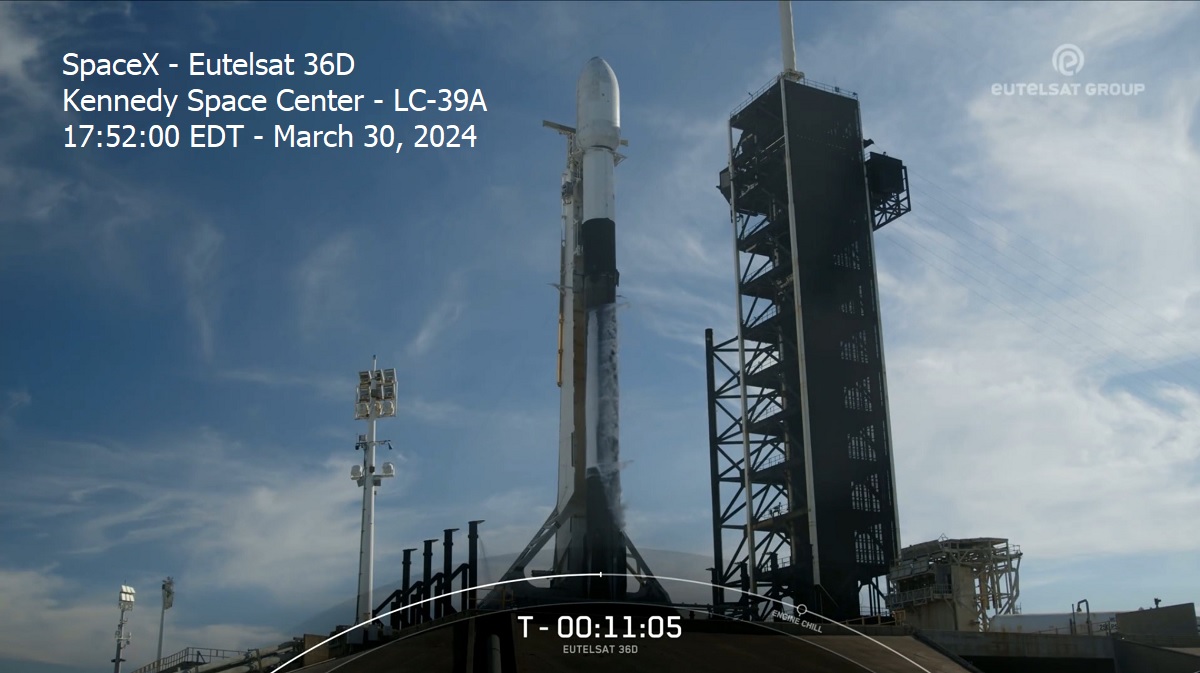
SpaceX - Eutelsat 36D

Screenshot from the launch of Eutelsat 36D. At last we get to see a normal GTO mission in daylight Mission Rundown: SpaceX Falcon 9 - Eutels...